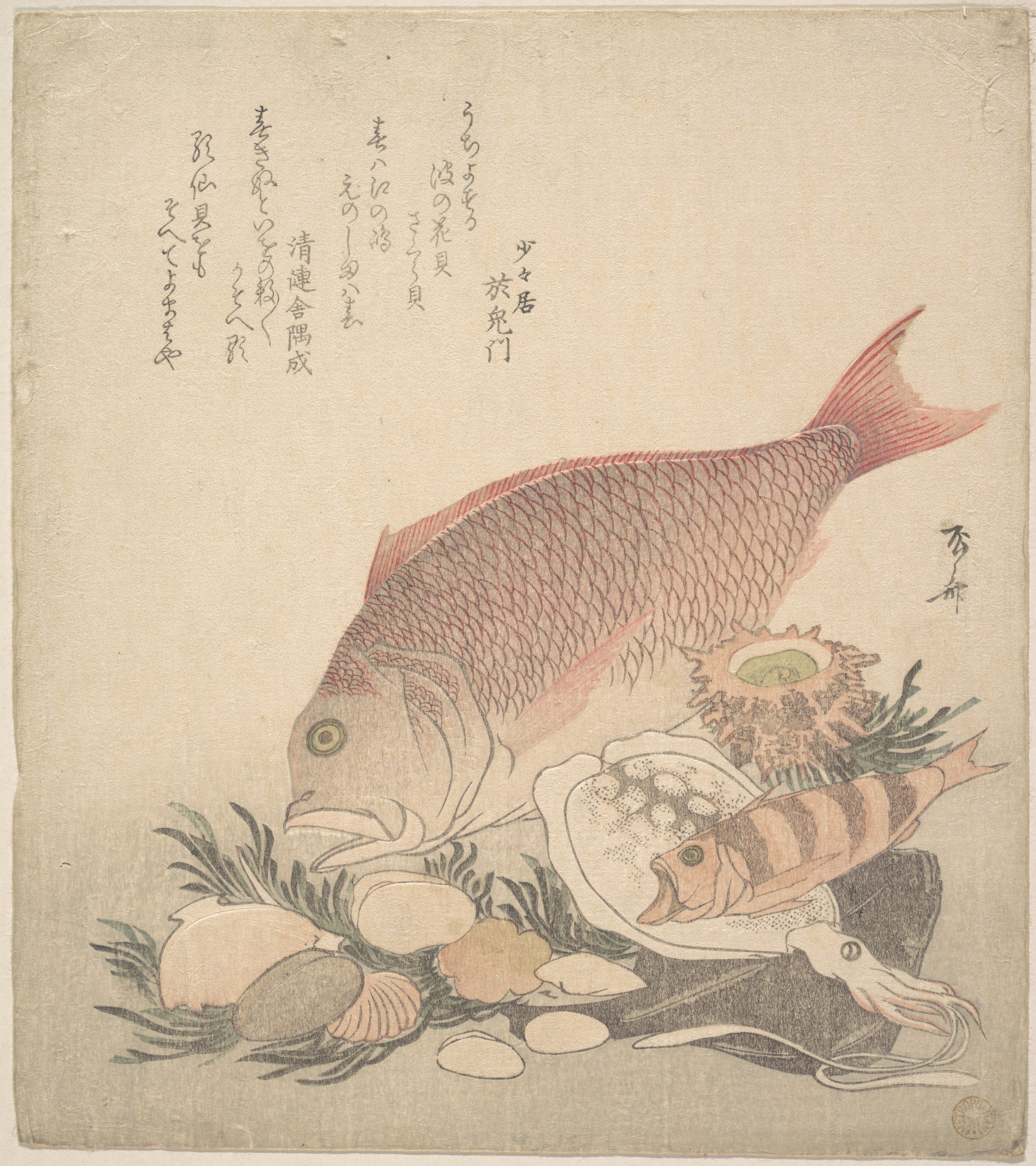
Large and Small Fish Swimming Among Shells and Moss at the Bottom of the Sea
- Date:
- ca. 1830
- Medium:
- Woodblock print (surimono); ink and color on paper
- Source:
- Metropolitan Museum of Art
Description
Large and Small Fish Swimming Among Shells and Moss at the Bottom of the Sea is a surimono print by Ryuryukyo Shinsai in the Metropolitan Museum of Art, dated to about 1820. The composition imagines the seabed as a populous miniature world, with fish of various sizes moving through banks of shells and tufts of marine growth that fill the sheet from edge to edge. As a designer within the Hokusai school whose early training had been under Tawaraya Sori, Shinsai engages here with a subject closely associated with Hokusai's own enthusiasm for shells and aquatic life, and the print belongs to a strand of surimono that pushed the still-life mode toward immersive natural observation. Each fish is given an individual posture and silhouette, and the shells are arranged so that their varied geometries form a textured carpet, demonstrating the Hokusai school's analytic interest in form. Surimono printers exploited blind embossing and metallic pigments to mark the polished interiors of shells and the iridescence of fish scales, and an early nineteenth-century impression preserves that tactile finish. The kyoka verses that originally accompanied the sheet would have likely played on themes of hidden abundance, fishermen's craft, or the depth of feeling concealed beneath a calm surface. The Metropolitan Museum of Art preserves this impression as a striking late example of Shinsai's surimono and as a witness to the Hokusai school's expansive natural-history imagination.
More Prints by Ryūryūkyo Shinsai

More Fish Prints


Frequently Asked Questions
Large and Small Fish Swimming Among Shells and Moss at the Bottom of the Sea was created by Ryūryūkyo Shinsai (柳々居辰斎) in ca. 1830.
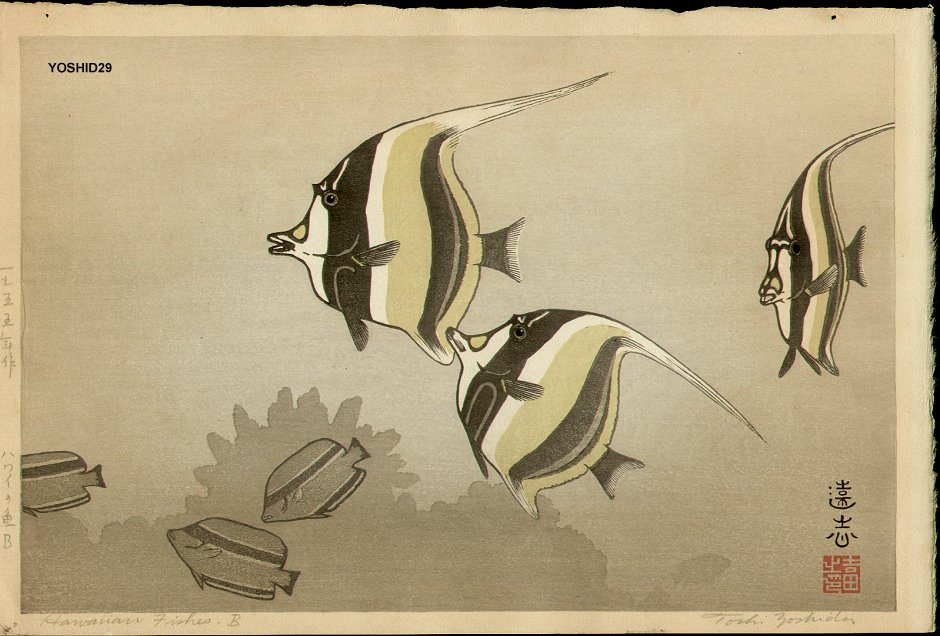
Large and Small Fish Swimming Among Shells and Moss at the Bottom of the Sea depicts fish.