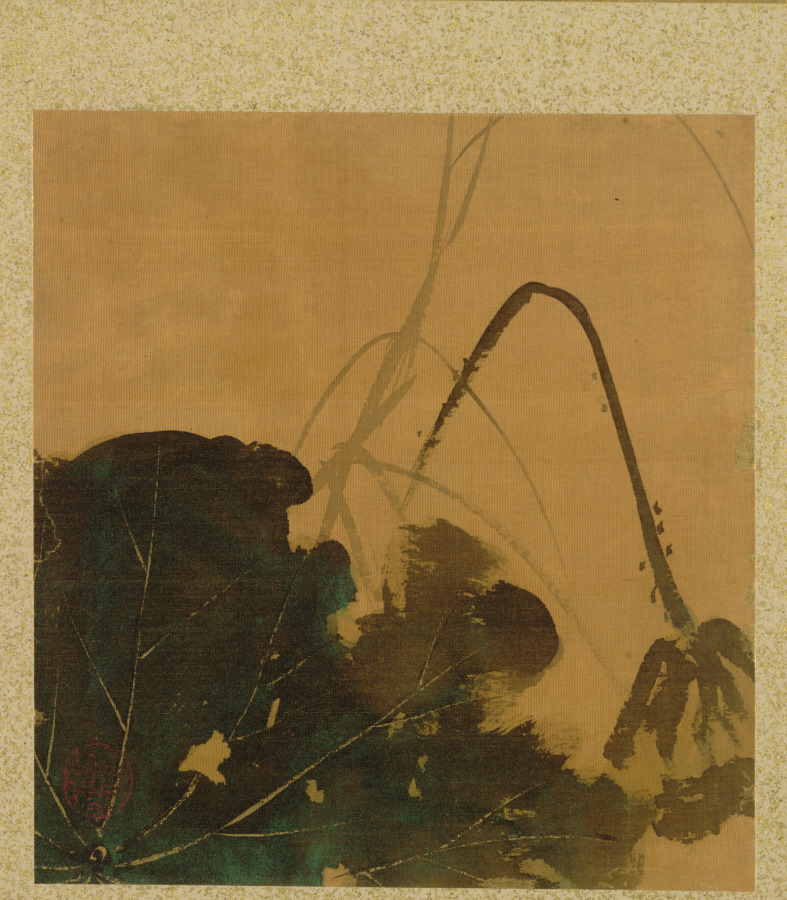
Lotus
- Date:
- 1847
- Medium:
- Leaf in accordion-style album; ink, color, and lacquer on paper
- Source:
- Cleveland Museum of Art
Description
Lotus, dated 1847, is a leaf of the Album of Paintings by the Venerable Zeshin held by the Cleveland Museum of Art, in which Shibata Zeshin gathered a series of small individually conceived compositions from the seasonal and emblematic vocabulary of Shijo painting. The lotus, with its Buddhist resonance and its pictorial elegance, was a recurrent subject across East Asian painting traditions, and Zeshin treats it here with the Shijo emphasis on observed naturalism rather than on emblematic stylization. His training under Suzuki Nanrei and Okamoto Toyohiko in Kyoto had grounded him in the school's attention to the structural particulars of plants, and the leaf renders the broad pad, the rising stem, and the petals of the blossom with that disciplined observational care. Zeshin's earlier and equally formative training was as a lacquer artist under Koma Kansai II, where he had learned to compose with a fundamental economy of means, and the lacquer-painter's instinct for letting a single brush gesture stand without revision carries into the assured drawing of the lotus stem and petals. By 1847 he had consolidated his Edo practice into one of the city's leading studios for the integration of Shijo painting with the lacquer tradition, and album leaves of this kind operated as private demonstrations of his range. The Shijo tradition's intimate seasonal repertory invited handling of the lotus less as a religious symbol than as a particular plant observed at a particular moment of bloom, and the leaf accordingly reads with the quiet attentiveness that distinguished Zeshin's kacho production. The Cleveland Museum of Art preserves the leaf (https://clevelandart.org/art/1990.130.f) within the full album, where it documents the artist's mid-career command of the painted small format that would carry his reputation forward into the Meiji decades.
More Prints by Shibata Zeshin


Frequently Asked Questions
Lotus was created by Shibata Zeshin (柴田是真) in 1847.