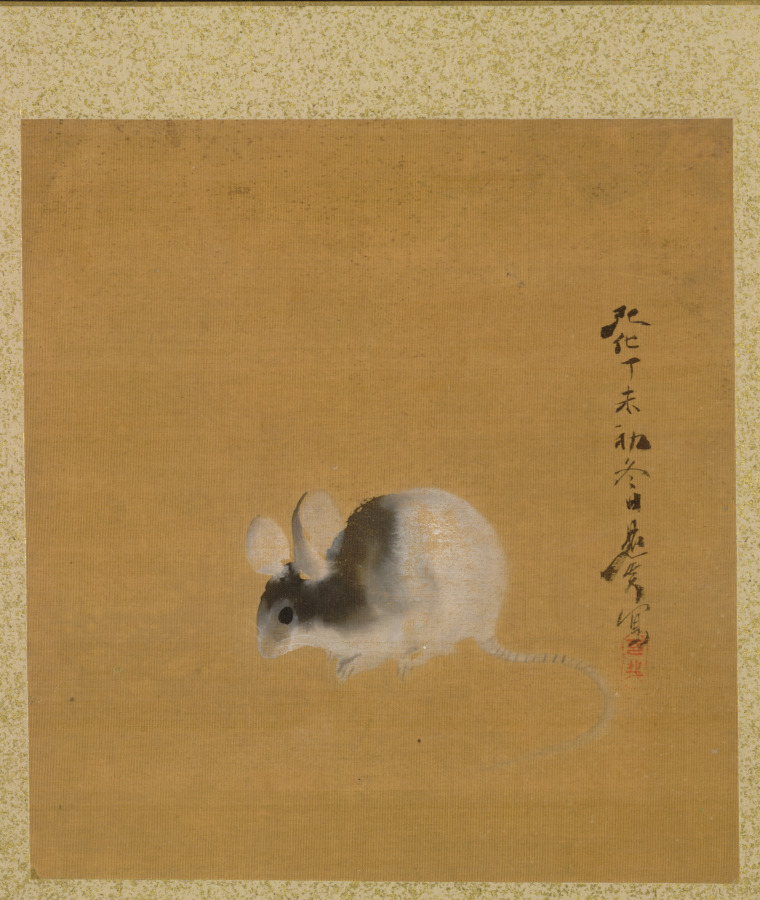
Mouse
- Date:
- 1847
- Medium:
- Leaf in accordion-style album; ink, color, and lacquer on paper
- Source:
- Cleveland Museum of Art
Description
Mouse, dated 1847, is one of the leaves of the Album of Paintings by the Venerable Zeshin in the Cleveland Museum of Art, in which Shibata Zeshin extended the kacho-e tradition into the small-mammal repertory through a single-figure study. The mouse had been a recurring subject in Japanese painting, associated with the deity Daikoku among the Seven Gods of Good Fortune and more generally with the domestic and granary environments where the creature was familiar, and Shijo painters had absorbed the subject into their broader observational program. Zeshin's training under Suzuki Nanrei and Okamoto Toyohiko had given him the manner for handling small mammals with the school's typical attentiveness to body form and posture, and the leaf renders the mouse with calligraphic economy, the rounded volume of the body and the alert head drawn with assured brushwork. His earliest training under Koma Kansai II in lacquer had instilled in him a sensitivity to the materiality of surface, and the painted treatment of the mouse's fur carries that lacquer-painter's instinct for the modulation of tone across a textured field. By 1847 Zeshin was working in his fortieth year at the consolidation of his cross-genre Edo practice, and the album leaves of this kind operated as private demonstrations of his integrated manner. The single-figure format places maximum demand on the brushwork to carry the composition unaided, and the leaf accordingly reads as an exercise in the kind of compressed economy that Shijo album practice had made its own. The Cleveland Museum of Art preserves the leaf (https://clevelandart.org/art/1990.130.l) within the full album as a representative document of Zeshin's mid-career engagement with the small-mammal subject.
More Prints by Shibata Zeshin


Frequently Asked Questions
Mouse was created by Shibata Zeshin (柴田是真) in 1847.