
Bolero
- Medium:
- Mokuhanga (Japanese woodblock)
- Image courtesy of
- Hanga Ten
Description
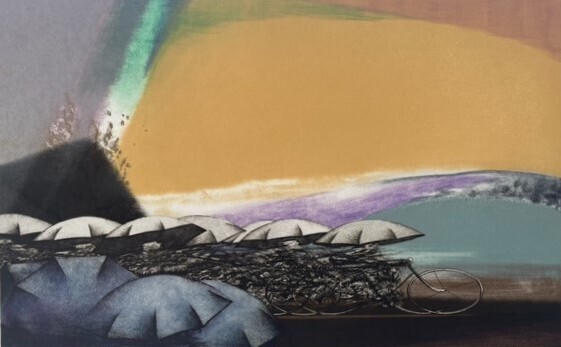
Bolero takes its title from Maurice Ravel's 1928 orchestral work, a composition built on the obsessive repetition of a single rhythmic and melodic cell that gradually accrues instrumental layers. The reference suggests a print organized around visual repetition — perhaps multiple cyclists, umbrellas, or birds arrayed across the composition in a sequential or rhythmic pattern that builds in density or intensity from one side to another. This kind of musical-titled print is consistent with Kuroda's broader practice, which often treats his recurring motifs as compositional units to be repeated, varied, and arranged in patterns more concerned with rhythm than with narrative description. The cross-medium reference also reflects the international cultural framework Kuroda operates within, having studied in the United States and exhibited extensively in European print biennials. Technically, a repetition-based composition demands precise registration across multiple woodblocks to maintain the alignment of the repeating elements. Printed in mokuhanga on washi, the work likely combines flat printed areas with bokashi gradations to give the repeated forms varying tonal weight.
More Prints by Shigeki Kuroda


Frequently Asked Questions
Bolero was created by Shigeki Kuroda (黒田茂樹).