Biography
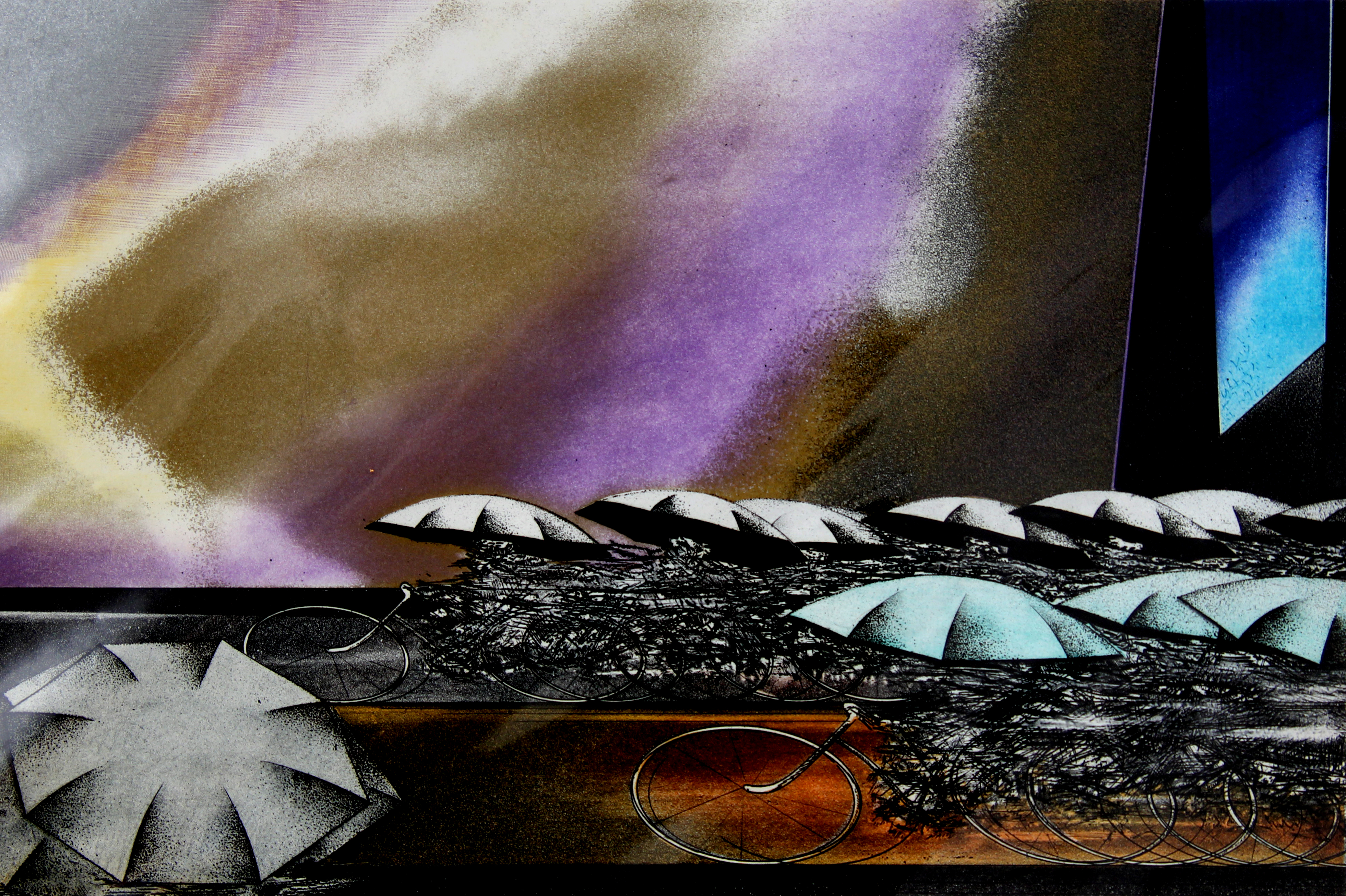
Shigeki Kuroda is one of the most distinctive contemporary Japanese printmakers, internationally recognized for his kinetic depictions of cyclists carrying umbrellas — a motif that has become his unmistakable artistic signature. Born in 1953 in Yokohama, Kanagawa Prefecture, Kuroda graduated from Tama Art University in Tokyo in 1979, where he began formal studies in painting and developed a deep interest in printmaking.
In 1984, Kuroda traveled to the United States on a Japanese Government Fellowship, where he expanded his technical repertoire by studying etching, drypoint, mezzotint, and aquatint. This advanced training in American printmaking workshops complemented his Japanese education and gave him the technical command that distinguishes his mature work.
Kuroda's signature bicycle prints combine the sharp, incisive lines of drypoint etching with the softer tonal gradations of aquatint, often supplemented with watercolor, pencil, and sumi-Indian ink. This mixed-media approach allows him to explore complex visual problems — movement, nuanced lighting effects, and abstract spatial relationships — within a printmaking framework. His cyclists are typically depicted in blurred, overlapping layers that convey a powerful sense of speed and motion.
The umbrella motif carries particular resonance in Kuroda's work, pairing a familiar emblem of everyday Japanese life with the momentum of the moving bicycle. The riders thus become a meditation on the tension between tradition and modernity, stillness and velocity, in contemporary Japanese life. Kuroda typically employs a restrained color palette, with strong colors used sparingly and emphasis placed on line, structure, and tonal contrast.
Since 2003, Kuroda has also produced smaller-format prints featuring flowers, birds, and other animals, occasionally incorporating mezzotint techniques, demonstrating his versatility across subjects while maintaining his characteristic technical sophistication.
Kuroda's prints are held in prestigious institutional collections worldwide, including the Art Institute of Chicago, the Cleveland Museum of Art, the British Museum in London, the Honolulu Academy of Art, and the Achenbach Foundation in San Francisco. He has exhibited at the Print Biennale in Bradford and Ljubljana, and continues to live and work in Japan.
Key Facts
- Active Period
- 1953
- Nationality
- 🇯🇵Japan
- Movement
- Contemporary Mokuhanga
- Works Indexed
- 14
Frequently Asked Questions
Shigeki Kuroda is one of the most distinctive contemporary Japanese printmakers, internationally recognized for his kinetic depictions of cyclists carrying umbrellas — a motif that has become his unmistakable artistic signature. Born in 1953 in Yokohama, Kanagawa Prefecture, Kuroda graduated from Tama Art University in Tokyo in 1979, where he began formal studies in painting and developed a deep interest in printmaking.
Shigeki Kuroda was active born in 1953. They were associated with the Contemporary Mokuhanga movement.
Shigeki Kuroda's work was shaped by the Contemporary Mokuhanga tradition in Japanese woodblock printmaking. Contemporary Mokuhanga: Contemporary mokuhanga (literally "wood-block print") encompasses artists working from approximately 1970 to the present who continue or reinvent traditional Japanese woodblock printing techniques.
Shigeki Kuroda's prints frequently feature etching, birds & flowers, landscapes, rivers & lakes, snow scenes, rain.
Woodblock Prints by Shigeki Kuroda (14)
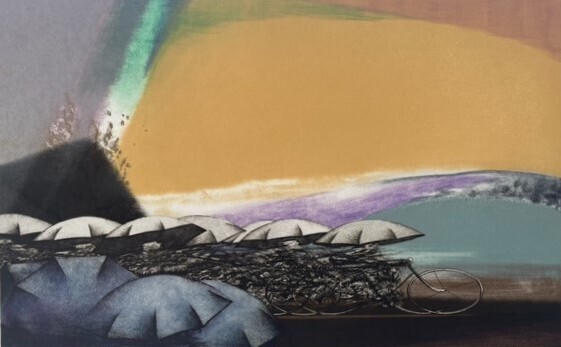
Stream
1986
Intaglio Print
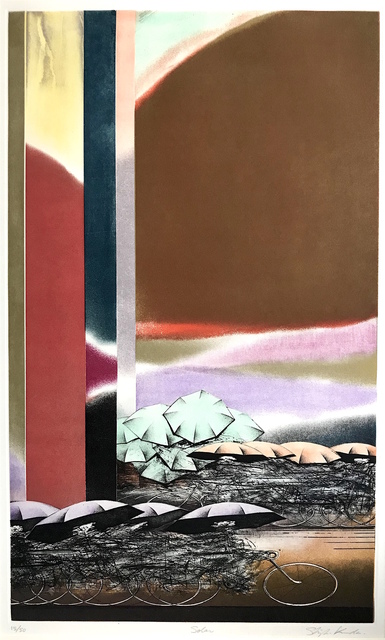
Solar
2000
Etching

AI
Mokuhanga (Japanese woodblock)

AO
Mokuhanga (Japanese woodblock)

Dating
Mokuhanga (Japanese woodblock)

Eastern Rain
Mokuhanga (Japanese woodblock)
Gleam 5
Color etching and aquatint

Bird Land
Mokuhanga (Japanese woodblock)

Blue Bird
Mokuhanga (Japanese woodblock)

Blue Snow
Mokuhanga (Japanese woodblock)

White bird
Mokuhanga (Japanese woodblock)

Bolero
Mokuhanga (Japanese woodblock)

Sunny
Mokuhanga (Japanese woodblock)

White-cheeked starling
Mokuhanga (Japanese woodblock)