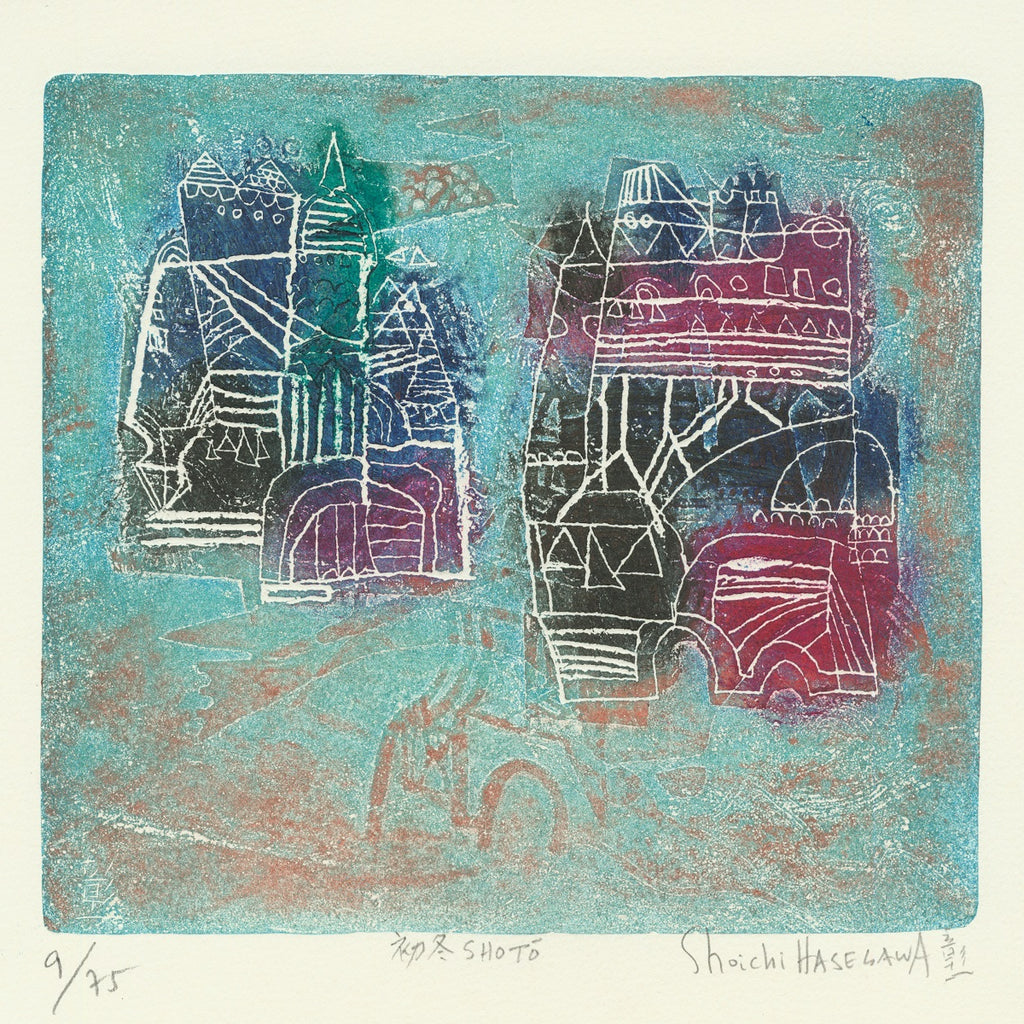
Shoto
- Medium:
- Intaglio printed in color on Arches wove paper
- Image courtesy of
- Armstrong Fine Art
Description
Shoto, printed in color on Arches wove paper, is among Hasegawa's works with Japanese titles, and the word—meaning small waves or a diminutive surge—suggests a composition organized around rhythmic, repeating marks that accumulate into a larger pattern. Arches wove paper, a heavy European cotton-fiber sheet similar in weight to BFK Rives, accepts intaglio inks cleanly and retains dimensional stability across multiple plate passes, making it suitable for the layered color registration Hasegawa employed. The wave motif connects to a long tradition in Japanese visual art—from Katsushika Hokusai's dynamic breakers to the more restrained ripple patterns of Edo-period decorative arts—but Hasegawa abstracts it through calligraphic strokes whose rhythm implies rather than depicts water. The intaglio color process allows him to print sequential hues from separate plates or through viscosity inking on a single plate, producing the translucent overlaps that give his color etchings their characteristic internal glow.
More Prints by Shoichi Hasegawa


More Calligraphy Prints

Frequently Asked Questions
Shoto was created by Shoichi Hasegawa (長谷川潔一).
Shoto uses Etching, on intaglio printed in color on arches wove paper.
Shoto depicts calligraphy and abstract.