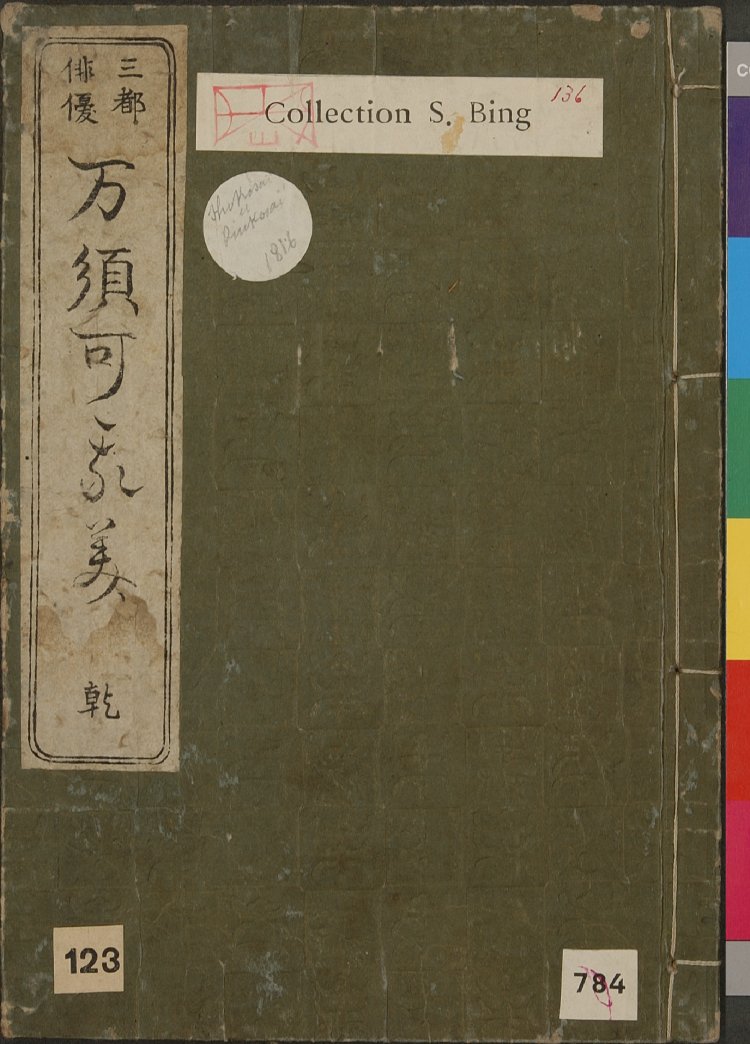
Santō yakusha masukagami (A Clear Mirror of Actors of the Three Cities)
三都俳優ますかゞみ
- Date:
- 1806
- Medium:
- Colour woodblock-printed illustrated book, two volumes
- Source:
- British Museum
Description
This 1806 color-printed actor book by Shōkōsai Hanbei, held by the British Museum (registration 1979,0305,0.212.1), is the more ambitious of his two surviving illustrated publications and one of the landmark documents of late-Kansei and early-Bunka kamigata-e. The work is issued in two volumes under the title Santō yakusha masukagami (三都俳優ますかゞみ, "A Clear Mirror of Actors of the Three Cities"), the "three cities" being the kabuki capitals of Edo, Osaka, and Kyoto, and contains forty-two half-length portraits of the leading actors of each. Each portrait is accompanied by a kyōka (comic verse) supplied either by professional Osaka poets or, in some cases, by Shōkōsai himself under the literary signature Eirakujin (詠楽人, "one who likes to compose poems"). The format places the artist within the Kansei-era vogue for actor compendia that linked the three regional kabuki traditions — Edo's mainstream, Osaka's kamigata, and Kyoto's lighter style — into a single survey volume, anchoring his Osaka studio's documentary mission to the broader national kabuki audience. The print preserved at the British Museum (registration 1979,0305,0.212.1) entered the collection in 1979 as part of a larger Osaka acquisition, and remains the principal Western reference copy for the book. The Santō yakusha masukagami also stands as the more compact successor to his earlier Ehon futaba no aoi (1798), which had been the first full-color illustrated actor book published in Osaka, and the two volumes together represent the technical and editorial high point of Shōkōsai's mature career immediately before his documented work tapers off around 1809.
More Prints by Shōkōsai Hanbei
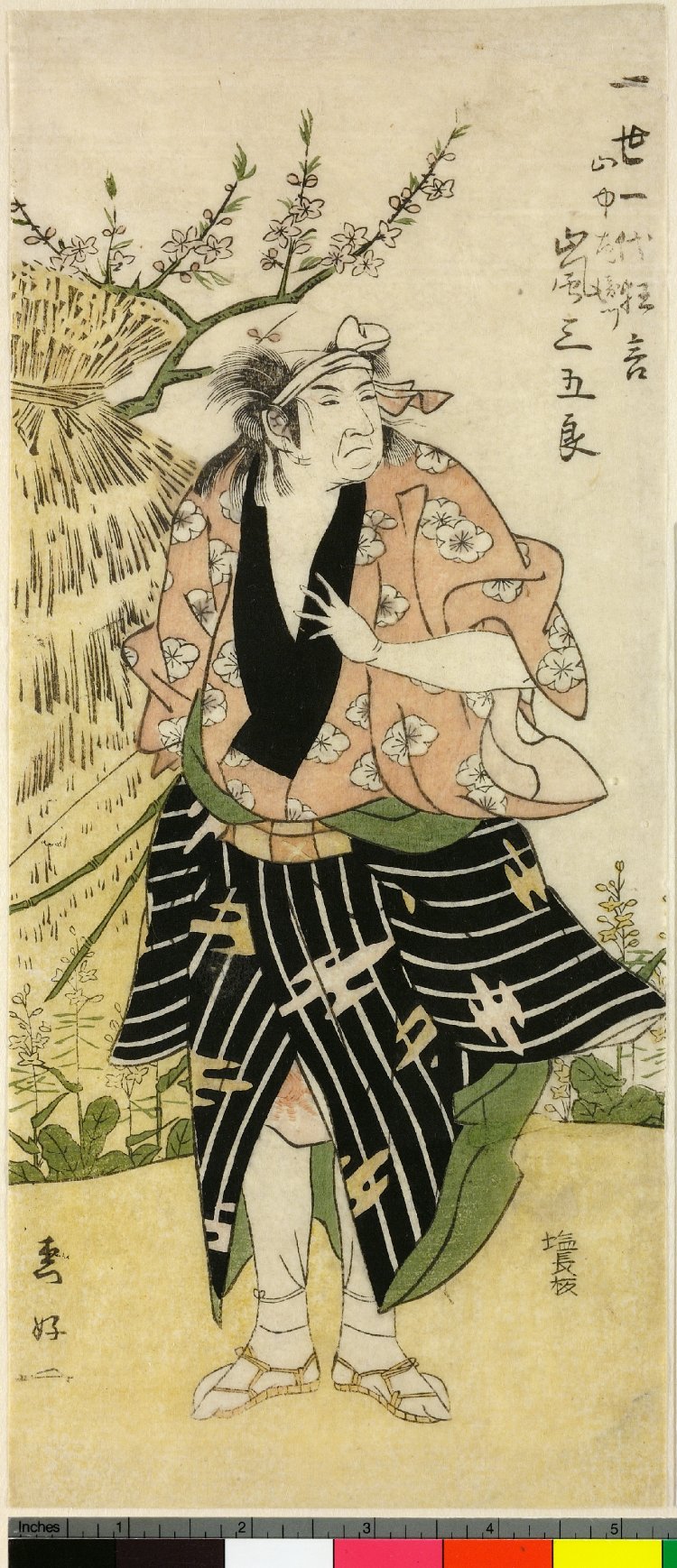
Portrait of Arashi Sangorō II as Yamanaka Saemon
1798 (third month)
Colour woodblock print
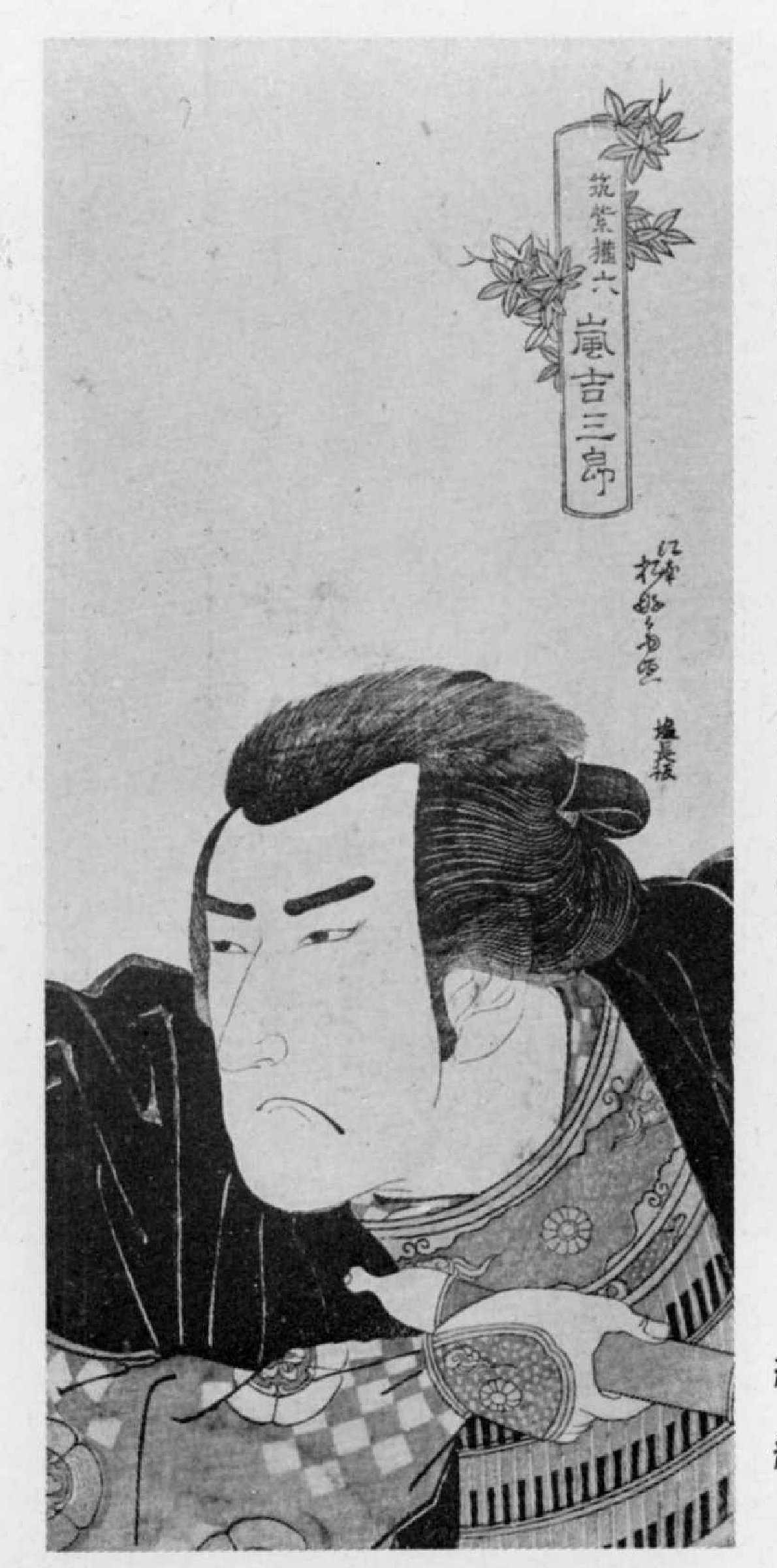
Arashi Kichisaburō as Tsukushi no Gonroku
「嵐吉三郎 筑紫権六」
c. 1800-1804
Colour woodblock print
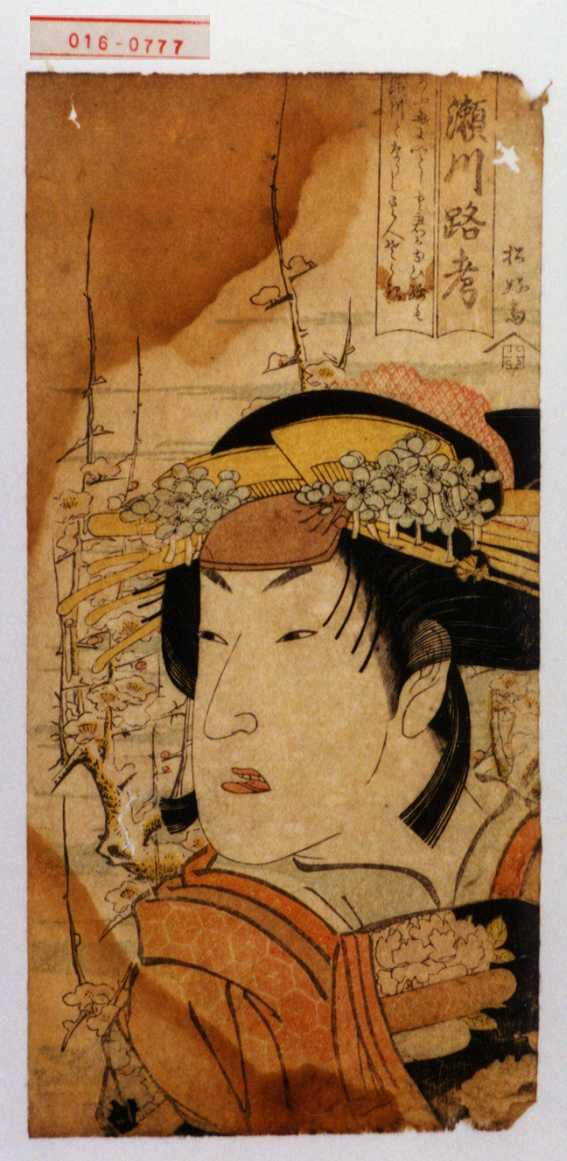
Segawa Rokō (Segawa Kikunojō III)
「瀬川路考」
1801
Colour woodblock print
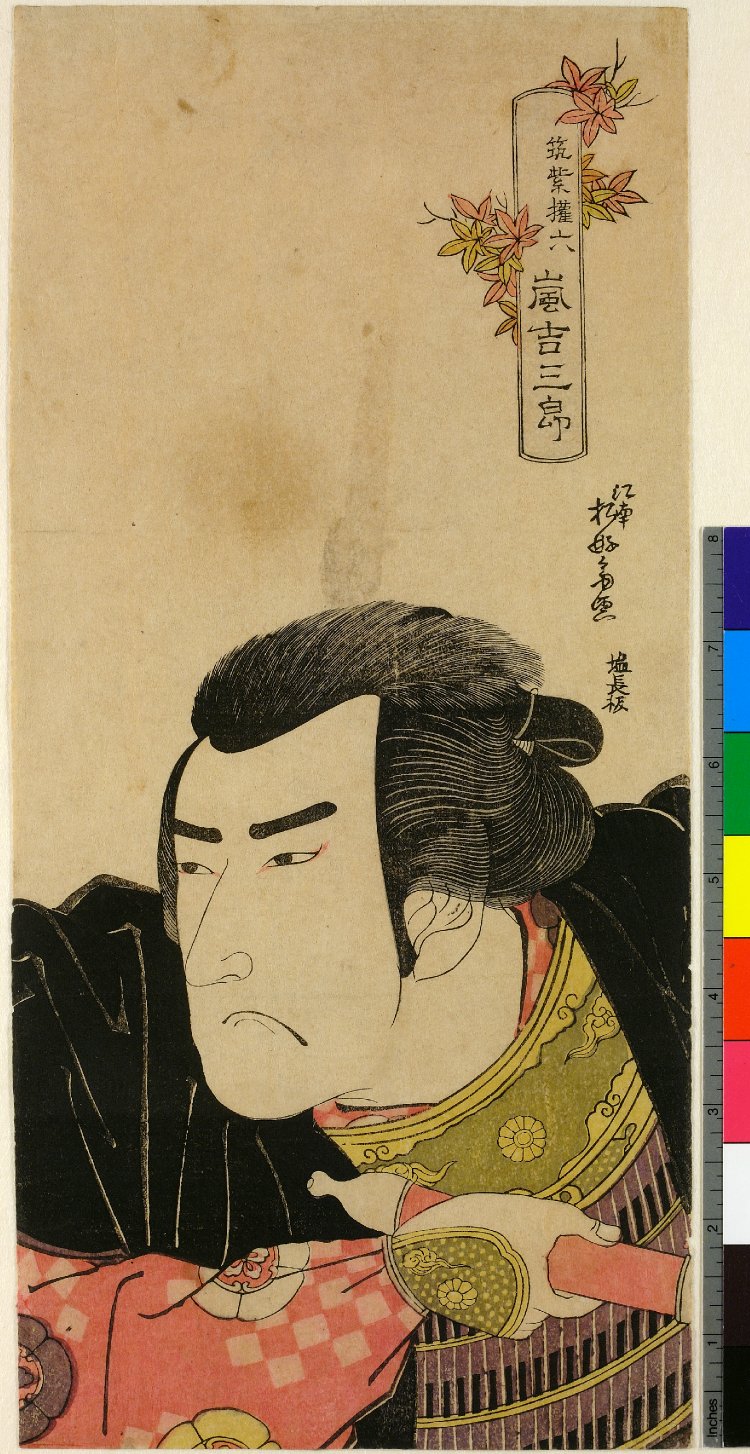
Arashi Kichisaburō II as Tsukushi no Gonroku (from Keisei hako denju)
1804 (first month)
Colour woodblock print
Frequently Asked Questions
Santō yakusha masukagami (A Clear Mirror of Actors of the Three Cities) (三都俳優ますかゞみ) was created by Shōkōsai Hanbei (松好斎半兵衛) in 1806.