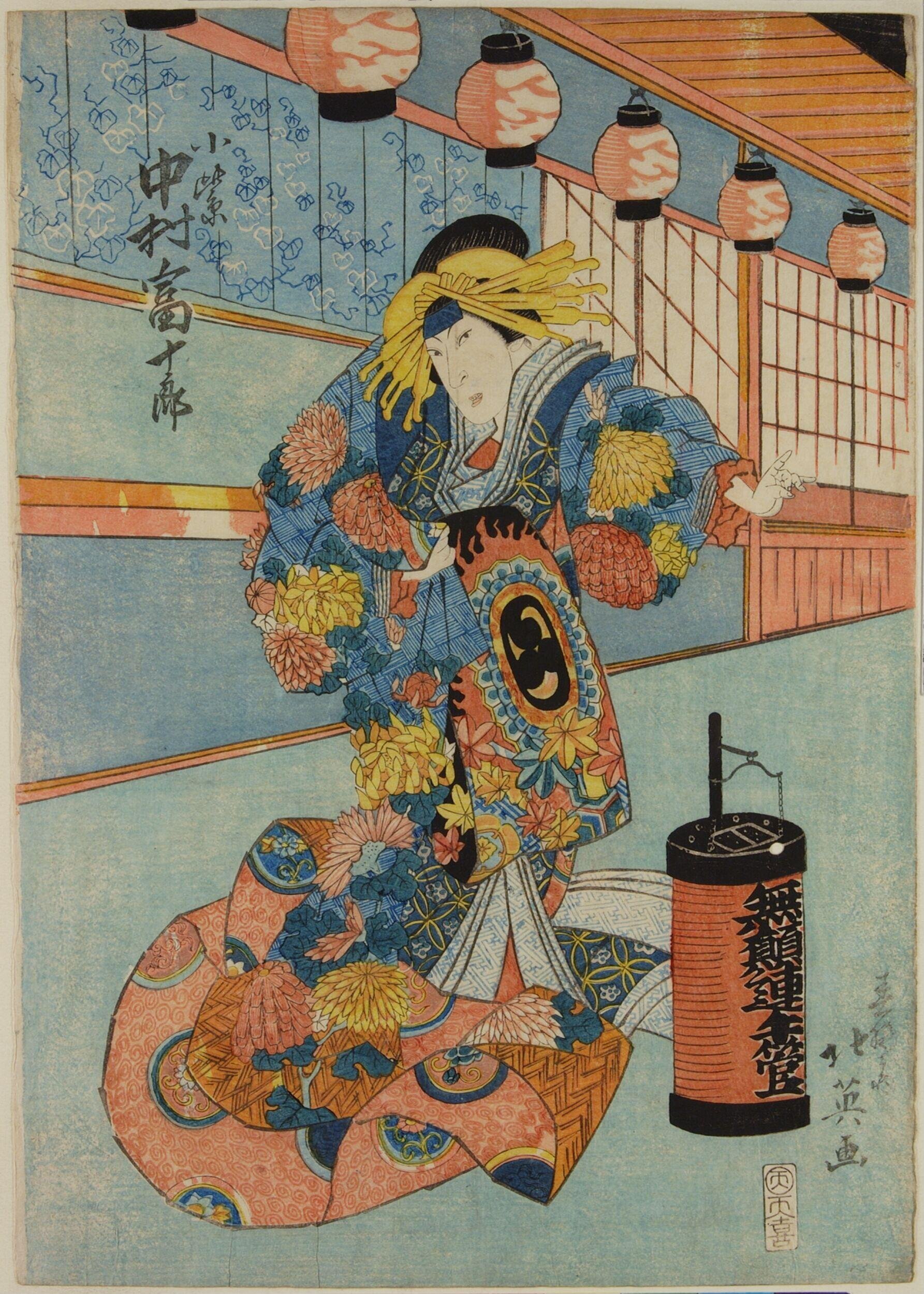
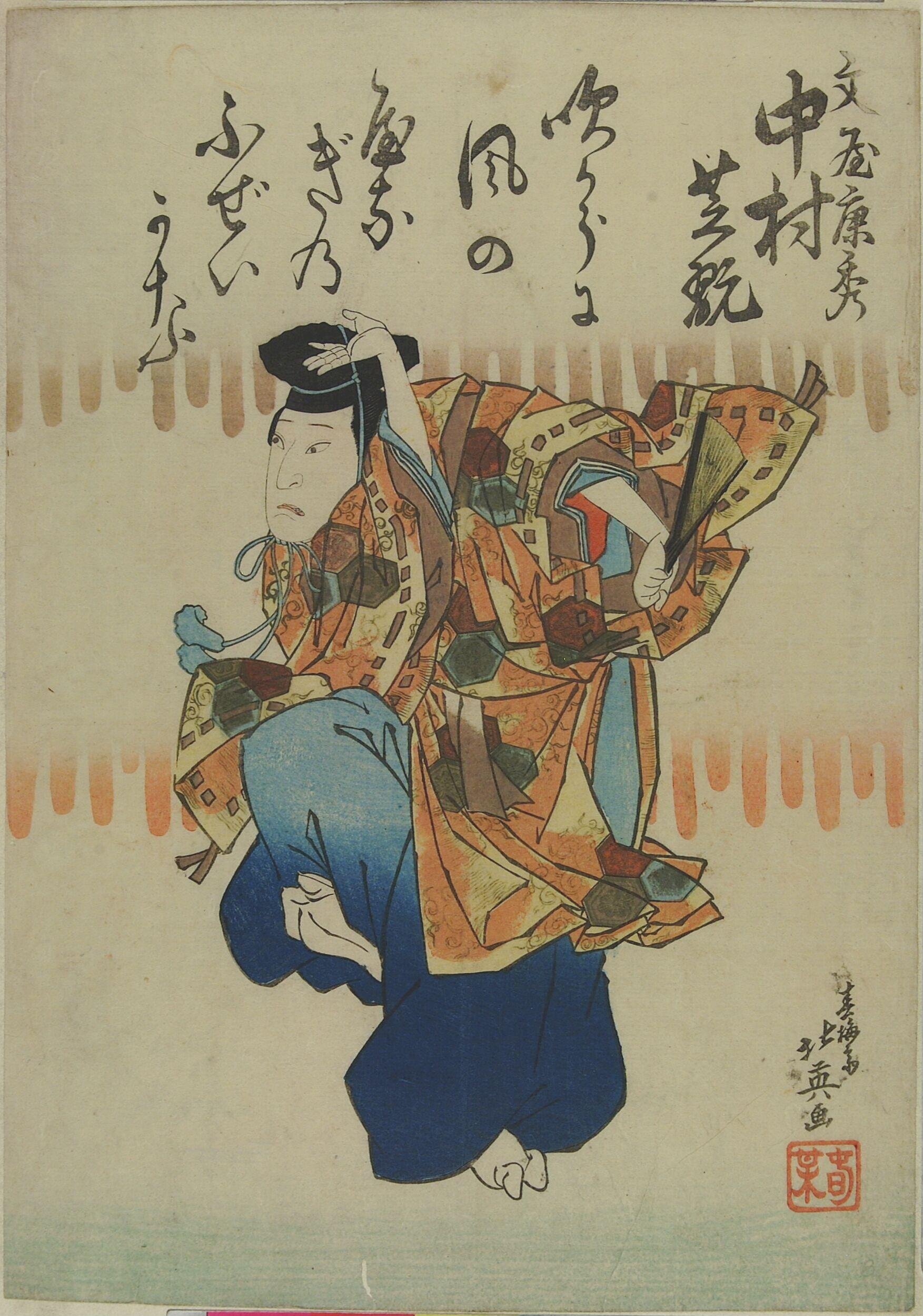
Actor Nakamura Tomijūrō as Komurasaki
- Date:
- 1835
- Medium:
- Source:
- Victoria and Albert Museum
Description
This 1835 Victoria and Albert Museum (https://collections.vam.ac.uk/item/O409656) yakusha-e by Shunbaisai Hokuei shows Nakamura Tomijuro II in the role of Komurasaki, the legendary courtesan of the Edo-period Miura-ya brothel whose tragic love affair with the samurai-turned-outlaw Hirai Gonpachi became one of the great subject cycles of kabuki and ukiyo-e tradition. Komurasaki's story, dramatized in numerous plays alongside Gonpachi's, told of her devotion to her doomed lover and her ultimate suicide on his grave following his execution at Suzugamori, providing the female heroine half of one of the most beloved romantic-tragic narratives of late-Edo popular culture. The role required the elaborate costume and bearing of the high-ranking pleasure-quarter courtesan: multiple layered robes with seasonal motifs, the elaborate upswept hair with abundant kanzashi ornaments, and the carefully composed posture that conveyed both social position and the underlying emotional depth of the tragic heroine. Nakamura Tomijuro II, an established Kamigata onnagata of the mid-1830s, brought to the role the gestural sophistication and personal-likeness features that distinguished Hokuei's mature portrait sequence. The print may have been issued in coordination with the companion Arashi Rikan II-as-Hirai-Gonpachi single portrait and the Hirai-Gonpachi/Banzui-Chobei double portrait also dated to 1835 in the V&A's Hokuei group, an instance of the Osaka publishing convention of issuing related single-figure and combined compositions as integrated documentary sets responding to a particular production. The single-figure half-length composition is in Hokuei's standard mature format. The Victoria and Albert impression preserves the careful color registration that defined premium Osaka workshop production, the 1835 Gonpachi-Komurasaki cycle being one of the best-documented theatrical sequences in the artist's surviving oeuvre.
More Prints by Shunbaisai Hokuei
Frequently Asked Questions
Actor Nakamura Tomijūrō as Komurasaki was created by Shunbaisai Hokuei (春梅斎北英) in 1835.