
Kawakami Sumio
- Medium:
- Mokuhanga (Japanese woodblock)
- Image courtesy of
- Saru Gallery
Description
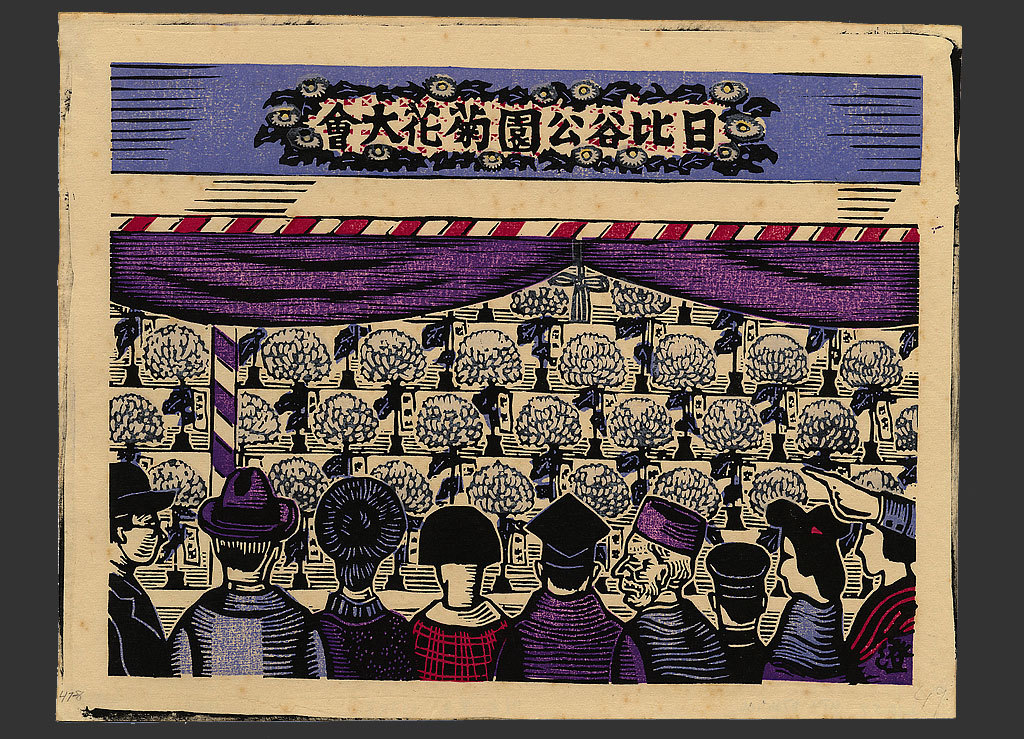
A self-portrait, identifying the artist by his own name as both subject and signature. Self-portraiture sat at the center of sosaku-hanga ideology, where the principle of jiga, jikoku, jizuri — self-drawn, self-carved, self-printed — made the artist's hand and face into emblems of the movement's break from the Edo-period publisher-craftsman division of labor. Kawakami's self-portraits typically render the head in the same flat, cartoon-direct manner he applied to his nanban foreigners: heavy outline, unmodulated color blocks, eyeglasses and moustache reduced to graphic signs rather than modeled features. There is no atmospheric perspective, no chiaroscuro, no bokashi gradient softening the planes — the portrait reads as a printed object first and a likeness second. Among contemporaries who pursued lyrical abstraction or Western academic figure work, Kawakami's self-image stands apart as deliberately handmade and folkish, closer in feeling to a wooden ema votive plaque or a shop sign than to a studio portrait.
More Prints by Sumio Kawakami
![Title unknown [Flowers in a vase] by Sumio Kawakami](https://1.api.artsmia.org/800/135636.jpg)


Featured in Collections
Curated cross-cuts that include this print.
Frequently Asked Questions
Kawakami Sumio was created by Sumio Kawakami (川上澄生).