
Nanbanesque behaviour
- Medium:
- Mokuhanga (Japanese woodblock)
- Image courtesy of
- Saru Gallery
Description
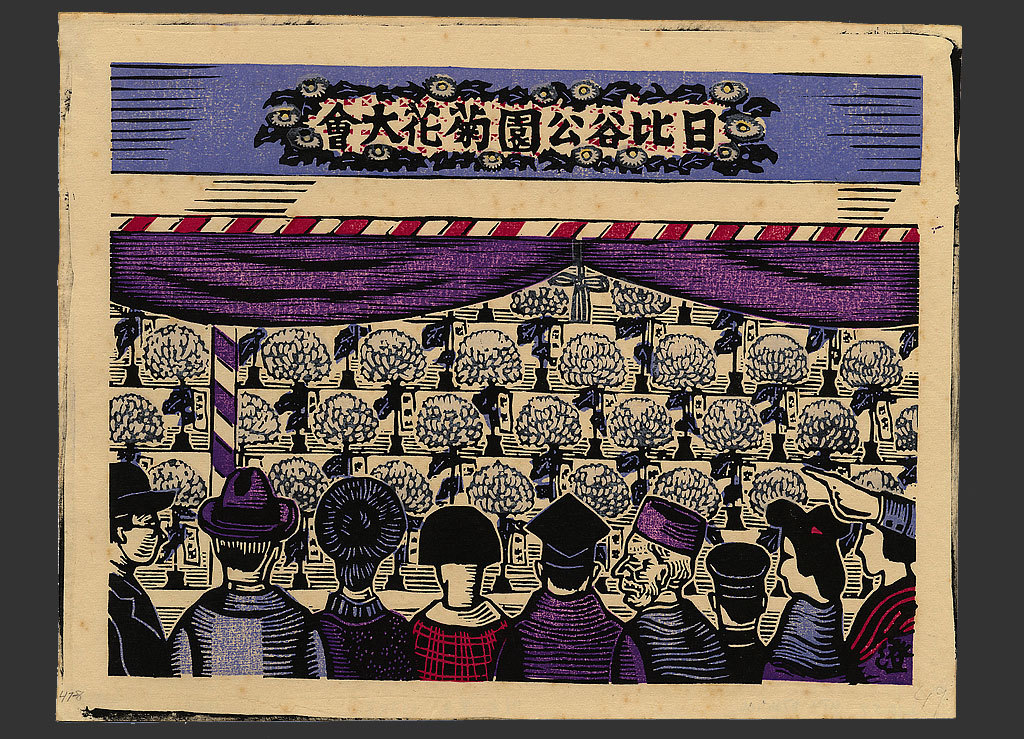
A nanban-themed scene in which Western figures — Portuguese or Dutch traders, or perhaps the long-nosed Iberian missionaries of the late sixteenth century — perform some social ritual that Kawakami found foreign and faintly comic. The title's coinage, treating Western manners as a behavioral category, is characteristic of his mature voice: he turned the encyclopedic curiosity of Edo namban screens into an affectionate, slightly satirical anthropology. Compositionally, prints in this vein arrange their figures in shallow, frieze-like space with no recession, the costumes (high-crowned hats, hose, balloon trousers, pipes, parasols) reduced to graphic silhouettes that the viewer reads as type before person. The carving favors clean contour over textural detail, and the printing relies on flat fields of opaque color rather than the layered transparent washes used in landscape mokuhanga. The print belongs to the long sequence of nanban subjects that defined Kawakami's contribution to sosaku-hanga and circulated widely in the small-edition print culture of the 1920s and 1930s.
More Prints by Sumio Kawakami
![Title unknown [Flowers in a vase] by Sumio Kawakami](https://1.api.artsmia.org/800/135636.jpg)


Featured in Collections
Curated cross-cuts that include this print.
Frequently Asked Questions
Nanbanesque behaviour was created by Sumio Kawakami (川上澄生).