
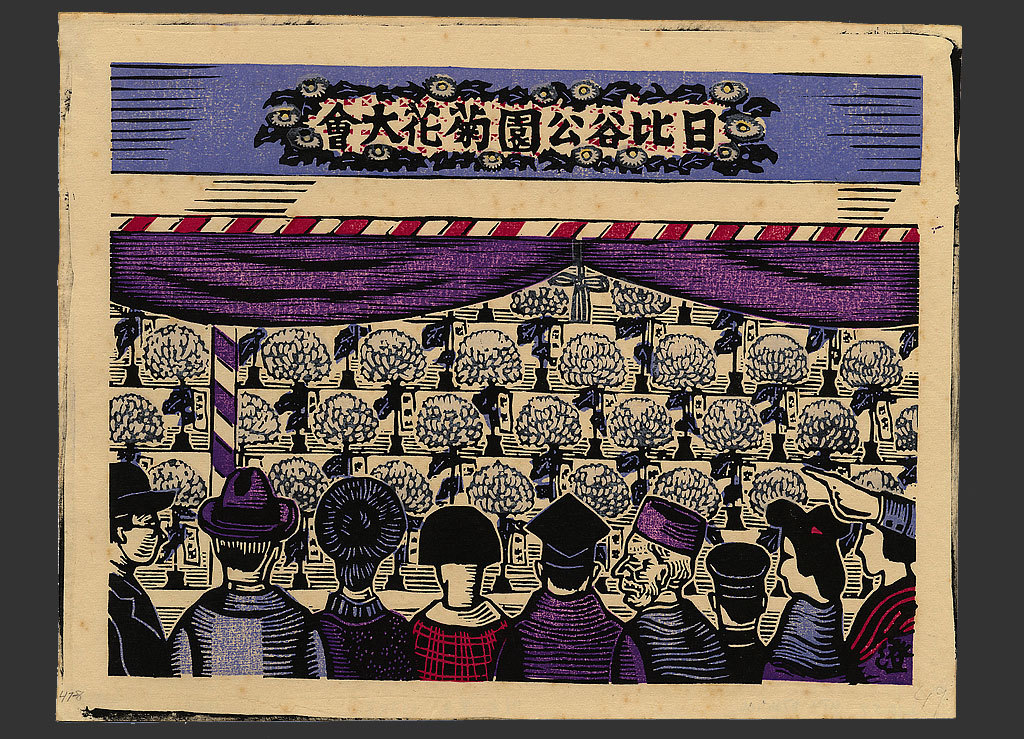
Self-printed picture postcard
- Medium:
- Mokuhanga (Japanese woodblock)
- Image courtesy of
- Saru Gallery
Description
The picture postcard was a recurring form for Kawakami, who produced numerous small-format prints intended for circulation among friends and patrons—a continuation of the surimono tradition of privately commissioned prints adapted to twentieth-century postal use. Self-printed (jisuri) is the operative term: it signals adherence to the sosaku-hanga creed that the artist must carve and print the work personally, in contrast to the professional carver-and-printer division of labor inherited from Edo-period ukiyo-e. The small format encouraged compression of motif and a graphic directness well-suited to Kawakami's idiom of bold outlines and flat color. The card-sized image typically combines a single figure or object with hand-printed lettering, blurring the distinction between print and ephemera in a way that suited Kawakami's anti-academic sensibility. Such postcards were exchanged within sosaku-hanga circles and at print clubs (hanga kai), and surviving examples are now collected as a distinct subset of his output.
More Prints by Sumio Kawakami
![Title unknown [Flowers in a vase] by Sumio Kawakami](https://1.api.artsmia.org/800/135636.jpg)


Featured in Collections
Curated cross-cuts that include this print.
Frequently Asked Questions
Self-printed picture postcard was created by Sumio Kawakami (川上澄生).