
Untitled work by Sumio Kawakami
- Source:
- ukiyo-e.org
Description
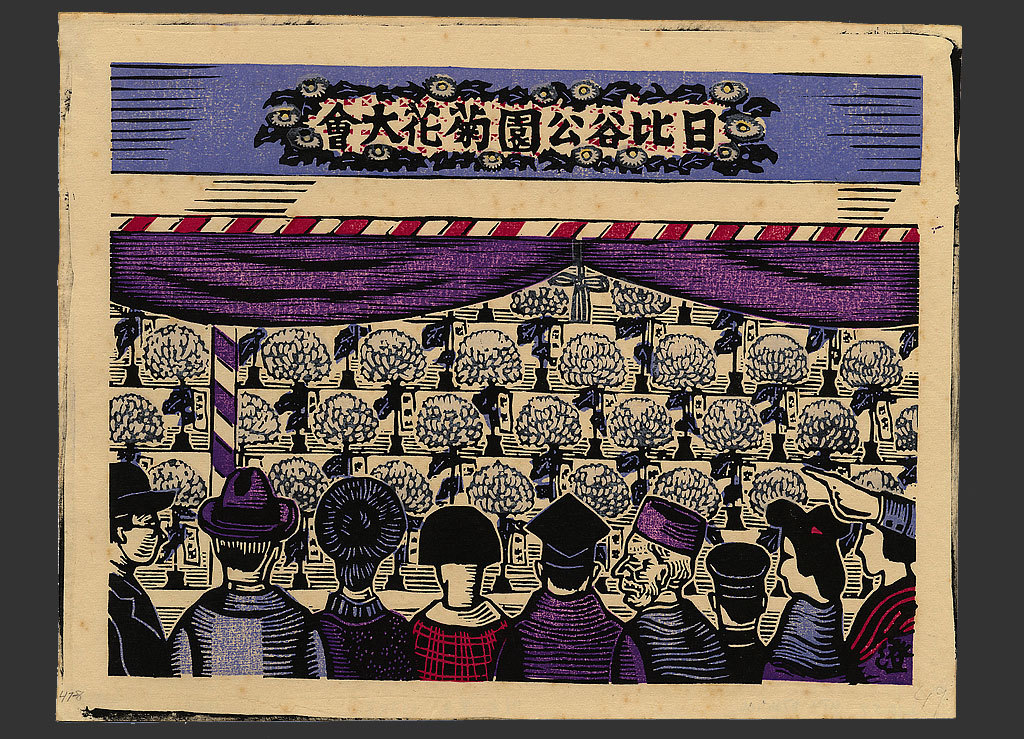
This untitled print by Sumio Kawakami exemplifies the distinctive folk-art sensibility the artist brought to the sosaku-hanga (creative print) movement of twentieth-century Japan. Kawakami occupies a singular place in the history of Japanese printmaking: largely self-taught, he developed a deliberately naive, hand-carved style that set him apart from his more academically trained peers and aligned him with the broader sosaku-hanga ideal of the artist as designer, carver, and printer of his own work. The composition shows the unrefined cutting and assertive black contours that became Kawakami's signature, a visual language he traced in part to his fascination with Japan's early encounter with the West. Throughout his career Kawakami produced namban-influenced prints that drew on the imagery of sixteenth- and seventeenth-century namban byobu folding screens, which depicted Portuguese and Spanish traders, Jesuit missionaries, and the exotic goods they introduced to Nagasaki. That namban vocabulary, with its ruffs, breeches, broad-brimmed hats, and ships at anchor, runs through much of his graphic output as a kind of personal mythology of cultural exchange. Even when the subject is not overtly historical, as in this sheet, the same earthy palette, woodgrain textures, and confident block-cut shapes carry the namban inheritance forward. The print is preserved in the holdings catalogued by ukiyo-e.org, a research portal that aggregates Japanese print collections from museums and dealers worldwide, where it stands as a representative example of Kawakami's idiosyncratic visual idiom. For collectors and scholars studying the social history of the sosaku-hanga movement, works of this kind document how a self-trained artist outside the major Tokyo print circles helped expand the expressive range of postwar Japanese woodblock printmaking.
More Prints by Sumio Kawakami
![Title unknown [Flowers in a vase] by Sumio Kawakami](https://1.api.artsmia.org/800/135636.jpg)


Featured in Collections
Curated cross-cuts that include this print.
Frequently Asked Questions
(untitled) was created by Sumio Kawakami (川上澄生).