
A Young Woman in a Summer Shower
- Date:
- 1765
- Medium:
- Color woodblock print; chuban, surimono
- Source:
- Art Institute of Chicago
Description
A Young Woman in a Summer Shower, a 1765 chuban-format design by Suzuki Harunobu in the Art Institute of Chicago, belongs to the inaugural year of the polychrome nishiki-e technique that the artist is traditionally credited with helping to bring to maturity. The print shows a slender bijin caught by sudden summer rain, her umbrella tilted to deflect the slanting water as she hurries along a path or pauses beneath a wall. Rain in Edo ukiyo-e is one of the most expressive atmospheric devices available to a print designer: a series of diagonal lines can transform an ordinary street scene into a charged emotional moment. Harunobu deploys this device with characteristic restraint, allowing the line of rain to set the diagonal of the composition while the figure's body resists or yields to it. Her kimono is rendered with careful attention to pattern and color, the new polychrome resources of nishiki-e giving her textile a richness unavailable in earlier two- and three-color prints. Such weather-driven bijin-ga designs would become a staple of Edo ukiyo-e well into the nineteenth century, but Harunobu's version is among the earliest sophisticated treatments of the motif. The print exemplifies the new lyrical possibilities that nishiki-e opened to the chuban format in the hands of its most inventive practitioner.
More Prints by Suzuki Harunobu

Two Women Washing Their Hair
c. 1767/68
Color woodblock print; chuban

Parody of Kawachi-goe from "Tales of Ise"
1765
Color woodblock print; right sheet of chuban diptych (left sheet: 1925.2025)

Young Man Holding Umbrella Beside a Fence
c. 1767/68
Color woodblock print; chuban

Going to the Theater
c. 1770/71
Color woodblock print; chuban
More Summer Prints
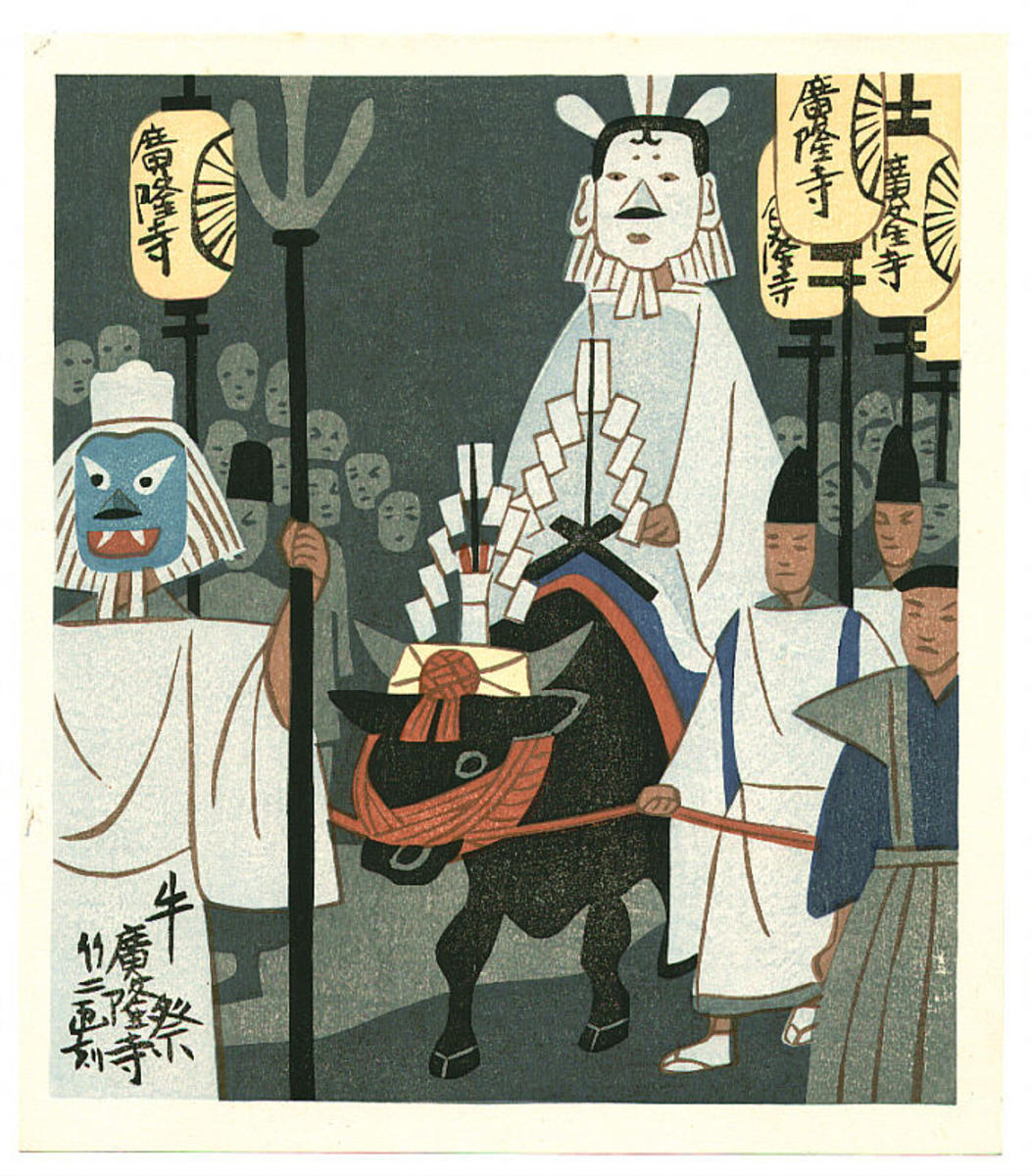
Bull Festival at Koryuji
広隆寺牛祭
Woodblock print
February (The Annual Festival of the Fushimi Inari)
二月 (伏見稲荷大社祭)
second half 20th century
Woodblock print, ink and color on paper

July (Gorgeous Procession of Yama-hoko or the Floats at the Gion Festival)
七月 (祇園祭山鉾巡行)
second half 20th century
Woodblock print, ink and color on paper

August (The Bonfire Festival of the Daimonji Hill Viewed from the Sanjo Bridge)
八月 (三条大橋より大文字)
second half 20th century
Woodblock print, ink and color on paper
Frequently Asked Questions
A Young Woman in a Summer Shower was created by Suzuki Harunobu (鈴木春信) in 1765.
A Young Woman in a Summer Shower depicts summer.