
Flower and girl
- Medium:
- Mokuhanga (Japanese woodblock)
- Image courtesy of
- Saru Gallery
Description
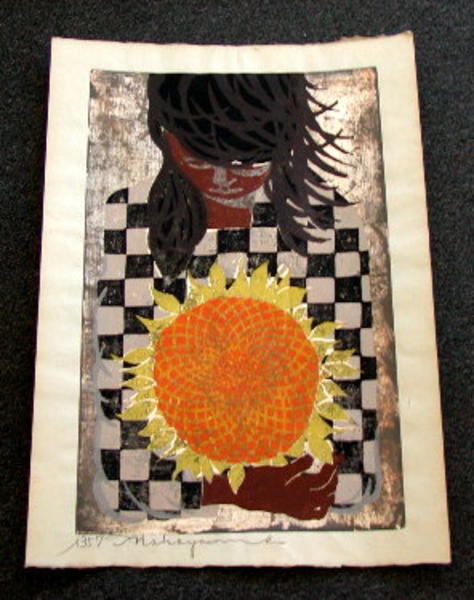
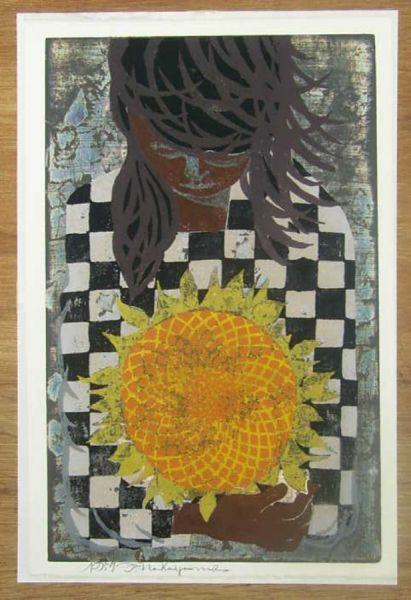
A young child paired with a flower, fusing two subjects Nakayama returned to repeatedly across his post-horse production. From the late 1950s onward, Nakayama developed a distinctive vocabulary for child figures — disproportionately large heads, simplified facial features rendered through minimal carved lines, and decorative patterning across hair or kimono that recalled folk-craft traditions while remaining unmistakably modern. The carving in works of this type relies on broad gouge strokes and flat color planes rather than the fine line work of earlier shin-hanga production, a hallmark of his commitment to the sosaku-hanga ethos in which the artist designed, carved, and printed the entire work. Mokuhanga technique here typically involves multiple blocks for layered color over washi, with portions of the paper sometimes left bare to function as compositional negative space. The pairing of a child with a flower extends kacho-e logic into a personal idiom, treating the figure not as observed portrait but as decorative emblem held within the picture plane.
More Prints by Tadashi Nakayama
More Birds & Flowers Prints
Featured in Collections
Curated cross-cuts that include this print.
Frequently Asked Questions
Flower and girl was created by Tadashi Nakayama (中山正).
Flower and girl depicts birds & flowers and children.