
Urakami Catholic Church
by Tagawa Ken
- Source:
- ukiyo-e.org
Description
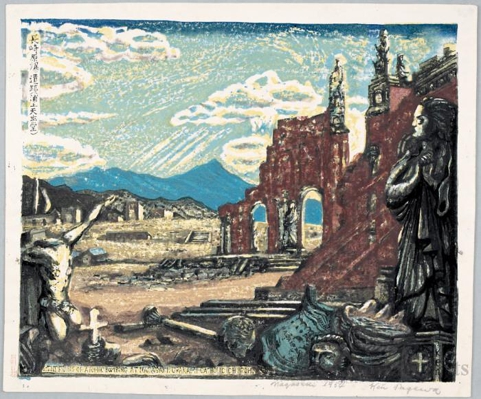
Urakami Catholic Church is a Japanese woodblock print by Tagawa Ken in the collection of the Honolulu Museum of Art, where it is catalogued under accession number 6359 and documented through ukiyo-e.org. The subject is one of the most historically charged buildings in Nagasaki: Urakami Cathedral, the principal church of the Urakami valley's long-suppressed Catholic community, which after centuries of clandestine practice during the Edo-period prohibition of Christianity finally built a large brick basilica completed in 1925. The original cathedral was destroyed in the atomic bombing of Nagasaki on 9 August 1945, having stood close to the hypocenter; the present building, rebuilt in 1959 and renovated thereafter, preserves the silhouette of twin towers and a long basilica nave that distinguish Urakami from nearly every other church in Japan. Tagawa Ken's print works squarely within contemporary mokuhanga, the modern Japanese woodblock tradition in which printmakers handle design, carving, and printing as an integrated craft. The church's brick masses and arched openings translate naturally into the medium's layered blocks of color, where the warm reds and ochres of brick can be set against sky and foliage in flat, deliberate planes. The architectural subject also continues a thread that runs through twentieth-century Japanese printmaking, in which artists turned to churches, bridges, factories, and stations as motifs that recorded the country's modernization and, in Urakami's case, its layered religious history. The Honolulu Museum of Art holds a notable body of Japanese prints, and the placement of Tagawa Ken's view of Urakami within that collection ensures that this particular landmark, with its difficult and resilient history, continues to be seen alongside other woodblock studies of Japan's sacred sites.
More Prints by Tagawa Ken


Frequently Asked Questions
Urakami Catholic Church was created by Tagawa Ken (田川憲).