
Shamisen gusa 三味線草 (Shamisen Leaves)
- Source:
- ukiyo-e.org
Description
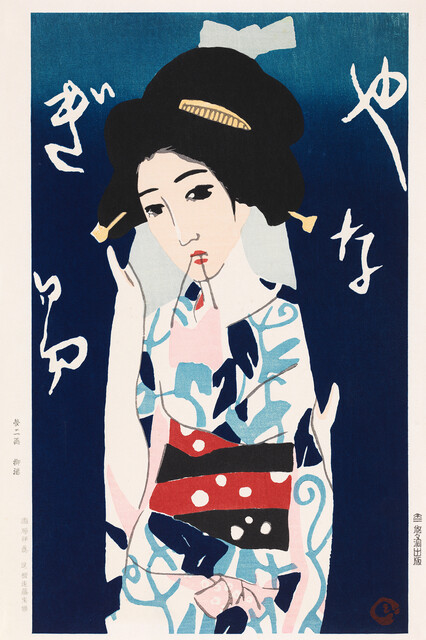
Shamisen gusa, or Shamisen Leaves, brings together two motifs that Takehisa Yumeji explored throughout his career: the modern Japanese bijin and the music she plays. The print, documented on ukiyo-e.org and held by the British Museum, sets a slender woman with the long oval face of a yumeji-shiki beauty against a botanical motif drawn from the plant commonly called shamisen-gusa, whose triangular fruit was thought to resemble the body of the three-stringed lute. By titling the work after this plant rather than after the instrument itself, Yumeji introduces a layer of poetic indirection typical of Taisho roman sensibility, suggesting music through plant life rather than through any explicit performance scene. The shamisen had a long association with female entertainers in the floating world, from late Edo geisha to early twentieth-century cafe and theater performers, and Yumeji's audience would have understood the title as an invitation to imagine an entire backstage world of training, longing, and quiet practice. As in his other prints, the design favors elongated silhouettes, decorative pattern, and a restrained palette over the dense color and figural crowding of nineteenth-century ukiyo-e. The result is an image that reads as much like a song's frontispiece as a single print, in keeping with Yumeji's parallel career as a magazine and book designer. For collectors, Shamisen gusa is a particularly attractive example of how he wove music, plant lore, and modern Japanese bijin imagery into a unified Taisho roman aesthetic.
More Prints by Takehisa Yumeji


Frequently Asked Questions
Shamisen gusa 三味線草 (Shamisen Leaves) was created by Takehisa Yumeji (竹久夢二).