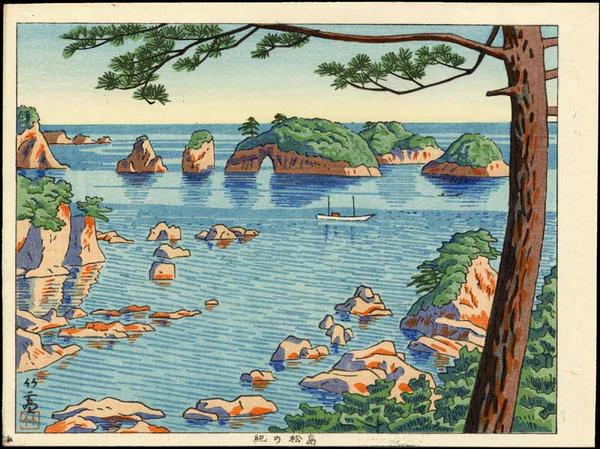
Matsushima
by Takeji Asano
- Medium:
- Woodblock print
- Source:
- ukiyo-e.org
Description
Matsushima, dated 1940 and preserved in the imagery aggregated through ukiyo-e.org (https://ukiyo-e.org/image/artelino/12539g1), belongs to Asano Takeji's prewar landscape practice during the high decade of shin-hanga production. Asano Takeji (1900-1999), a Kyoto-trained printmaker who studied at the Kyoto City School of Fine Arts and Crafts and worked closely with Kyoto publishers Uchida Bijutsu Shoshi and Tanseido, built a reputation in the 1930s and 1940s as one of the most accomplished landscape designers operating outside the Tokyo orbit of Watanabe Shozaburo. The shin-hanga ('new prints') movement to which Asano belonged sought to renew the Edo-period collaborative system for twentieth-century audiences, pairing a designer with skilled carvers, printers, and a publisher who coordinated production and distribution. The subject, Matsushima, refers either to the famous pine-clad islands of the Sendai Bay (one of the celebrated Nihon Sankei or 'three views of Japan' enshrined since the Edo period) or to a related coastal motif of pines and water; the print's subtitled grouping with views of Wakayama suggests an itinerant landscape series in which Asano applied his characteristic vocabulary of layered horizons, soft-keyed color, and atmospheric stillness to scenic sites outside his Kyoto base. His compositional manner in this period parallels contemporaries Tsuchiya Koitsu and Kawase Hasui, with whom he shared a commitment to mood and quiet luminosity, while his palette tends toward the cooler indigos and grey-greens favored by Kyoto printers. The 1940 date places the design at the threshold of the wartime restrictions that would soon curtail shin-hanga production for the export market, lending the sheet additional documentary value. Because the museum metadata available through ukiyo-e.org is limited to the title, date, and aggregator record, researchers seeking edition, publisher, and condition information should consult the originating dealer or institutional record. As a working artifact of late prewar shin-hanga, the print testifies to Asano's continued engagement with the canonical landscape subjects of the Japanese pictorial tradition.
More Prints by Takeji Asano


Featured in Collections
Curated cross-cuts that include this print.
Frequently Asked Questions
Matsushima was created by Takeji Asano (浅野竹二).