
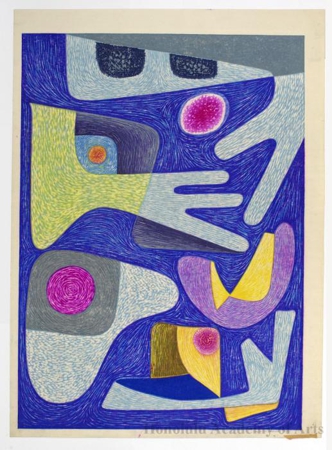
Forme VI
- Medium:
- Mokuhanga (Japanese woodblock)
- Image courtesy of
- Saru Gallery
Description
Forme VI, using the French spelling that appeared occasionally in postwar Japanese print titles aimed at international audiences, sits within a numbered sequence in which Shinagawa explored variations on a single sculptural shape. The Roman numeral suggests at least five preceding works, indicating sustained engagement with one motif rather than a quick study. The print likely centers on a substantial form — rounded, angular, or curved — isolated against a quiet ground so that its silhouette and internal modulations carry the composition. Mokuhanga's flat color planes suit this kind of formal isolation, while the woodgrain texture left by the block adds a subtle organic register beneath the geometry. Shinagawa's commitment to jiga, jikoku, jizuri meant that the identity of each variation emerged through the cumulative decisions of carving and printing rather than through preliminary drawings alone. Series like Forme align his practice with the broader twentieth-century concern, shared by sosaku-hanga and European modernism alike, with the standalone form as a vehicle for sustained perceptual attention.
More Prints by Takumi Shinagawa


![Music in Spring (Shunfu [Haru no fu]), Shôwa period, mid 20th century by Takumi Shinagawa](https://data.ukiyo-e.org/harvard/images/HUAM-CARP06220.jpg)
Featured in Collections
Curated cross-cuts that include this print.
Frequently Asked Questions
Forme VI was created by Takumi Shinagawa (品川工).