
New Town (411)
- Medium:
- Mokuhanga (Japanese woodblock)
- Image courtesy of
- Hanga Ten
Description
New Town — danchi or nyū taun in Japanese — refers to the planned residential developments that spread across the suburbs of Osaka, Kobe, and Kyoto from the 1960s onward, replacing former farmland with apartment blocks and standardized housing. The title carries unmistakable irony in the context of Tanaka's wider work, which is otherwise devoted to the very rural landscapes such developments displaced. The print likely depicts the rectilinear forms of new concrete housing, perhaps still set against remnants of older fields or vegetation, recording the transition rather than condemning it. With its low catalogue number (411), this is an earlier work, made when the postwar transformation of the Japanese landscape was still actively underway and the contrast between old and new was visible at every urban edge. The print stands as a counterweight within his oeuvre — the modern condition his minka prints were always implicitly defined against.
More Prints by Tanaka Ryohei


More Urban Scenes Prints

A Hundred Shades of Ink of Edo: Kiyonaga's Pipe (Edo zumi hyaku shoku: Kiyonaga no kiseru)
Woodblock print

View of Kabuki Theater from Matsuya (Ginza Matsuya yori Kabukiza), no. 3 from the series "Pictures of Ginza, First Series (Gashu Ginza dai isshu)"
1928
Color lithograph

Distant View of Mitsukoshi Movie Theater in Shinjuku from the Sixth Floor of Hoteiya (Hoteiya rokkai kara Shinjuku Mitsukoshi Musashi no kan enbo zu), no. 1 from the series "Scenery of Shinjuku (Gashu Shinjuku fukei)"
1930
Color lithograph
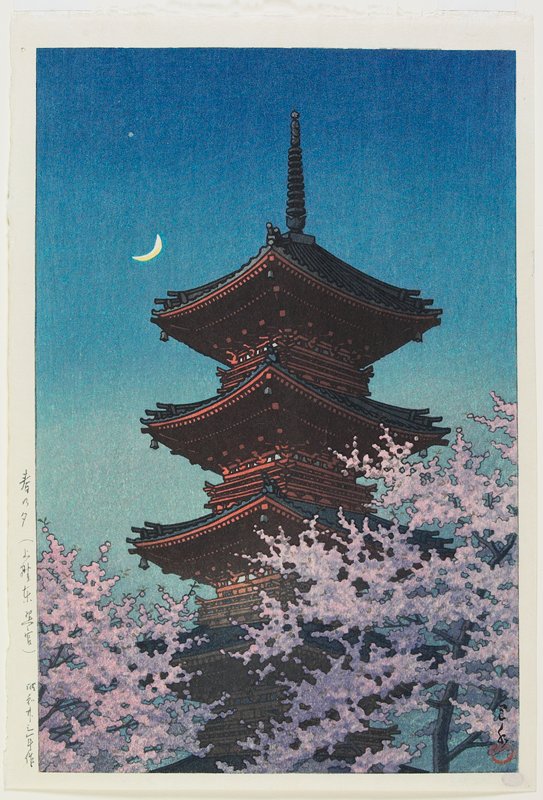
Spring Dusk at the Tōshō Shrine in Ueno
1948
Woodblock print, ink and color on paper
Featured in Collections
Curated cross-cuts that include this print.
Frequently Asked Questions
New Town (411) was created by Tanaka Ryohei (田中良平).
New Town (411) depicts urban scenes.