
Peking Camels
- Date:
- 1928
- Medium:
- Etching on off-white laid paper
- Source:
- Art Institute of Chicago
Description
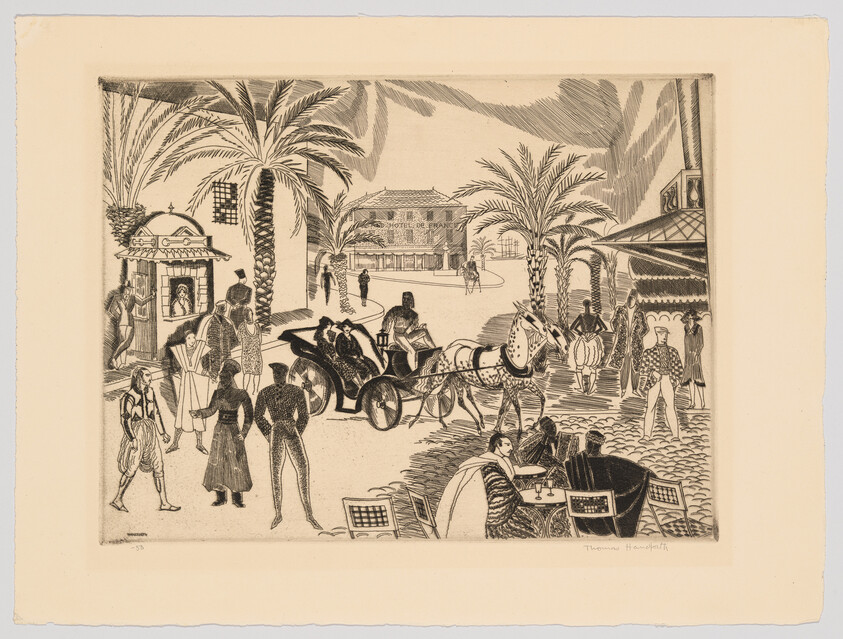
Peking Camels, etched by Thomas Handforth in 1928, is one of the most widely admired prints of the artist's brief but productive engagement with North China. Although Handforth would not settle in Peking until 1931, he had already begun to imagine the city through preparatory work in Paris and Mexico in the late 1920s, and Peking Camels belongs to this anticipatory phase, in which he drew on the published reports of Western residents and the Bactrian camel caravans that still moved tea, coal, and salt across the dusty plains north and west of the old Ming and Qing capital. The composition concentrates a long, knotted line of camels and their drivers across the foreground, with the soft chalky line of Peking's massive walls and gate towers retreating into the middle distance. Handforth handles the etched line with restraint: the camels themselves are described in sharp, almost calligraphic strokes that catch the unmistakable silhouette of the loaded humps and shaggy winter coat, while the surrounding atmosphere is built from looser, paler hatching that gives the open ground the bleached, sunlit quality that nineteenth-century travellers from the Russian and Mongolian routes had repeatedly noted. The Art Institute of Chicago, which holds this impression in its print and drawing collection (https://www.artic.edu/artworks/70342), preserves Peking Camels as a representative example of American interwar interest in Asia at street level rather than as exotic spectacle, and the print sits comfortably alongside the museum's earlier Hiroshige and Hokusai sheets that also took the working life of an East Asian capital as a serious artistic subject. For collectors of early twentieth-century American printmaking, and for students of the wider Pacific Rim cultural traffic that produced Handforth's career, the 1928 Peking Camels remains the indispensable early Handforth: the etching that announced his interest in China before he had ever set foot there and that anticipated the long Peking residence and the Caldecott-winning Mei Li that followed within the decade.
More Prints by Thomas Handforth



Frequently Asked Questions
Peking Camels was created by Thomas Handforth in 1928.