
Tierra Caliente
- Date:
- 1928
- Medium:
- Etching on cream laid paper
- Source:
- Art Institute of Chicago
Description
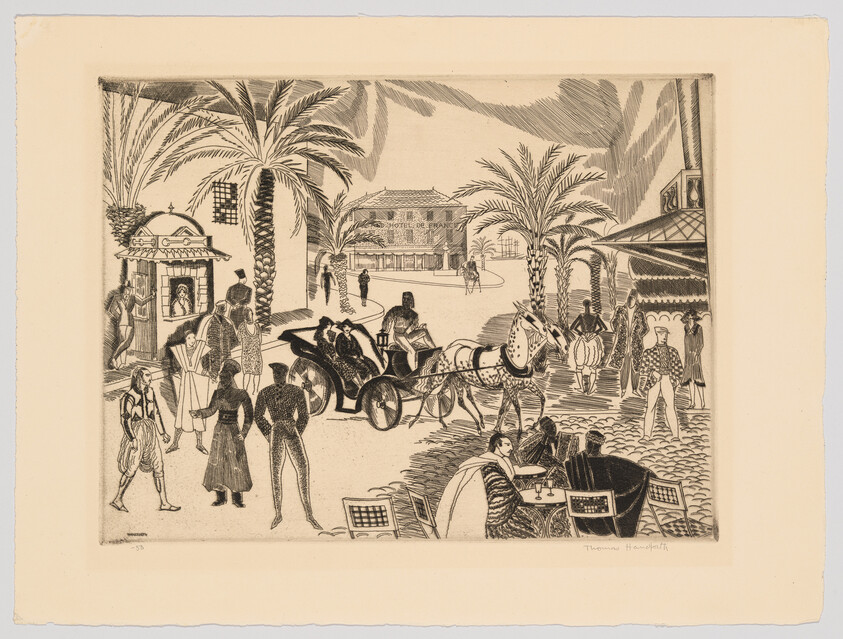
Tierra Caliente, etched by Thomas Handforth in 1928, is one of the keystone prints of the artist's southern Mexican period and was made during or just after his extended residence in the country in the second half of the 1920s. The Spanish title — literally 'hot land,' the term used in Mexico to describe the lowland tropical zone — points to the climate and geography of the composition, in which figures move through a sun-bleached village setting under the unrelenting light of the lowland coast. Handforth's etched line is loose and confident; the figures are described in a small number of essential strokes, while the surrounding ground and structures are built from looser passages of hatching that leave large portions of the paper open to suggest heat and glare. The print belongs to a coherent group of 1928 Mexican subjects that includes Pulque y Tortilla, Benito, and The Bride (Francesca), and that together establish Handforth among the American etchers of his generation who took post-revolutionary Mexico seriously as a subject. The Art Institute of Chicago, which holds this impression (https://www.artic.edu/artworks/70346), accessioned it as part of the consistent Handforth group acquired through Mrs. Merle Shera, and the work has been read by later commentators as evidence of an American intaglio response to the broader Mexican muralist and print renaissance of the 1920s. For students of Thomas Handforth, Tierra Caliente is a particularly clear demonstration of how his observational manner could compress a whole climate and social register into a small etched sheet, and of why his Mexican prints have continued to circulate alongside his better-known Peking etchings in surveys of American interwar travel printmaking.
More Prints by Thomas Handforth



Frequently Asked Questions
Tierra Caliente was created by Thomas Handforth in 1928.