Thomas Handforth
1897–1948
Japan
Biography
Thomas Scofield Handforth (1897–1948) was an American etcher, lithographer, illustrator, and children's book author whose long expatriate years in North Africa, Mexico, India, and China produced one of the most internationally inflected bodies of work in early twentieth-century American printmaking. Although he is best remembered today as the writer-illustrator of Mei Li, the 1938 picture book that won him the Caldecott Medal in 1939, his prints — etchings, drypoints, and lithographs drawn from the streets, markets, and houses of the countries he travelled — are the foundation of his artistic reputation. Impressions are held by major American museums including the Smithsonian American Art Museum, the Art Institute of Chicago, the Whitney Museum of American Art, and the Metropolitan Museum of Art, as well as by institutions abroad such as the British Museum, the Victoria and Albert Museum, and the Museum of Fine Arts, Boston.
Handforth was born in Tacoma, Washington, on September 16, 1897, and grew up amid the maritime traffic of Puget Sound and the cultural mixing of the Asian-Pacific Rim that would shape his later subject matter. He studied at the University of Washington in 1915–16 before moving east, where he trained at the National Academy of Design (1916–18) and the Art Students League of New York (1919–20). His training was interrupted by service in the First World War, in which he enlisted in the United States Army and produced anatomical drawings. After the war he travelled to Paris on the prevailing wave of American artists drawn to postwar Europe, studying at the École des Beaux-Arts between about 1920 and 1922. The Paris years gave him exposure to French printmaking and to the wider European appetite for travel imagery that would feed his subsequent itinerant practice.
For the better part of the next two decades Handforth lived almost continuously outside the United States. He travelled through France, Italy, Austria, Hungary, England, and Tunisia across the first half of the 1920s, producing the streetscapes, markets, and figural subjects from which his North African etchings are drawn, and he lived and worked in Morocco in 1928–29. Around 1930 he worked in Mexico, where his prints of daily life placed him among American interpreters of Mexican subjects in the era of Diego Rivera, José Clemente Orozco, and the wider Mexican mural and printmaking renaissance. In 1930 he was awarded a Guggenheim Fellowship for creative work in etching abroad, which funded his travel to Asia. He settled in Peking (Beijing) about 1931 and was based there for some six years, with intermittent travel that included time in India, before the worsening international situation drew him back to the United States late in the decade. The Peking years produced his best-known print subjects — camel caravans on the city's outskirts, market porters, courtyards, and the wider cast of Chinese street figures whose direct observation was, for him, the central justification of the long expatriate years.
His etchings and drypoints from this period are characterised by vigorous, sometimes deliberately rough line work; an interest in single figural protagonists set within sketchily indicated environments; and a willingness to apply Western academic drawing to non-Western subjects without the picturesque flattening typical of much earlier travel imagery. He was a member of the Chicago Society of Etchers and the Brooklyn Society of Etchers, two of the leading American print societies of the interwar decades, and his prints were regularly shown in their annual exhibitions.
It was in the closing years of his Chinese residence that Handforth conceived Mei Li, the picture book based on a Chinese girl he had observed in Peking. He completed the lithographic illustrations and final text after returning to the United States, and the book was published by Doubleday in 1938. In 1939 the American Library Association awarded the Caldecott Medal — then only in its second year — to Mei Li, recognising it as the most distinguished American picture book for children of the previous year; he received the medal at the association's annual conference in San Francisco in June 1939. The award transformed his public reputation, and Mei Li remains one of the best-known and most studied early Caldecott winners; its frank, observed Chinese subject matter and its handling of an East Asian protagonist in a major American children's book have been the subject of significant later scholarship.
He followed Mei Li with a number of book and magazine illustration projects and continued to make prints, though his pace slowed in the 1940s as he confronted serious ill health. He had moved to the Los Angeles area by the 1940s, and he died there on October 19, 1948, at the age of fifty-one. Much of his personal papers, prints, and drawings were eventually distributed to museums and to the Tacoma Public Library, which today maintains the substantial Thomas S. Handforth Digital Image Archive of more than three hundred drawings, prints, paintings, and letters.
For the purposes of a Japanese prints collection, Handforth occupies an unusual but pertinent position. He was not himself a Japanese artist or a sōsaku-hanga practitioner, but his career was shaped throughout by direct engagement with East Asia — Peking in particular — and by the same broad Western interest in Chinese and Japanese printmaking traditions that produced the American shin-hanga audience. His etchings of Peking camels, markets, and street figures are among the most accomplished American printed images of pre-war China and stand as a useful counterpart to the better-known Japanese print tradition: an outsider's, etched and lithographed account of life in an East Asian capital during the same decades in which Japanese woodblock artists were continuing their own twentieth-century renewal of the medium. His inclusion in collections built around East Asian printmaking is therefore historically apt, even though his technical line runs from European intaglio rather than from Japanese woodblock.
Key Facts
- Active Period
- 1897–1948
- Nationality
- 🇯🇵Japan
- Subjects
- Fish
- Works Indexed
- 21
Frequently Asked Questions
Thomas Scofield Handforth (1897–1948) was an American etcher, lithographer, illustrator, and children's book author whose long expatriate years in North Africa, Mexico, India, and China produced one of the most internationally inflected bodies of work in early twentieth-century American printmaking. Although he is best remembered today as the writer-illustrator of Mei Li, the 1938 picture book that won him the Caldecott Medal in 1939, his prints — etchings, drypoints, and lithographs drawn from the streets, markets, and houses of the countries he travelled — are the foundation of his artistic reputation. Impressions are held by major American museums including the Smithsonian American Art Museum, the Art Institute of Chicago, the Whitney Museum of American Art, and the Metropolitan Museum of Art, as well as by institutions abroad such as the British Museum, the Victoria and Albert Museum, and the Museum of Fine Arts, Boston.
Thomas Handforth was active from 1897 to 1948.
Thomas Handforth's prints frequently feature fish.
Original prints by Thomas Handforth can be found in collections including Art Institute of Chicago, Whitney Museum of American Art, Smithsonian American Art Museum, Clark Art Institute (via Wikimedia Commons).
Woodblock Prints by Thomas Handforth (21)
A Merry Christmas to You
1924
Etching on paper

The Bride (Francesca)
1927
Etching on paper

Tierra Caliente
1928
Etching on cream laid paper

Black Eros
1928
Etching on cream laid paper

The Forge
1928
Etching on cream laid paper

Benito
1928
Etching on cream laid paper

Fish Scow
1928
Etching on cream laid paper

Pulque y Tortilla
1928
Etching on cream laid paper

Casablanca Fort
1928
Etching on cream laid paper

Promenade II
1928
Etching on cream laid paper

Peking Camels
1928
Etching on off-white laid paper

Leda
1928
Etching on cream laid paper
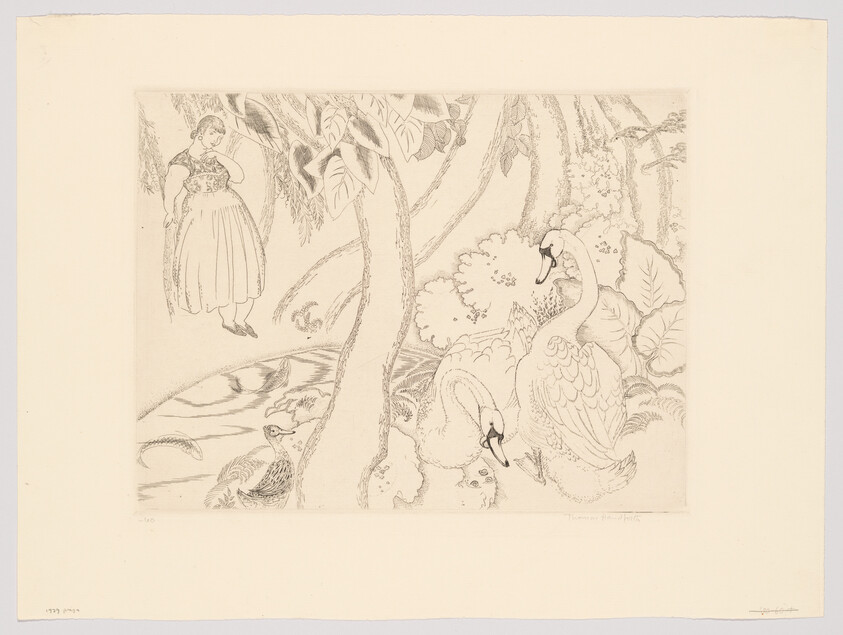
Leda (Whitney impression)
c. 1929
Etching

Rodeo
1930
Etching on off-white laid paper
Easter Greetings
n.d.
Etching and drypoint on paper

Fleet Wilderness
n.d.
Etching on ivory laid paper
Untitled (Arab with Goats)
n.d.
Etching on paper
His Reeds
n.d.
Lithograph on paper
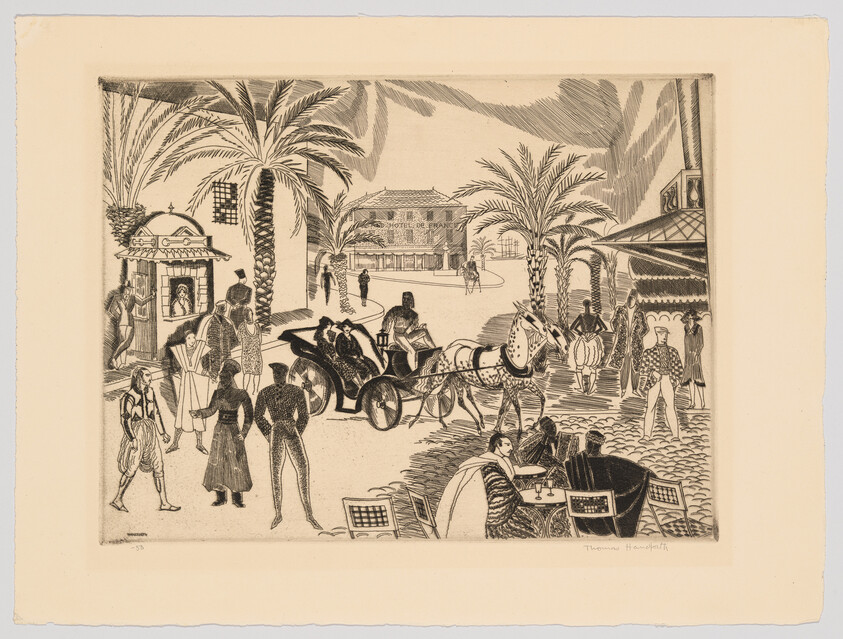
Sfax
n.d.
Etching
Sfax, Tunis
n.d.
Etching on paper
Chinese Man
n.d.
Etching on paper