
Journey, Shôwa period, dated June 1983
by Toko Shinoda
- Source:
- ukiyo-e.org
Description
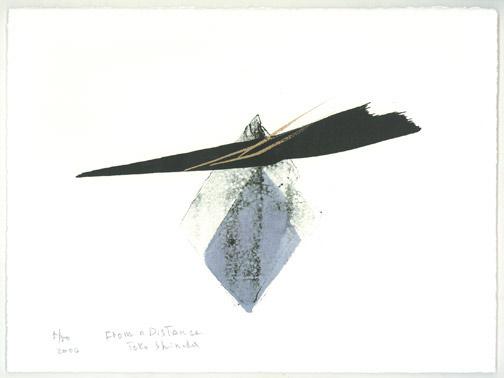
Journey, dated June 1983, is a Shôwa-period work by Toko Shinoda held in the collection of the Harvard Art Museums and documented through ukiyo-e.org. Created during a particularly mature phase of Shinoda's career, the print exemplifies her singular fusion of contemporary sumi-e and woodblock sensibilities with the gestural vocabulary of mid-twentieth-century abstraction. Shinoda was trained from early childhood in classical calligraphy, and that lineage remains audible in every stroke she committed to paper, even as she pulled the medium decisively into a contemporary register. Journey distills that tension between rooted tradition and forward motion into a composition whose title gestures toward passage, transit, or interior movement rather than any depicted landscape. The sheet relies on the resonance of black sumi ink against the reserved field of the paper, with the asymmetric placement of marks creating a sense of arrested momentum. Each gesture carries the weight of a single, unrepeated breath of the brush, the kind of mark that Shinoda described as the result of decades of preparation for a single decisive moment. As a 1983 work, Journey sits within the period in which Shinoda was internationally recognized as one of the leading living artists working in ink, with exhibitions on three continents and acquisitions by major museums. The piece reflects her insistence that abstract calligraphic expression could speak across cultures without renouncing its grounding in East Asian materials and discipline. Viewed within the Harvard collection alongside other postwar Japanese works, Journey illustrates how Toko Shinoda enlarged the field of modern Japanese printmaking by treating the printed sheet as a continuation, not a translation, of the calligrapher's gesture.
More Prints by Toko Shinoda
![Title unknown [Abstract image with lines] by Toko Shinoda](https://1.api.artsmia.org/800/135627.jpg)


Featured in Collections
Curated cross-cuts that include this print.
Frequently Asked Questions
Journey, Shôwa period, dated June 1983 was created by Toko Shinoda (篠田桃紅).