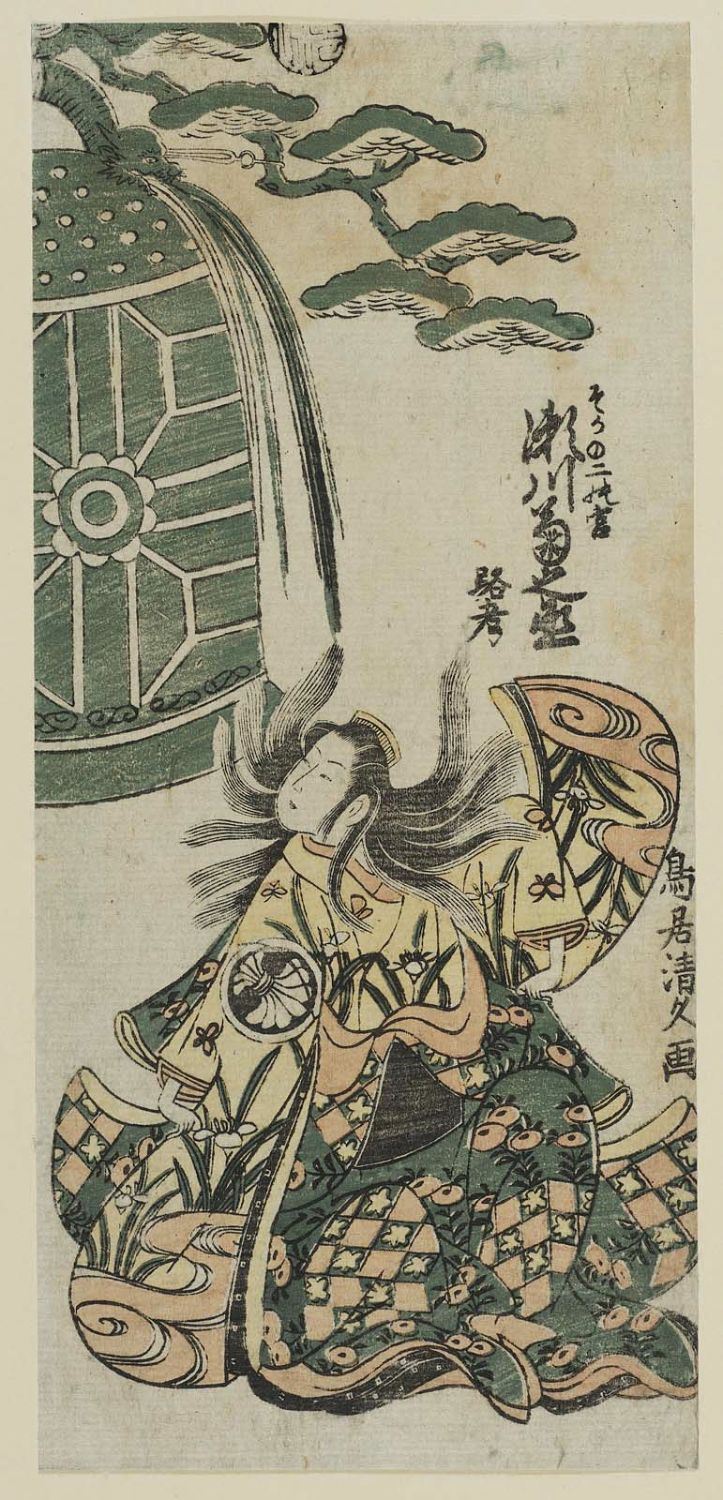
Actor Segawa Kikunojō II as Soga no Ninomiya
- Date:
- 1764
- Medium:
- Woodblock print; ink and color on paper
- Source:
- Museum of Fine Arts, Boston
Description
Torii Kiyohisa portrays Segawa Kikunojō II - the leading onnagata (female-role specialist) of Edo kabuki in the 1750s and 1760s and the actor most frequently documented across surviving Torii-school yakusha-e of the period - in the role of Soga no Ninomiya. The Soga vengeance cycle - the legendary fourteenth-century story of the Soga brothers Jūrō and Gorō avenging their father's murder - was the most-staged dramatic framework of Edo kabuki, restaged in dozens of variant adaptations each season and supplying the Torii workshop with a near-continuous flow of publicity commissions across the eighteenth century. Soga no Ninomiya is one of the female roles that recurs across these adaptations, the elder sister of Soga no Gorō and a stock onnagata part that allowed the leading female-role specialists of each generation to display their controlled stillness, the precise carriage of the long courtly kimono, and the delicate carriage of the head and shoulders that marked the onnagata's distinctive theatrical persona. Segawa Kikunojō II had taken over from his father Segawa Kikunojō I as the leading onnagata of the Ichimura-za and Nakamura-za around 1751, and his career through the 1750s and 1760s coincides almost exactly with Kiyohisa's brief documented activity as a Torii-school pupil. The print is held by the Museum of Fine Arts, Boston, whose Japanese print collection is the largest outside Japan, and dates to 1764 - the very year in which Suzuki Harunobu and his Edo collaborators introduced the registered eight- or ten-colour nishiki-e technique that would transform the visual range of Japanese woodblock prints. As one of the only signed prints by Kiyohisa preserved in any open-access museum collection, the sheet stands as a representative example of the second-rank Torii-school yakusha-e production that filled out the Edo kabuki publicity market in the years immediately preceding the brocade-print revolution.
Frequently Asked Questions
Actor Segawa Kikunojō II as Soga no Ninomiya was created by Torii Kiyohisa (鳥居清久) in 1764.