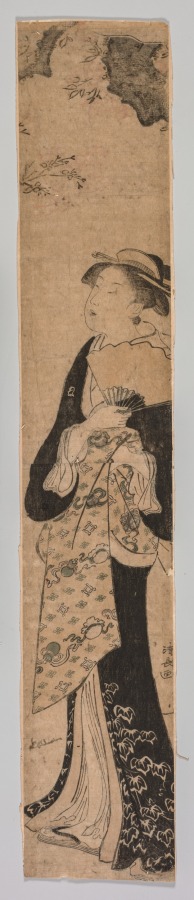
A Beauty in Spring
- Date:
- 1752–1815
- Medium:
- color woodblock print
- Source:
- Cleveland Museum of Art
Description
A Beauty in Spring, in the Cleveland Museum of Art's Japanese print collection with a recorded date of 1752, is a single-figure Torii Kiyonaga design that distils the artist's mature Edo bijin-ga manner into a portrait of a young woman standing in a quiet spring setting. (The 1752 date in the museum record falls before Kiyonaga's birth and almost certainly refers to a series date traditionally assigned to the model rather than to the year of the print's manufacture; the style is consistent with Kiyonaga's 1780s production.) The figure occupies most of the sheet, her kimono falling in long vertical folds and her head set small above broad shoulders, in the canonical proportions Kiyonaga established for the genre. A spring motif—plum or cherry, a budding branch, a seasonal pattern in the textile—anchors the scene without crowding it, allowing the woman's bearing rather than her surroundings to carry the meaning. As a Torii school designer, Kiyonaga inherited a strong, controlled line, and the work shows how that linear discipline could be turned from kabuki signboards to the celebration of urban femininity. The Cleveland Museum of Art records the print as part of its Edo period holdings and treats it as a representative example of the artist's contribution to bijin-ga. For collectors, A Beauty in Spring is the kind of standing-figure design that defined Kiyonaga's brand in the 1780s and that later commentators credited with paving the way for the more psychologically intense portraits of Utamaro, who took up many of Kiyonaga's compositional habits.
More Prints by Torii Kiyonaga

Watching the Water Festival from Azuma Bridge, from the series "Eight Precincts of the Kinryuzan Temple in Asakusa (Asakusa Kinruzan hakkei)"
c. 1782
Color woodblock print; chuban

Courtesans of Yoshiwara and their attendants viewing the peonies on Nakanocho
c. 1787
Color woodblock print; center and right sheets of oban triptych

A visit to a shrine, from the series "Twelve Scenes of Popular Customs (Fuzoku juni tsui)"
c. 1786
Color woodblock print; koban

A Party Viewing the Moon Across the Sumida River
c. 1787
Color woodblock print; oban triptych
More Spring Prints

Frequently Asked Questions
A Beauty in Spring was created by Torii Kiyonaga (鳥居清長) in 1752–1815.
A Beauty in Spring depicts spring.