
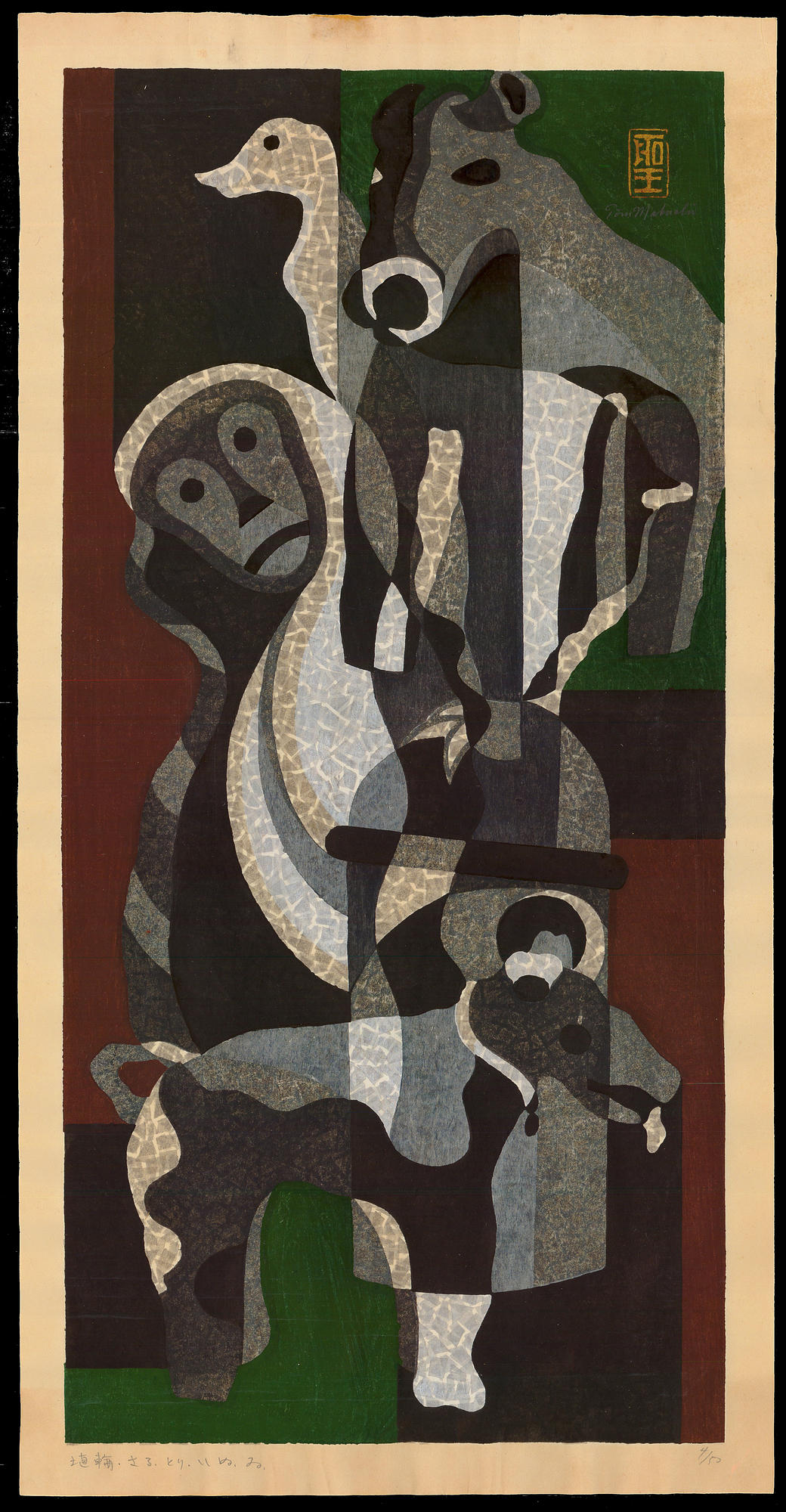
Budo to uri (Grapes and Melons)
by Toru Mabuchi
- Source:
- ukiyo-e.org
Description
Budo to uri (Grapes and Melons) is a Japanese woodblock print by Toru Mabuchi that gathers two summer fruits into a single quiet still life. Mabuchi worked within the sosaku-hanga (creative print) movement, the twentieth-century reform of Japanese printmaking in which the artist personally designs, carves, and prints each work, and that hands-on approach is visible across his still life output. Here the grapes appear as a compact mass of rounded forms, their volume suggested by close-valued tones and the slight variations the woodblock medium produces between pulls, while the melons rest as broader, simpler shapes that anchor the composition. The contrast between the small repeating units of the grapes and the larger, smoother bodies of the melons is the kind of formal pairing sosaku-hanga artists liked to explore: ordinary kitchen subjects pushed toward an almost abstract play of shape, weight, and texture. The Japanese woodblock surface gives the fruit a matte, slightly grainy presence, with the carved outlines reading as drawn rather than mechanical. This impression is documented through ukiyo-e.org by way of a British Museum reference image (AN00226327_001_l), which preserves a museum-quality record of the print and situates Mabuchi within the institutional collecting of postwar Japanese prints. For collectors and researchers studying Toru Mabuchi, Budo to uri is a representative example of how he treated produce and other domestic subjects as serious material for a Japanese woodblock practice that valued considered design over decorative display.
More Prints by Toru Mabuchi


Featured in Collections
Curated cross-cuts that include this print.
Frequently Asked Questions
Budo to uri (Grapes and Melons) was created by Toru Mabuchi (馬渕徹).