
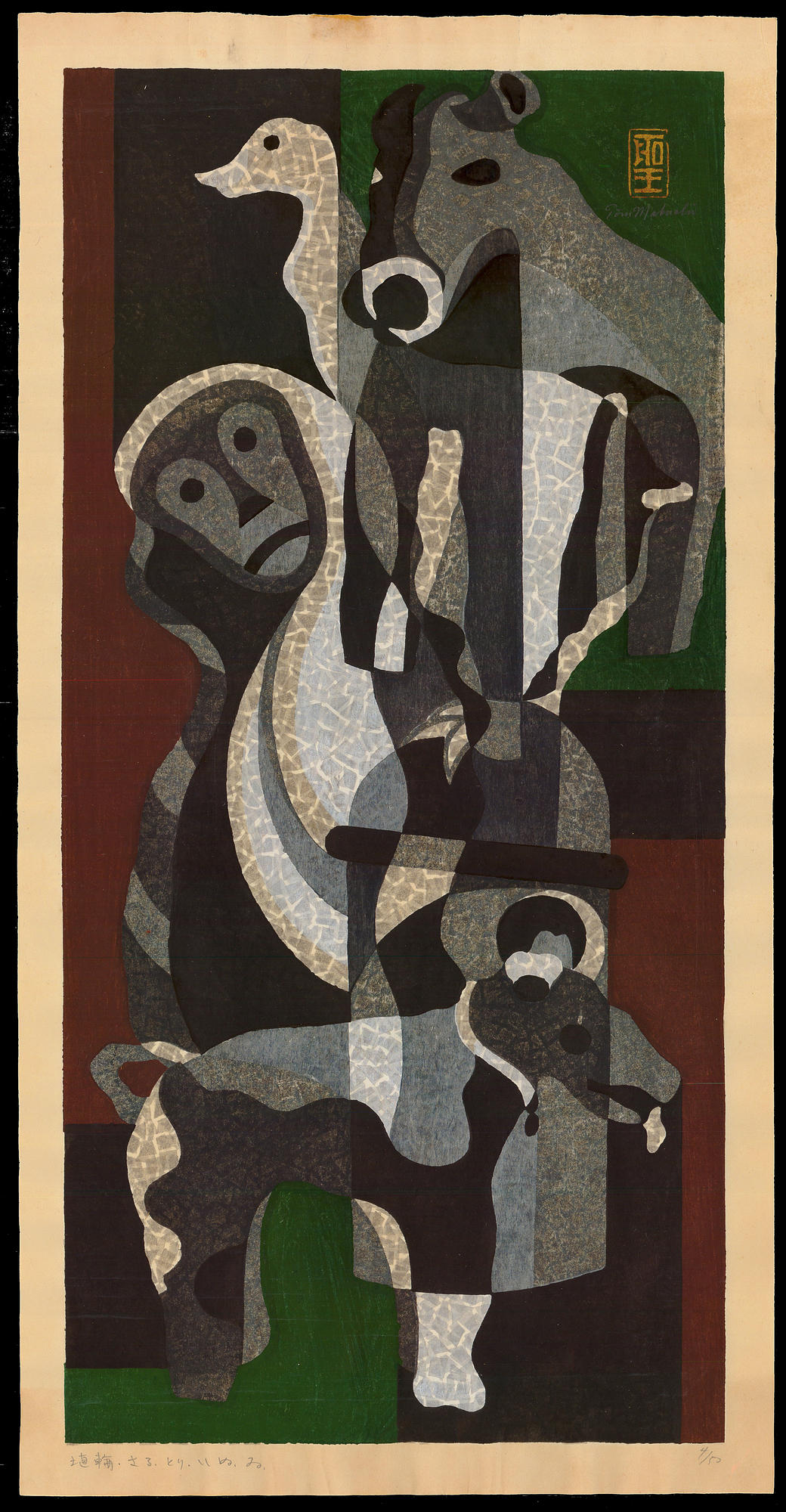
Haniwa (koban size)
by Toru Mabuchi
- Source:
- ukiyo-e.org
Description
Haniwa (koban size) is a small-format Japanese woodblock print by Toru Mabuchi that draws on one of his most personal subjects: the haniwa, the unglazed terracotta tomb figures of the Kofun period (roughly 3rd-6th century CE). The 'koban size' designation refers to a compact, oblong print format borrowed from Edo-period print conventions; Mabuchi adapts it here to a sosaku-hanga (creative print) context, where the artist personally designs, carves, and prints each block. The haniwa appears as a frontal, simplified figure, its archaic geometry of head, eyes, and body reduced to the essential shapes a woodblock can carry comfortably. The Japanese woodblock surface emphasizes the dry, earthy quality of the original terracotta, with carved outlines and softly inked planes standing in for the matte clay body. Mabuchi returned to haniwa repeatedly across his career, and the recurring subject became a way for him to anchor a thoroughly modern print practice in something deeply Japanese and pre-Buddhist. In a koban-sized impression like this one, the figure feels both monumental and intimate: small enough to handle, but composed with the steady centered gravity of a much larger work. The print is documented through ukiyo-e.org via a Japanese Art Open Database (JAODB) listing (00042257). For collectors interested in how postwar sosaku-hanga artists engaged with Japan's ancient material culture, Haniwa (koban size) is a concise, well-formed example of Mabuchi's approach.
More Prints by Toru Mabuchi


Featured in Collections
Curated cross-cuts that include this print.
Frequently Asked Questions
Haniwa (koban size) was created by Toru Mabuchi (馬渕徹).