
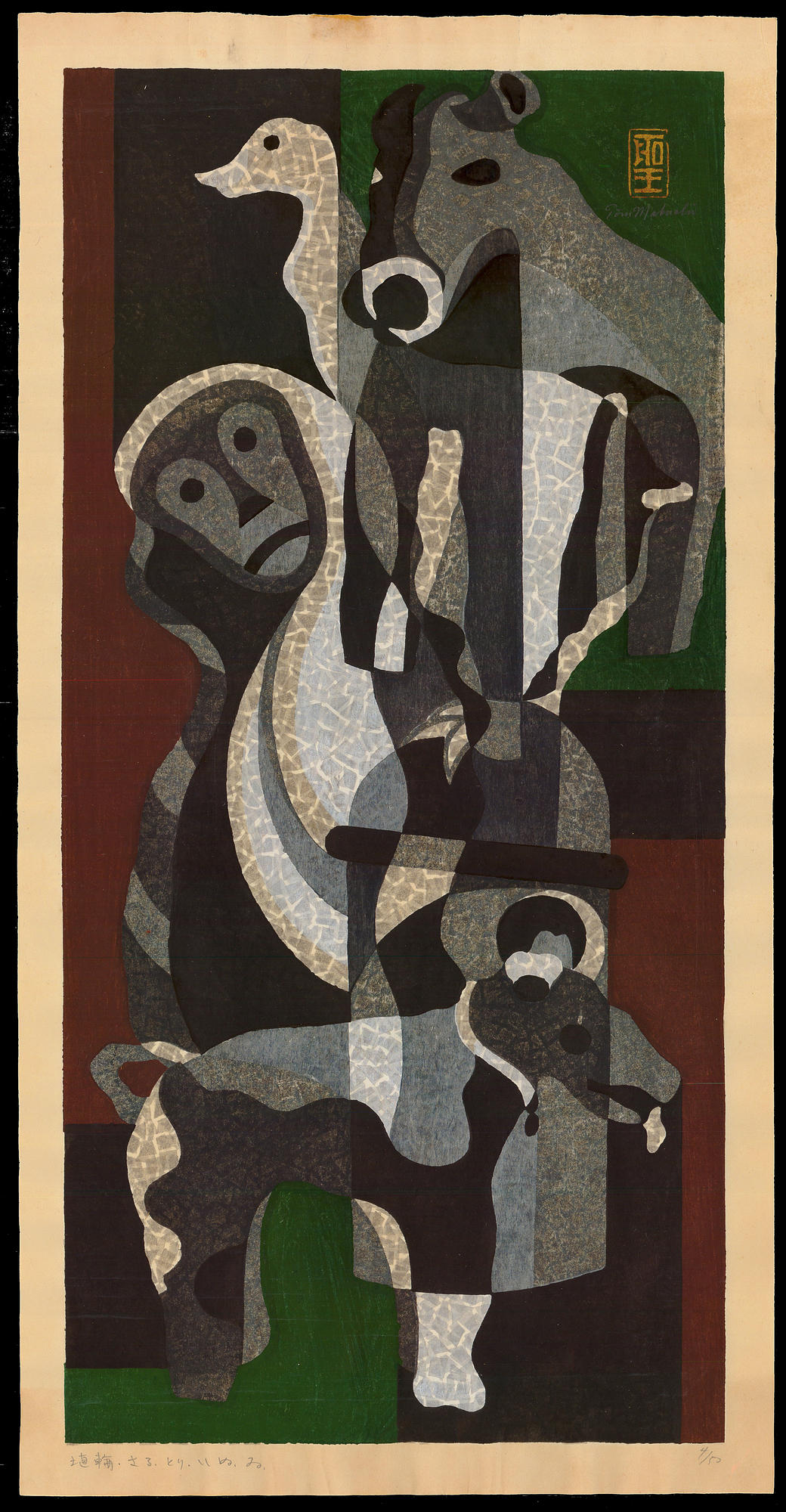
Persimmons, Shôwa period, dated 1962
by Toru Mabuchi
- Source:
- ukiyo-e.org
Description
Persimmons, dated 1962 in the Showa period, is a Japanese woodblock print by Toru Mabuchi held in the collection of the Harvard Art Museums (HUAM-CARP01037) and documented through ukiyo-e.org. The 1962 date places the work in Mabuchi's mature postwar period, when the sosaku-hanga (creative print) movement was operating at full strength and Japanese artists were finding sustained international audiences for woodblock work that broke with older ukiyo-e workshop conventions. The subject of persimmons returns repeatedly in Mabuchi's still life output, and this museum-held impression shows why he kept coming back to it: the fruit's round, geometrically stable form and its saturated orange-red color give the Japanese woodblock medium clean shapes to carve and a strong chromatic anchor to print against quieter surrounding tones. Mabuchi's treatment here is consistent with his broader practice, with carved outlines kept simple, hand inking allowed to register slight surface variation, and the spacing around the fruit handled as active compositional material rather than empty background. As a sosaku-hanga artist he designed, carved, and printed the work himself, which is part of what gives this Persimmons its tight internal unity. The Harvard provenance and a firm 1962 date provide a stable documentary anchor for researchers tracing the chronology of Mabuchi's still lifes. For collectors of Showa-era Japanese woodblock prints and of Toru Mabuchi in particular, this is a well-provenanced example of one of his signature subjects.
More Prints by Toru Mabuchi


Featured in Collections
Curated cross-cuts that include this print.
Frequently Asked Questions
Persimmons, Shôwa period, dated 1962 was created by Toru Mabuchi (馬渕徹).