
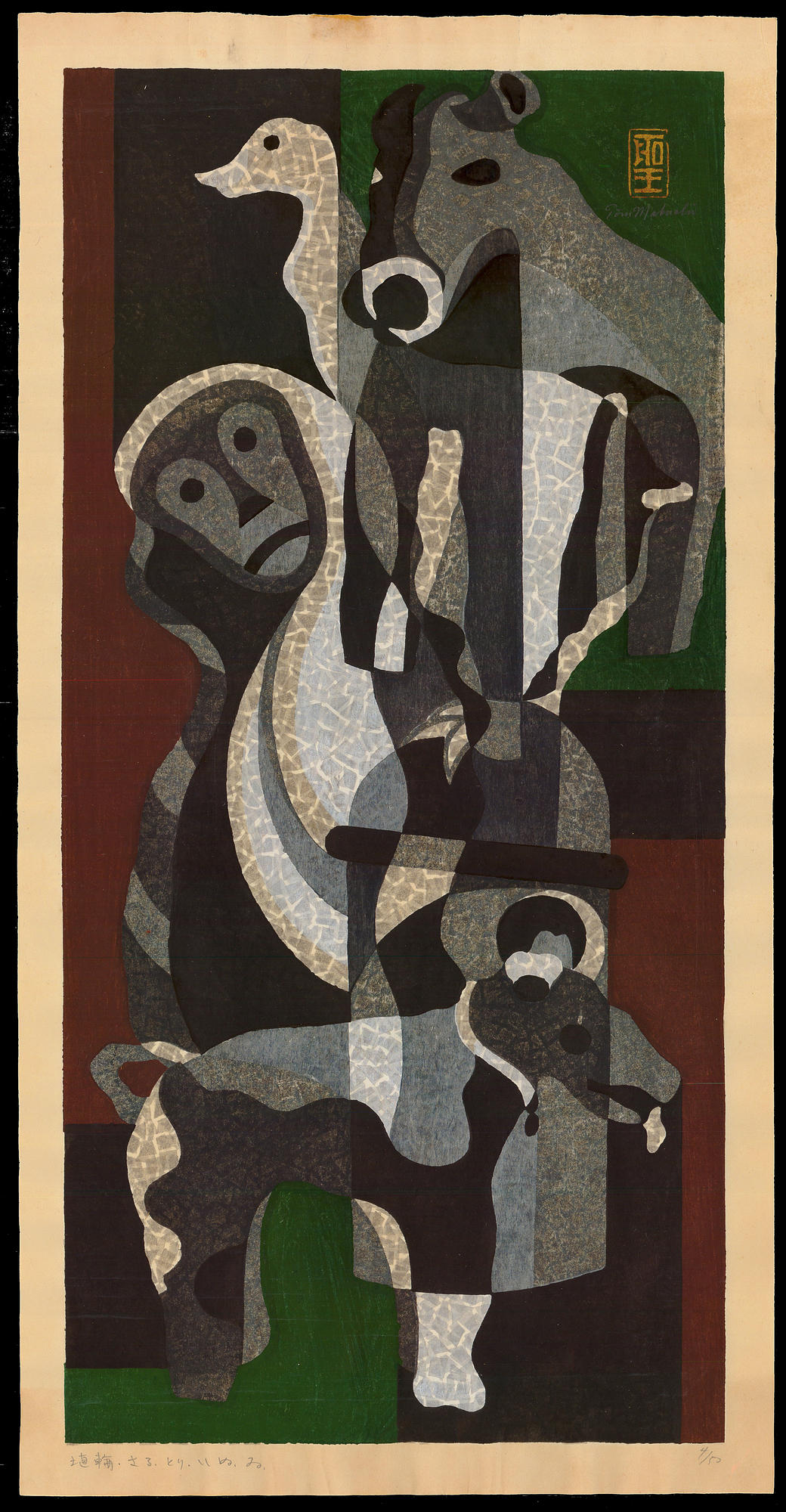
Pottery and Haniwa Figure
by Toru Mabuchi
- Source:
- ukiyo-e.org
Description
Pottery and Haniwa Figure is a Japanese woodblock print by Toru Mabuchi in the collection of the Art Gallery of Greater Victoria, indexed through ukiyo-e.org. The composition brings together pottery and a haniwa figure, the latter referring to the terracotta tomb sculptures of Japan's Kofun period, produced between roughly the third and sixth centuries. By placing a haniwa alongside a pottery vessel, Mabuchi connects two distinct registers of Japanese ceramic culture, one rooted in ancient burial practice and the other in everyday or decorative use. This kind of pairing was attractive to mid-twentieth-century Japanese artists who looked to pre-Buddhist forms as a source of native modernist vocabulary, and Mabuchi's still-life prints frequently incorporate ancient objects of this kind. As a sosaku-hanga artist, Mabuchi designed, carved, and printed the blocks himself, and Pottery and Haniwa Figure makes use of the creative-print technique to render simplified silhouettes, textured surfaces, and carefully placed color planes. The Art Gallery of Greater Victoria holds an important collection of Japanese prints, including sosaku-hanga works that document the international circulation of mid-twentieth-century Japanese printmaking, and Mabuchi's print is preserved within that holding. Its accessibility through ukiyo-e.org allows the work to be studied alongside Mabuchi's other haniwa-related compositions and within the broader Japanese woodblock tradition's engagement with antiquity.
More Prints by Toru Mabuchi


Featured in Collections
Curated cross-cuts that include this print.
Frequently Asked Questions
Pottery and Haniwa Figure was created by Toru Mabuchi (馬渕徹).