
Two Haniwa
by Toru Mabuchi
- Source:
- ukiyo-e.org
Description
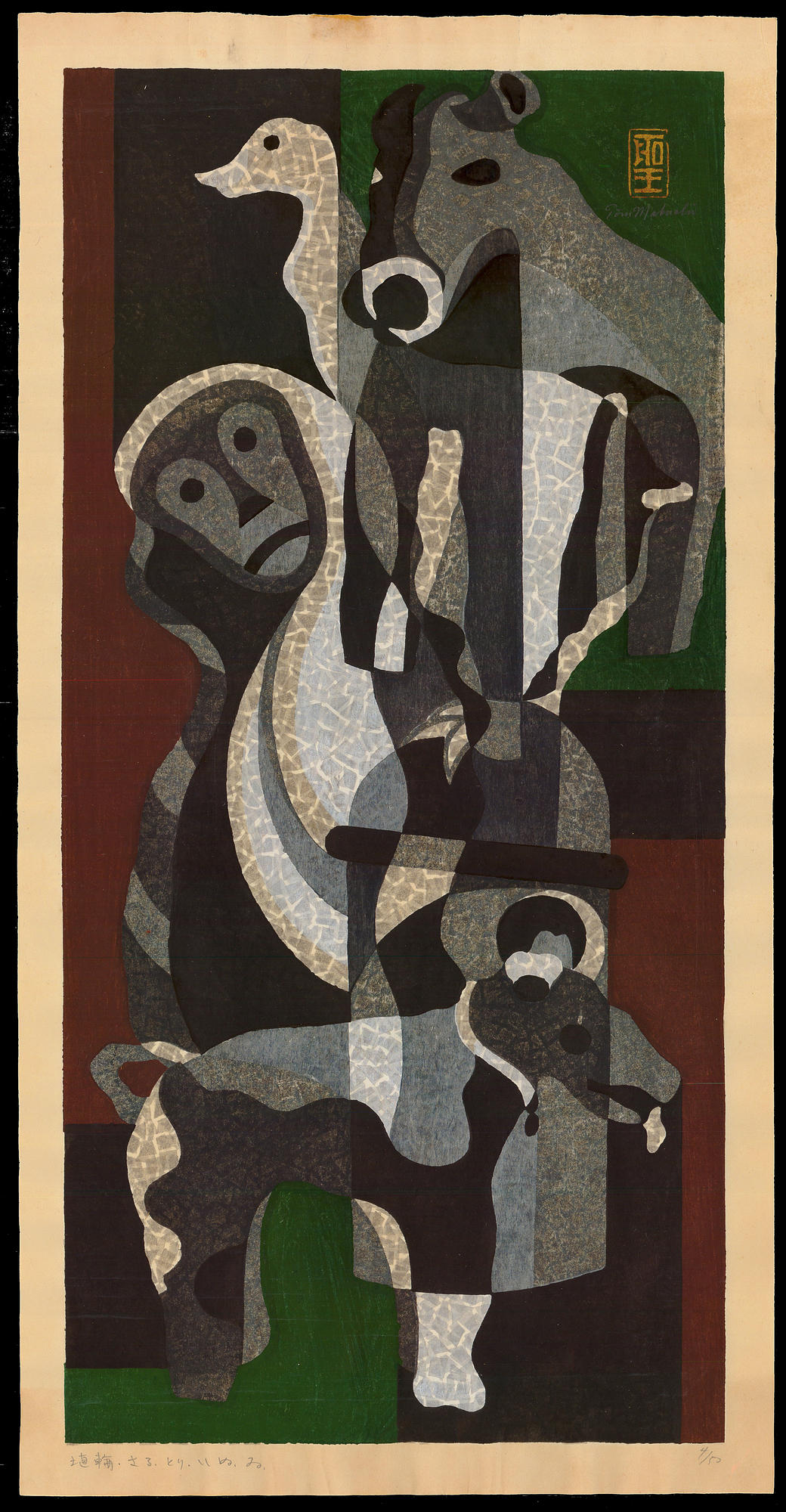
Two Haniwa is a Japanese woodblock print by Toru Mabuchi in the collection of the Honolulu Museum of Art, indexed through ukiyo-e.org. The subject is a pair of haniwa, the terracotta tomb figures produced in Japan during the Kofun period, between roughly the third and sixth centuries, to surround burial mounds. Haniwa take many forms, including human figures, animals, houses, and abstract cylinders, and their stripped, simplified shapes have appealed to modern Japanese artists seeking a native sculptural vocabulary that resonates with contemporary design. Mabuchi was among the sosaku-hanga artists drawn to haniwa as a recurring motif, returning to these ancient figures in several still-life and emblematic compositions. As a creative-print artist, Mabuchi designed, carved, and printed the blocks himself, treating the haniwa subjects with an emphasis on silhouette, surface texture, and balanced placement within the picture plane. Two Haniwa pairs its figures to invite comparison of pose and form, a strategy that recalls both classical East Asian compositional pairings and modernist design exercises. The Honolulu Museum of Art holds an important collection of Japanese prints, including sosaku-hanga works that arrived through donations and curatorial acquisitions in the postwar period, and Two Haniwa is preserved within that broader holding. Its accessibility through ukiyo-e.org allows researchers and collectors to study Mabuchi's haniwa subjects alongside his still lifes and landscapes within the Japanese woodblock tradition.
More Prints by Toru Mabuchi


Featured in Collections
Curated cross-cuts that include this print.
Frequently Asked Questions
Two Haniwa was created by Toru Mabuchi (馬渕徹).