
Court lady sitting beside hanging incense burner
- Date:
- 1820s
- Medium:
- Color woodblock print; shikishiban, surimono
- Source:
- Art Institute of Chicago
Description
In this surimono by Totoya Hokkei, dated 1820 in the Art Institute of Chicago's catalogue, a court lady is shown beside a hanging incense burner, a refined evocation of Heian aristocratic culture as remembered in Edo's literary imagination. Such themes were favored in the Edo kyoka-e circles that supported the surimono market, where commissioning poets and connoisseurs prized images that gave their kyoka verses a classical setting. Hokkei, trained in the Hokusai school as one of Katsushika Hokusai's most prolific pupils, brought to these designs a precise, slightly archaizing figural style suited to the small shikishiban format. The hanging incense burner (tsuri-koro) is itself a marker of courtly taste, often associated with the world of Genji-monogatari and other classical sources, and its inclusion frames the woman as a participant in an idealized past. Surimono were privately printed in small editions on thick paper, with embossing, mica and metallic pigments often deployed sparingly but tellingly on objects such as lacquerware and silken garments. As a Hokusai-school surimono designer working at the height of the Edo kyoka-e movement, Hokkei here demonstrates how a single seated figure, with its sumptuous attire and refined accessories, could carry the literary atmosphere required of poetry-club commissions, anchoring the verses while delighting the eye.
More Prints by Totoya Hokkei

Potted Plant (Ueki), from the series "Eighteen Illustrations of the Ladder of Ancient Words (Kogentei juhachiban tsuzuki)"
1831
Color woodblock print; shikishiban, surimono
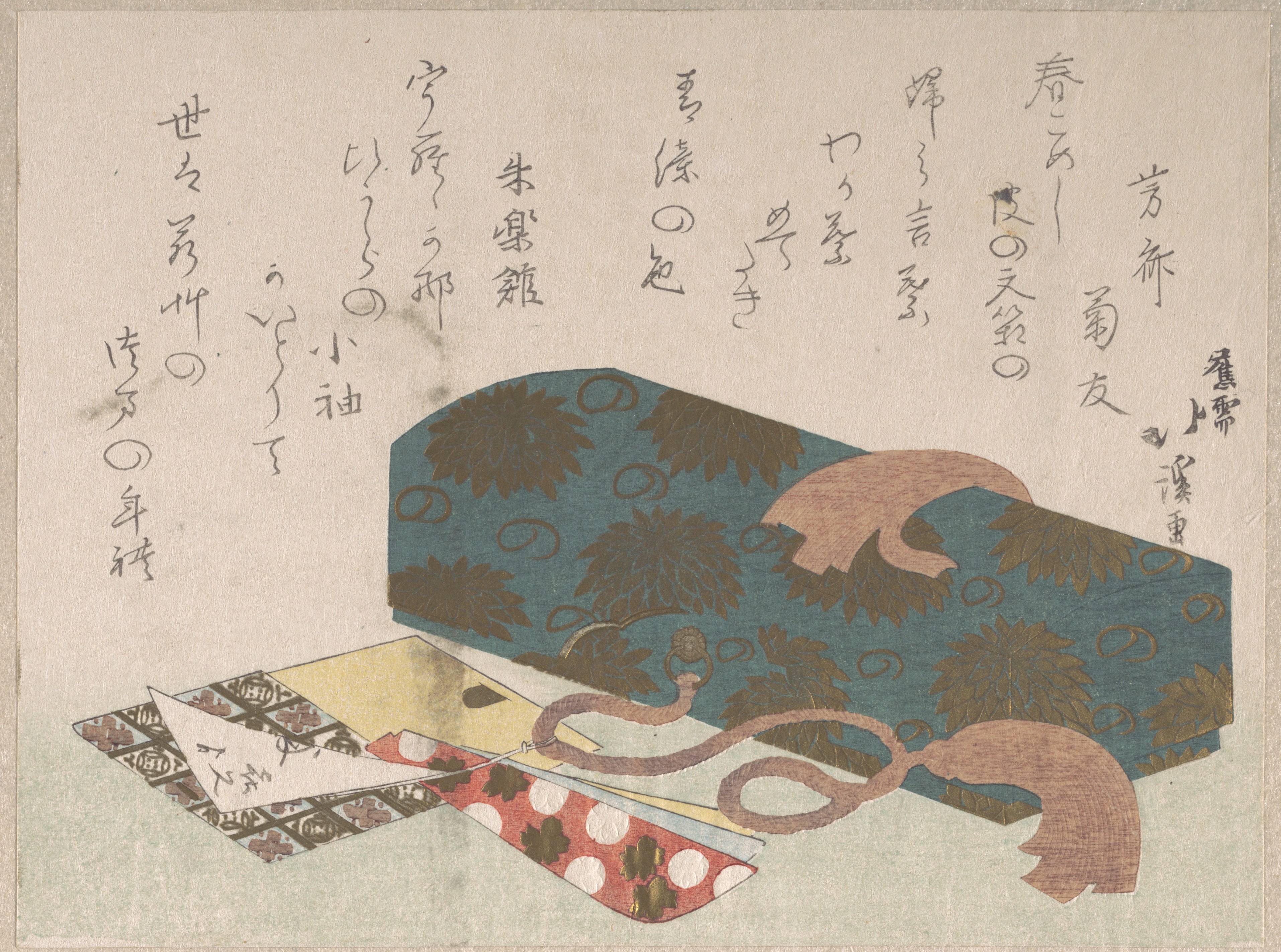
Letter-box and Toothpick Holders
19th century
Part of an album of woodblock prints (surimono); ink and color on paper

Illustration of a Chinese poem, from the series "Picture Book of Chinese Poems (Toshi gafu no uchi)"
c. 1830/44
Color woodblock print; chuban

Kyōka Verse Anthology of Elegant Friends (Kyōka gayū shū) 狂歌雅友集
1826 (Bunsei 9)
Woodblock printed book; ink and color on paper
Frequently Asked Questions
Court lady sitting beside hanging incense burner was created by Totoya Hokkei (魚屋北渓) in 1820s.