
Courtesan and Pekingese Dog at New Year
- Date:
- early 19th century
- Medium:
- Color woodblock print; surimono
- Source:
- Art Institute of Chicago
Description
This Art Institute of Chicago surimono depicts a Yoshiwara courtesan with a Pekingese dog at New Year, combining two emblems of refined urban leisure - the courtesan herself and the imported lapdog that was a favorite accessory of high-ranking pleasure-quarter beauties. The New Year setting locates the print in the most prestigious surimono commissioning season, when kyoka poetry circles exchanged elaborate prints to mark the year's beginning. Hokkei renders the courtesan with the slender elegance characteristic of his bijin-ga style - elongated proportions, finely drawn features, attention to the patterning and color of her elaborate New Year robes. The dog provides a tactile, animated counterweight to the courtesan's stately composure. Inscribed kyoka verses would have engaged the scene's specific resonances - perhaps the Yoshiwara's New Year customs, the exotic association of Pekingese with imported luxury, or classical poetic conventions about beauty and refinement. The Art Institute's impression preserves the refined printing and saturated coloration characteristic of Hokkei's privately commissioned New Year surimono, the highest tier of his prolific surimono output.
More Prints by Totoya Hokkei

Potted Plant (Ueki), from the series "Eighteen Illustrations of the Ladder of Ancient Words (Kogentei juhachiban tsuzuki)"
1831
Color woodblock print; shikishiban, surimono
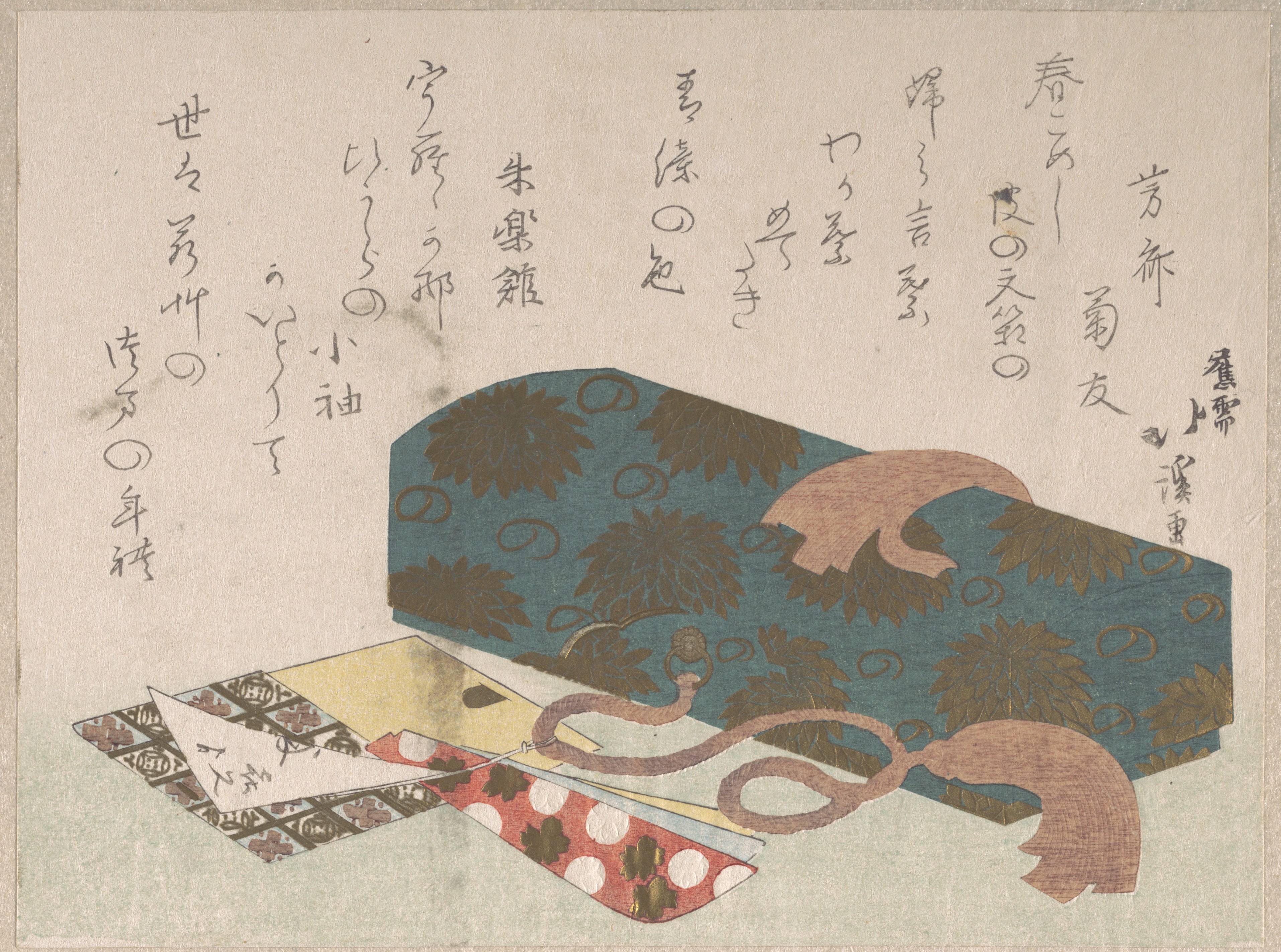
Letter-box and Toothpick Holders
19th century
Part of an album of woodblock prints (surimono); ink and color on paper

Illustration of a Chinese poem, from the series "Picture Book of Chinese Poems (Toshi gafu no uchi)"
c. 1830/44
Color woodblock print; chuban

Kyōka Verse Anthology of Elegant Friends (Kyōka gayū shū) 狂歌雅友集
1826 (Bunsei 9)
Woodblock printed book; ink and color on paper
Frequently Asked Questions
Courtesan and Pekingese Dog at New Year was created by Totoya Hokkei (魚屋北渓) in early 19th century.