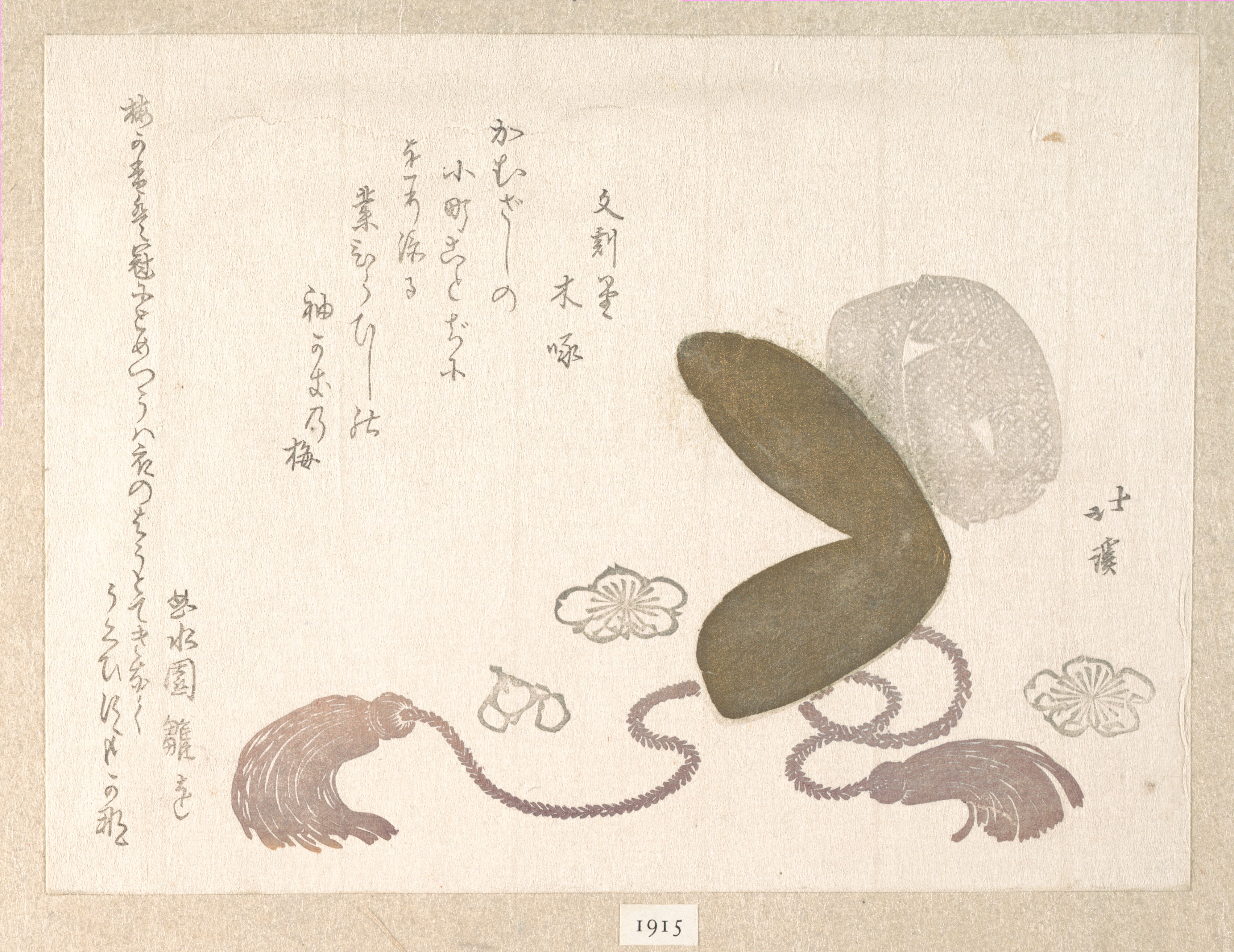
Eboshi (a court hat)
- Medium:
- Woodblock print (surimono); ink and color on paper
- Source:
- Metropolitan Museum of Art
Description
Totoya Hokkei's Eboshi (a court hat) is a finely conceived surimono that distills a single ceremonial object into an emblem of classical refinement. The eboshi, a tall lacquered cap of black or dark gauze, signaled aristocratic and warrior identity from the Heian period onward and remained a potent visual symbol in Edo culture, evoking Noh drama, court ritual, and the long lineage of Japanese poetic tradition. By isolating the hat against an open ground, Hokkei concentrates attention on its silhouette, the precise curvature of its peak, the subtle fabric texture, and the discreet ties that secured it on the wearer's head. Working within the Hokusai school as one of Katsushika Hokusai's senior pupils, Hokkei excelled at this kind of object-centered surimono, in which an everyday or ceremonial article becomes the visual occasion for a kyoka poem composed by a club member. The accompanying verse on such prints typically plays upon the object's associations, layering puns, classical allusions, and contemporary observation into a brief literary performance. The surimono format permitted refined printing techniques, including blind embossing (karazuri) to register the lacquer-like surface of the eboshi, gradient bokashi shading, and possibly metallic pigments. Held by the Metropolitan Museum of Art, Eboshi exemplifies the still-life mode that Totoya Hokkei developed with quiet authority. The composition recalls the broader interest among Hokusai school artists in objects of ceremonial significance, while keeping the visual language intimate and contemplative. For collectors and scholars, prints like this demonstrate how Hokkei built lyrical meaning out of minimal means, transforming a single article of courtly dress into a complete poetic and visual statement on a single sheet.
More Prints by Totoya Hokkei

Potted Plant (Ueki), from the series "Eighteen Illustrations of the Ladder of Ancient Words (Kogentei juhachiban tsuzuki)"
1831
Color woodblock print; shikishiban, surimono
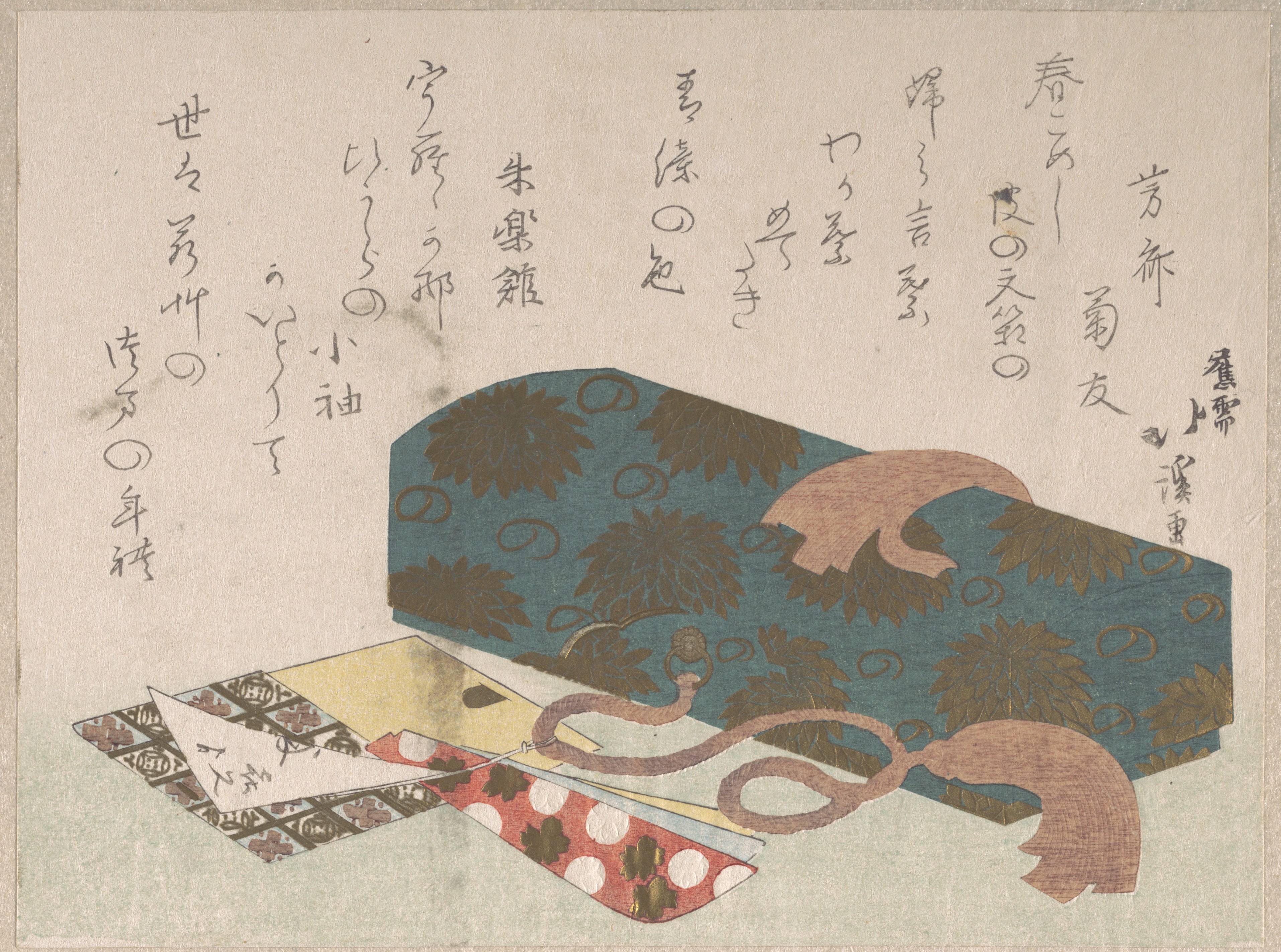
Letter-box and Toothpick Holders
19th century
Part of an album of woodblock prints (surimono); ink and color on paper

Illustration of a Chinese poem, from the series "Picture Book of Chinese Poems (Toshi gafu no uchi)"
c. 1830/44
Color woodblock print; chuban

Kyōka Verse Anthology of Elegant Friends (Kyōka gayū shū) 狂歌雅友集
1826 (Bunsei 9)
Woodblock printed book; ink and color on paper
Frequently Asked Questions
Eboshi (a court hat) was created by Totoya Hokkei (魚屋北渓).