
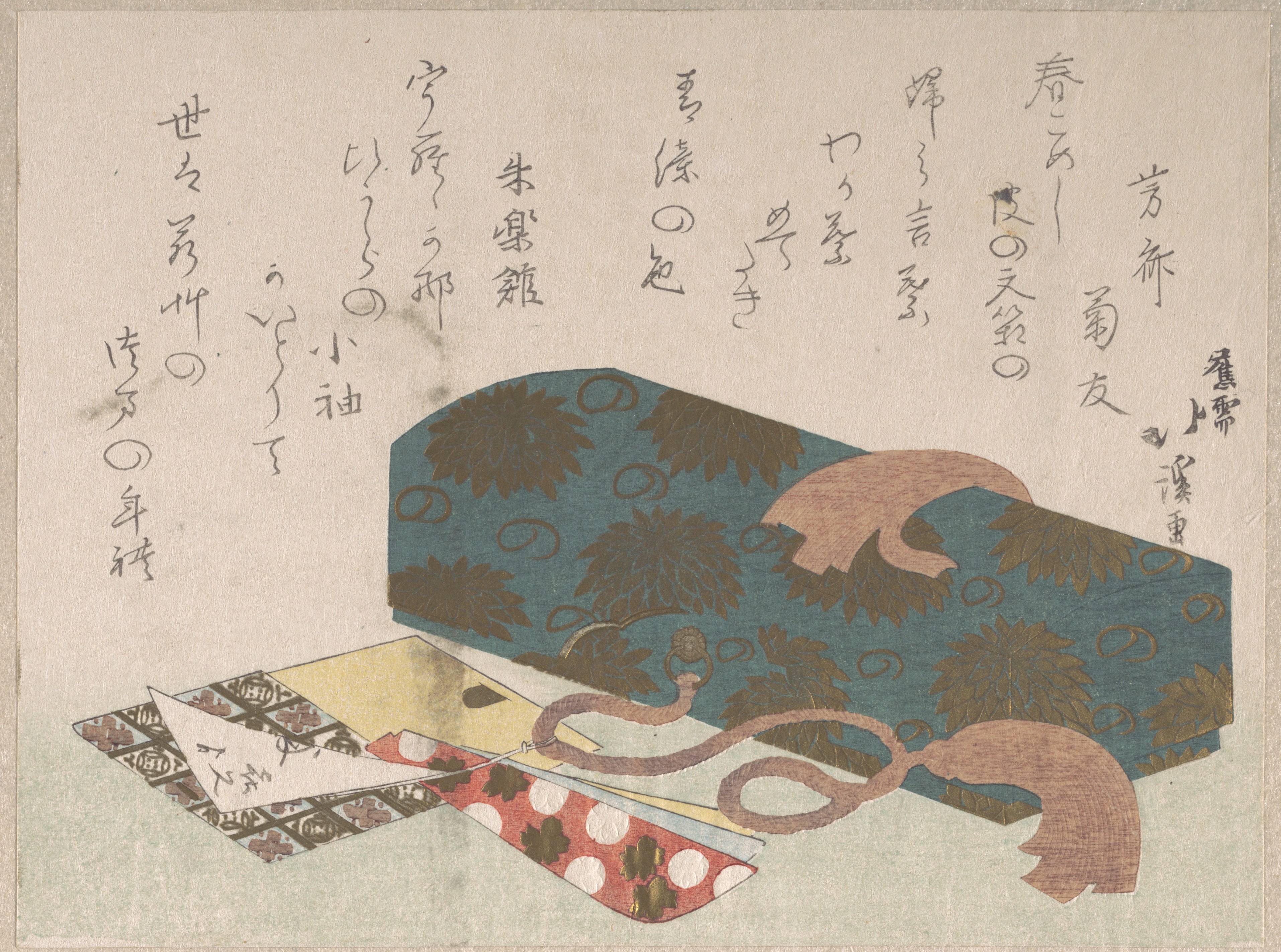
Fan-Box with Fans
- Date:
- 19th century
- Medium:
- Woodblock print (surimono); ink and color on paper
- Source:
- Metropolitan Museum of Art
Description
Fan-Box with Fans is a still-life surimono by Totoya Hokkei, a designer of privately commissioned prints in early nineteenth-century Edo and one of the most prominent pupils of Katsushika Hokusai. The image presents a lacquered fan box from which several folding fans extend in different states of opening, their painted leaves visible at varying angles. Hokkei treats the assembly as a careful exercise in geometry, arranging the wedge-shaped fan profiles around the rectangular box so that the eye moves between the closed neatness of the case and the spreading patterns of the open fans. Each fan carries a small picture, allowing Hokkei to display a sampler of decorative motifs: a sprig of plum, a wave pattern, a landscape fragment. The fan box itself is suggested with restrained line, its lacquer surface registered through the simple contrast of dark planes. Such compositions belong to the New Year gift-giving culture of Edo. Fans, both as practical objects and as supports for painting and poetry, were exchanged in the season, and a fan box loaded with finely decorated fans suggested abundance and cultivation. The sheet would have been commissioned by a kyoka poetry club for distribution with accompanying verses, printed in a small edition on hosho paper with metallic pigments and blind embossing. Hokkei's name was associated with refined still-lifes in the Hokusai school manner, and his fan compositions show his command of pattern design and his confident handling of overlapping forms. The print is held by the Metropolitan Museum of Art and exemplifies the elegant decorative idiom of the early nineteenth-century surimono.
More Prints by Totoya Hokkei

Potted Plant (Ueki), from the series "Eighteen Illustrations of the Ladder of Ancient Words (Kogentei juhachiban tsuzuki)"
1831
Color woodblock print; shikishiban, surimono
Letter-box and Toothpick Holders
19th century
Part of an album of woodblock prints (surimono); ink and color on paper

Illustration of a Chinese poem, from the series "Picture Book of Chinese Poems (Toshi gafu no uchi)"
c. 1830/44
Color woodblock print; chuban

Kyōka Verse Anthology of Elegant Friends (Kyōka gayū shū) 狂歌雅友集
1826 (Bunsei 9)
Woodblock printed book; ink and color on paper
Frequently Asked Questions
Fan-Box with Fans was created by Totoya Hokkei (魚屋北渓) in 19th century.