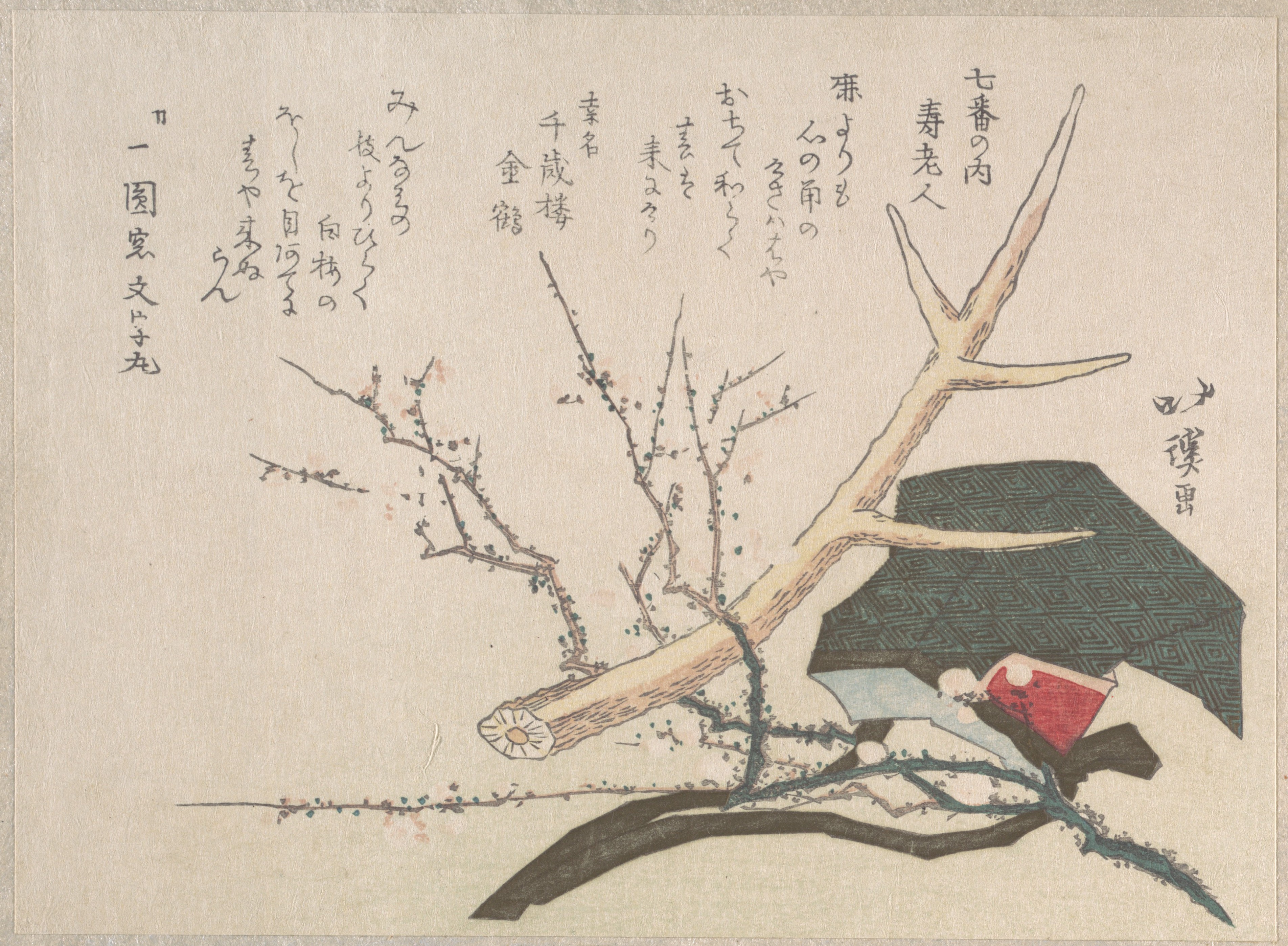
Hat, Deer-Horn and Plum Branch, Representing Jurōjin, the God of Life
- Date:
- 19th century
- Medium:
- Part of an album of woodblock prints (surimono); ink and color on paper
- Source:
- Metropolitan Museum of Art
Description
This compact still-life arrangement by Totoya Hokkei brings together three emblematic objects associated with Jurōjin, one of the Seven Gods of Good Fortune and a deity of longevity: a tall court-style hat, a curving deer antler, and a flowering plum branch. The composition is a model of surimono economy, in which a handful of carefully chosen attributes stand in for the deity himself rather than depicting him in figural form. Hokkei trained in the Hokusai school after an early apprenticeship with Kanō Yōsen'in, and that combination of orthodox painterly drawing and Hokusai's more inventive ukiyo-e sensibility is visible here in the steady contour of the antler and the controlled bend of the plum stem. Surimono of this kind were commissioned privately by kyōka poetry circles, printed in small editions on thick hosho paper with metallic pigments, embossing, and luxurious color. Their imagery was meant to be read like a rebus: the deer was the messenger of Jurōjin and a long-lived animal; plum was the first bloom of the year, signifying renewal; the hat alluded to the deity's traditional headgear. Together they form a New Year greeting in Edo kyoka-e form, where the printed image and an accompanying comic verse worked as a unified gift. Held at the Metropolitan Museum of Art, the sheet shows why Hokkei became one of the most sought-after designers of surimono in the 1810s and 1820s: he could distill a wealth of literary and seasonal reference into a quiet, balanced still life. Image courtesy of the Metropolitan Museum of Art.


