
Purse and mallet
- Date:
- n.d.
- Medium:
- Color woodblock print; shikishiban, surimono
- Source:
- Art Institute of Chicago
Description
This Art Institute of Chicago shikishiban surimono presents two of the most familiar attributes of Daikoku, one of the Seven Gods of Luck: a fat money purse swollen with cash and a wish-granting mallet. The choice to depict the attributes alone, without the god himself, exemplifies the wit characteristic of Hokkei's surimono designs - it is a mitate that asks the viewer to supply the absent deity, and through that act of completion to participate in the print's auspicious wish for prosperity. Such still-life surimono were ideally suited to New Year commissions, when poetry circles wanted images that would invoke good fortune for the year ahead. Hokkei renders the objects with meticulous detail - the texture of the purse's woven cord, the polished surface of the mallet's wooden handle - and arranges them in the shikishiban field with the kind of compositional economy that left ample space for the inscribed kyoka verses to take their place in the design. The Art Institute's impression preserves the refined printing and likely original metallic dusting that gave such surimono their celebrated luxury character. Daikoku's emblems made the print both decorative and talismanic, a New Year token of hoped-for prosperity exchanged among poetry-group members.
More Prints by Totoya Hokkei

Potted Plant (Ueki), from the series "Eighteen Illustrations of the Ladder of Ancient Words (Kogentei juhachiban tsuzuki)"
1831
Color woodblock print; shikishiban, surimono
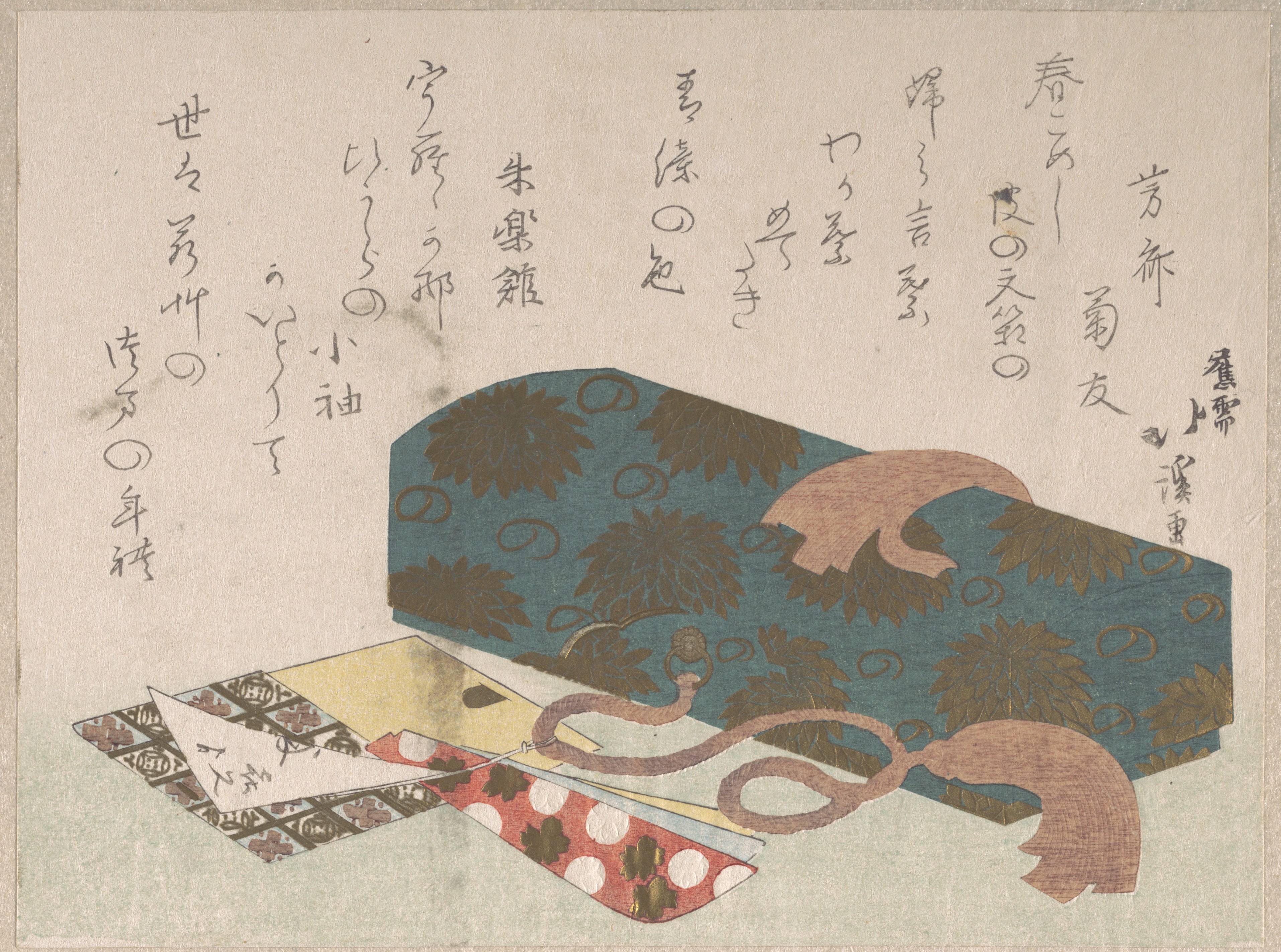
Letter-box and Toothpick Holders
19th century
Part of an album of woodblock prints (surimono); ink and color on paper

Illustration of a Chinese poem, from the series "Picture Book of Chinese Poems (Toshi gafu no uchi)"
c. 1830/44
Color woodblock print; chuban

Kyōka Verse Anthology of Elegant Friends (Kyōka gayū shū) 狂歌雅友集
1826 (Bunsei 9)
Woodblock printed book; ink and color on paper
Frequently Asked Questions
Purse and mallet was created by Totoya Hokkei (魚屋北渓) in n.d..