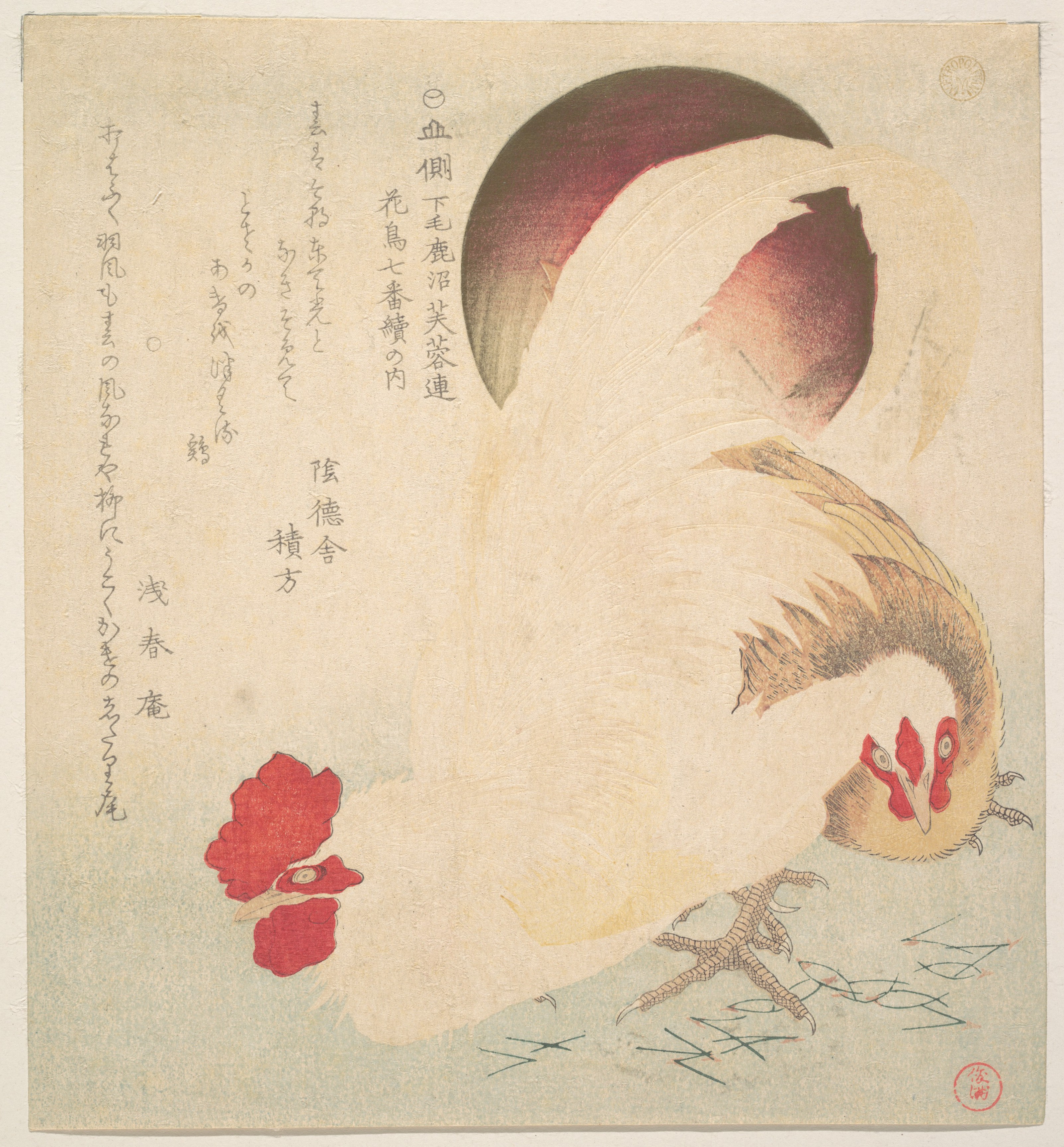
Rising Sun and a Cock and a Hen
- Date:
- ca. 1800
- Medium:
- Woodblock print (surimono); ink and color on paper
- Source:
- Metropolitan Museum of Art
Description
Rising Sun and a Cock and a Hen is a surimono by Totoya Hokkei, a designer of privately commissioned prints in early nineteenth-century Edo and one of the leading pupils of Katsushika Hokusai. The composition arranges a cock and hen on the ground beneath an early sun, the male bird standing alertly with raised tail while the hen lowers her head to peck. Behind them the sun rises as a pale disc washed in gradation. The motif of a cock and hen with a rising sun is among the most familiar New Year emblems in Japanese visual culture: the cock's morning crow inaugurates the day in the same way that the first sunrise inaugurates the year, while the paired birds suggest conjugal harmony and orderly household life. Hokkei treats the imagery with the formal restraint expected of such an auspicious subject, isolating the two birds and the sun against an empty field so that the symbolic meaning reads clearly. As a surimono the sheet would have accompanied kyoka verses and been distributed by a poetry circle in a small edition, printed on thick hosho paper with metallic pigments and blind embossing that lend texture to the feathers and warmth to the sun. Hokkei's training in the Hokusai school is evident in the confident drawing of the birds and the precise grading of color, but the calm centering of the design is his own. The print is preserved in the Metropolitan Museum of Art and exemplifies the way the Hokusai school used the surimono format to compress traditional New Year iconography into refined, deeply legible decorative emblems.
More Prints by Totoya Hokkei

Potted Plant (Ueki), from the series "Eighteen Illustrations of the Ladder of Ancient Words (Kogentei juhachiban tsuzuki)"
1831
Color woodblock print; shikishiban, surimono
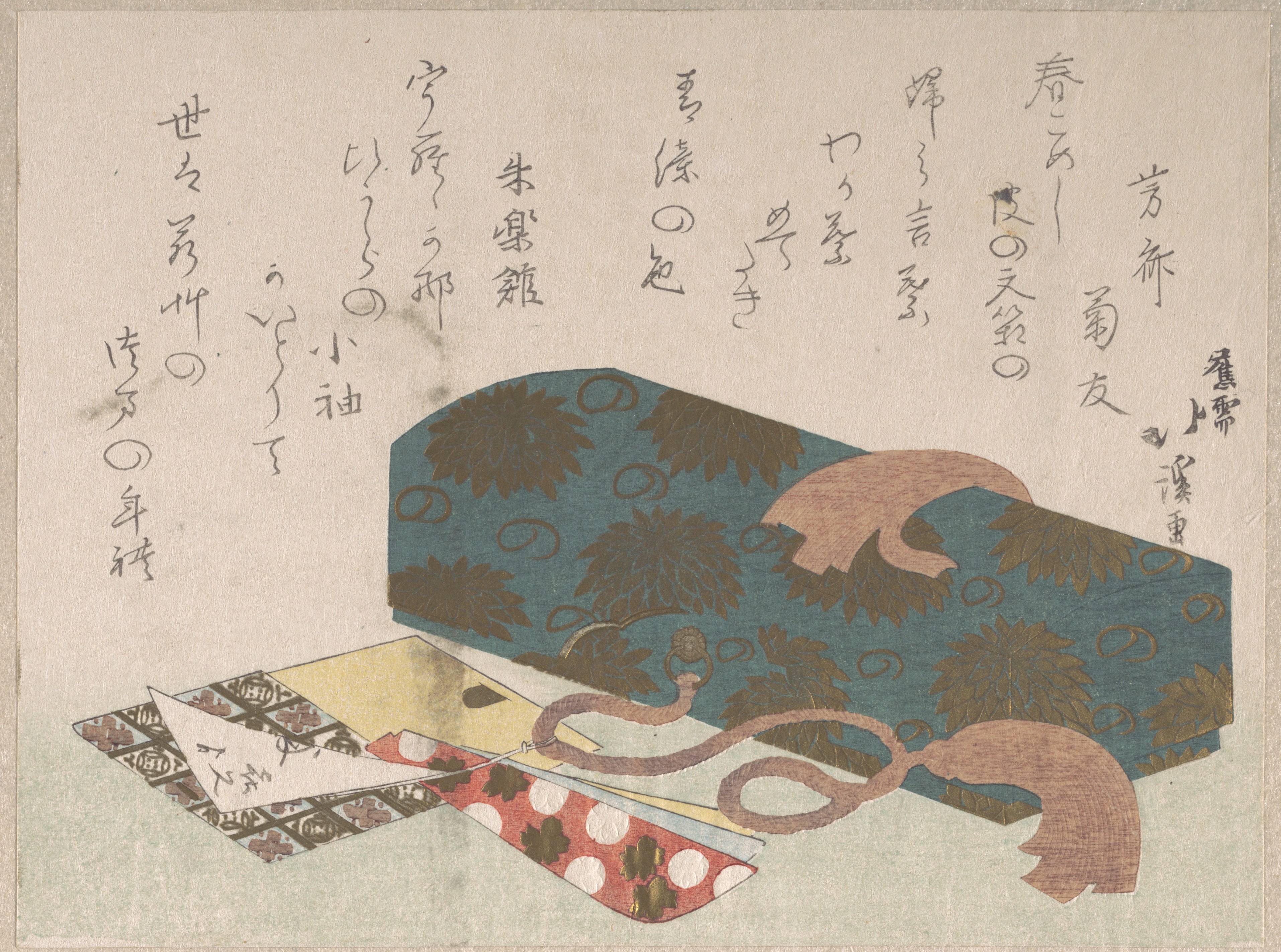
Letter-box and Toothpick Holders
19th century
Part of an album of woodblock prints (surimono); ink and color on paper

Illustration of a Chinese poem, from the series "Picture Book of Chinese Poems (Toshi gafu no uchi)"
c. 1830/44
Color woodblock print; chuban

Kyōka Verse Anthology of Elegant Friends (Kyōka gayū shū) 狂歌雅友集
1826 (Bunsei 9)
Woodblock printed book; ink and color on paper
Frequently Asked Questions
Rising Sun and a Cock and a Hen was created by Totoya Hokkei (魚屋北渓) in ca. 1800.