
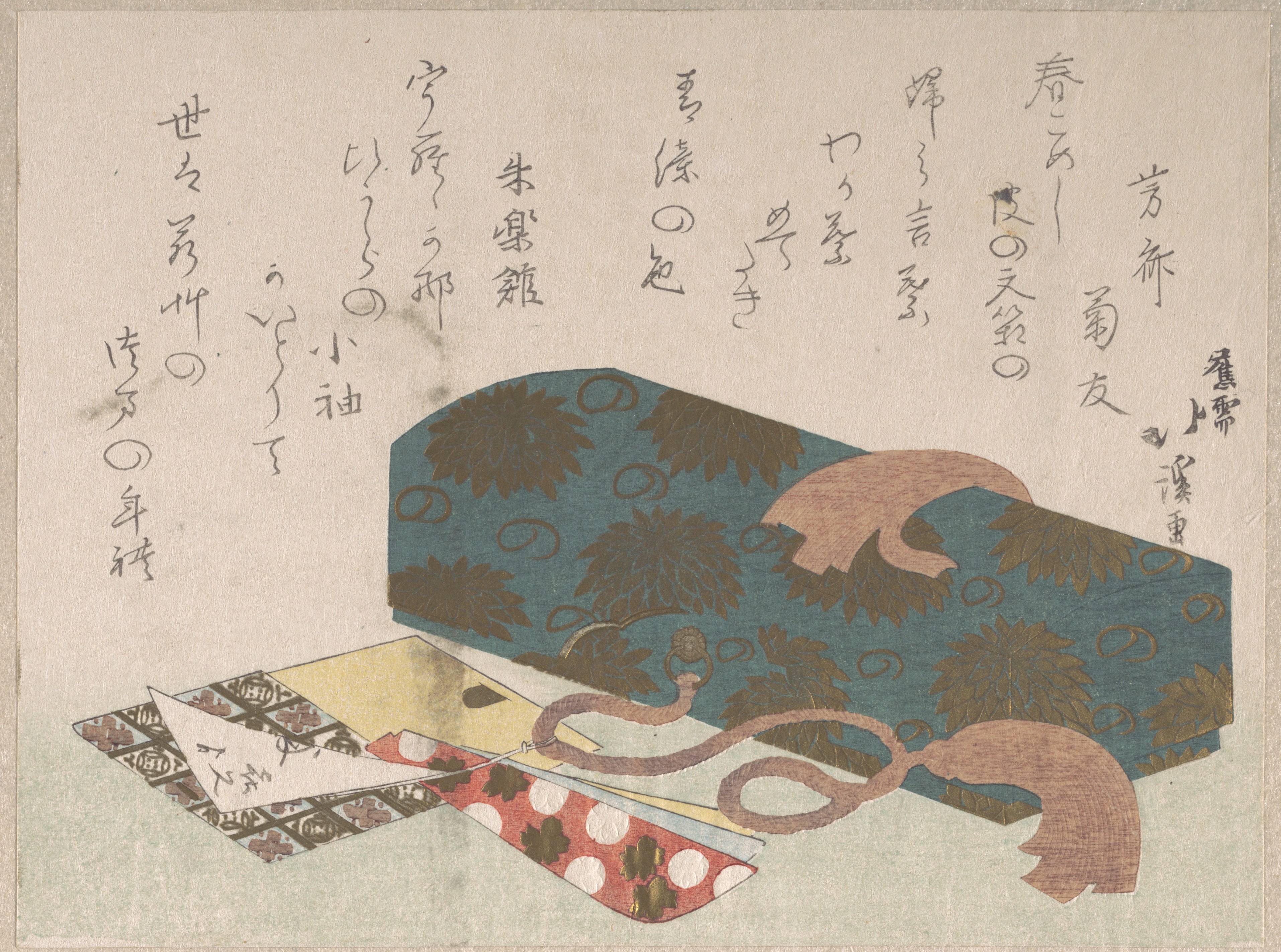
Two dolls and a brocade bag, from the series "Clothing, Food, and Shelter (Ishokuju no uchi)"
- Date:
- 1818
- Medium:
- Color woodblock print; shikishiban, surimono
- Source:
- Art Institute of Chicago
Description
Totoya Hokkei's surimono from the series Clothing, Food, and Shelter (Ishokuju no uchi) sets two dolls beside a brocade bag, building a small still life around objects associated with the first of those three basic needs. The series concept — clothing, food, and shelter — gave the commissioning kyōka group a framework for examining the textures of everyday life, and the dolls and bag here read as emblems of dress, craft, and the careful preservation of fine fabrics in well-managed households. Hokkei trained under Hokusai and worked at the center of the Hokusai school of surimono, and the print shows his characteristic combination of orderly arrangement, sensitive drawing of textiles, and willingness to let small details carry significant cultural weight. The brocade bag in particular invites attention to weaving and pattern, two of the great Edo connoisseurial interests, while the dolls — most likely associated with the seasonal display of festival dolls — extend the reference into the calendar of household ritual. The Art Institute of Chicago holds the sheet among its broader Hokkei surimono, and the Ishokuju no uchi project as a whole is a notable example of how Edo kyoka-e poetry groups organized series around conceptual triads. Image courtesy of the Art Institute of Chicago.
More Prints by Totoya Hokkei

Potted Plant (Ueki), from the series "Eighteen Illustrations of the Ladder of Ancient Words (Kogentei juhachiban tsuzuki)"
1831
Color woodblock print; shikishiban, surimono
Letter-box and Toothpick Holders
19th century
Part of an album of woodblock prints (surimono); ink and color on paper

Illustration of a Chinese poem, from the series "Picture Book of Chinese Poems (Toshi gafu no uchi)"
c. 1830/44
Color woodblock print; chuban

Kyōka Verse Anthology of Elegant Friends (Kyōka gayū shū) 狂歌雅友集
1826 (Bunsei 9)
Woodblock printed book; ink and color on paper
Frequently Asked Questions
Two dolls and a brocade bag, from the series "Clothing, Food, and Shelter (Ishokuju no uchi)" was created by Totoya Hokkei (魚屋北渓) in 1818.