
Two Men at a Shrine, Horse and Rider
- Date:
- early 19th century
- Medium:
- Color woodblock print; surimono
- Source:
- Art Institute of Chicago
Description
This Art Institute of Chicago surimono presents a multi-figure scene at a shrine: two men in conversation while a horse and rider pass nearby. Such combinations of figures, architecture, and animal movement were challenging compositional exercises in the small shikishiban format, and Hokkei rises to the task with the careful spatial economy that characterizes his surimono draftsmanship. The shrine setting provides both cultural context - perhaps suggesting a pilgrimage, a votive offering, or a seasonal festival - and an architectural anchor that organizes the scene. The horse and rider element brings movement and travel themes into the composition, evoking the broader world beyond the shrine precinct. Inscribed kyoka verses would have engaged the scene's specific cultural references, perhaps connecting it to a particular festival, a classical poem, or a kabuki scene that gave the imagery its mitate dimension. The Art Institute's impression preserves the saturated pigments and careful registration characteristic of Hokkei's privately commissioned surimono, demonstrating his command of complex multi-figure compositions within the demanding shikishiban field.
More Prints by Totoya Hokkei

Potted Plant (Ueki), from the series "Eighteen Illustrations of the Ladder of Ancient Words (Kogentei juhachiban tsuzuki)"
1831
Color woodblock print; shikishiban, surimono
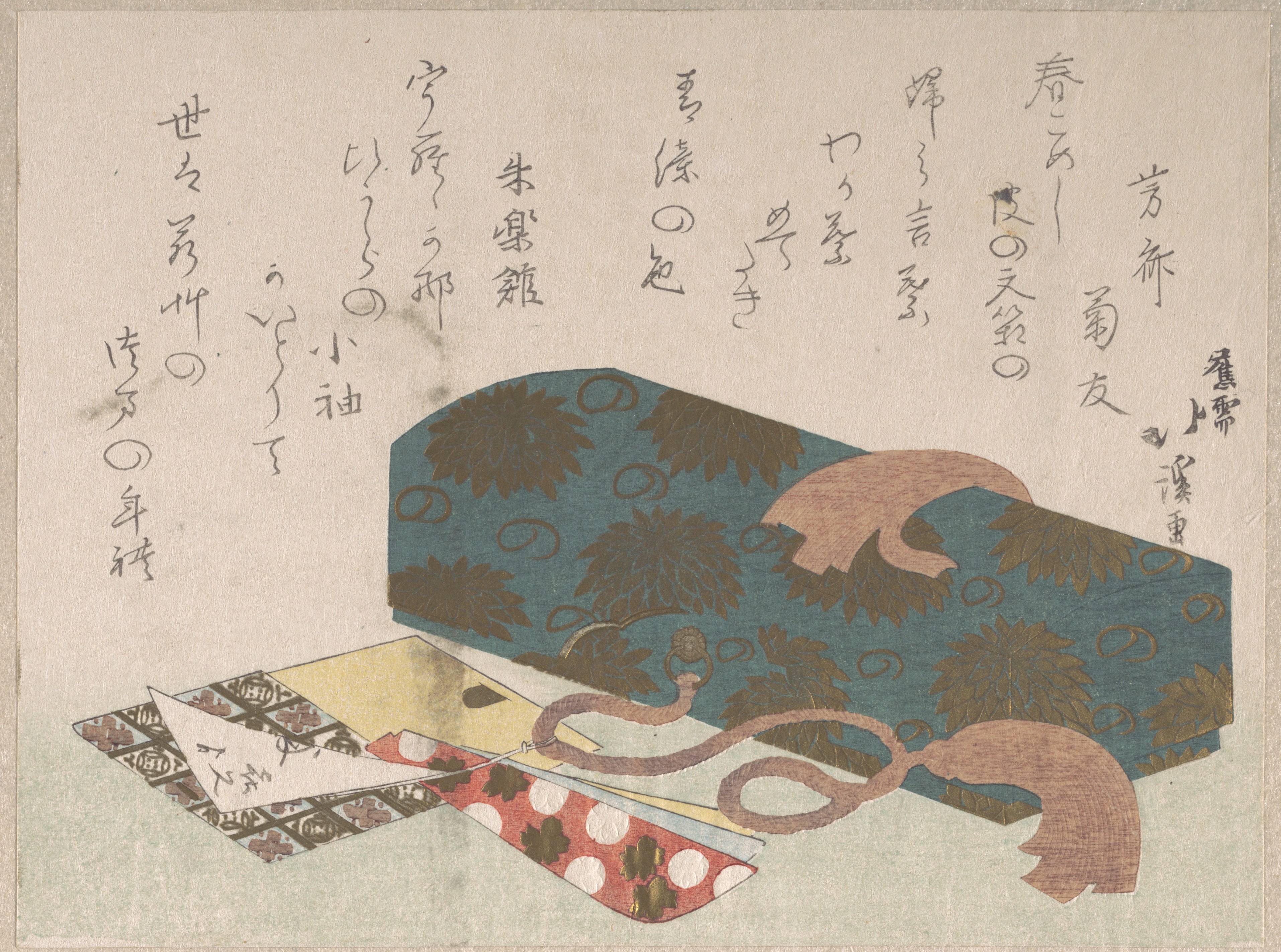
Letter-box and Toothpick Holders
19th century
Part of an album of woodblock prints (surimono); ink and color on paper

Illustration of a Chinese poem, from the series "Picture Book of Chinese Poems (Toshi gafu no uchi)"
c. 1830/44
Color woodblock print; chuban

Kyōka Verse Anthology of Elegant Friends (Kyōka gayū shū) 狂歌雅友集
1826 (Bunsei 9)
Woodblock printed book; ink and color on paper
Frequently Asked Questions
Two Men at a Shrine, Horse and Rider was created by Totoya Hokkei (魚屋北渓) in early 19th century.