
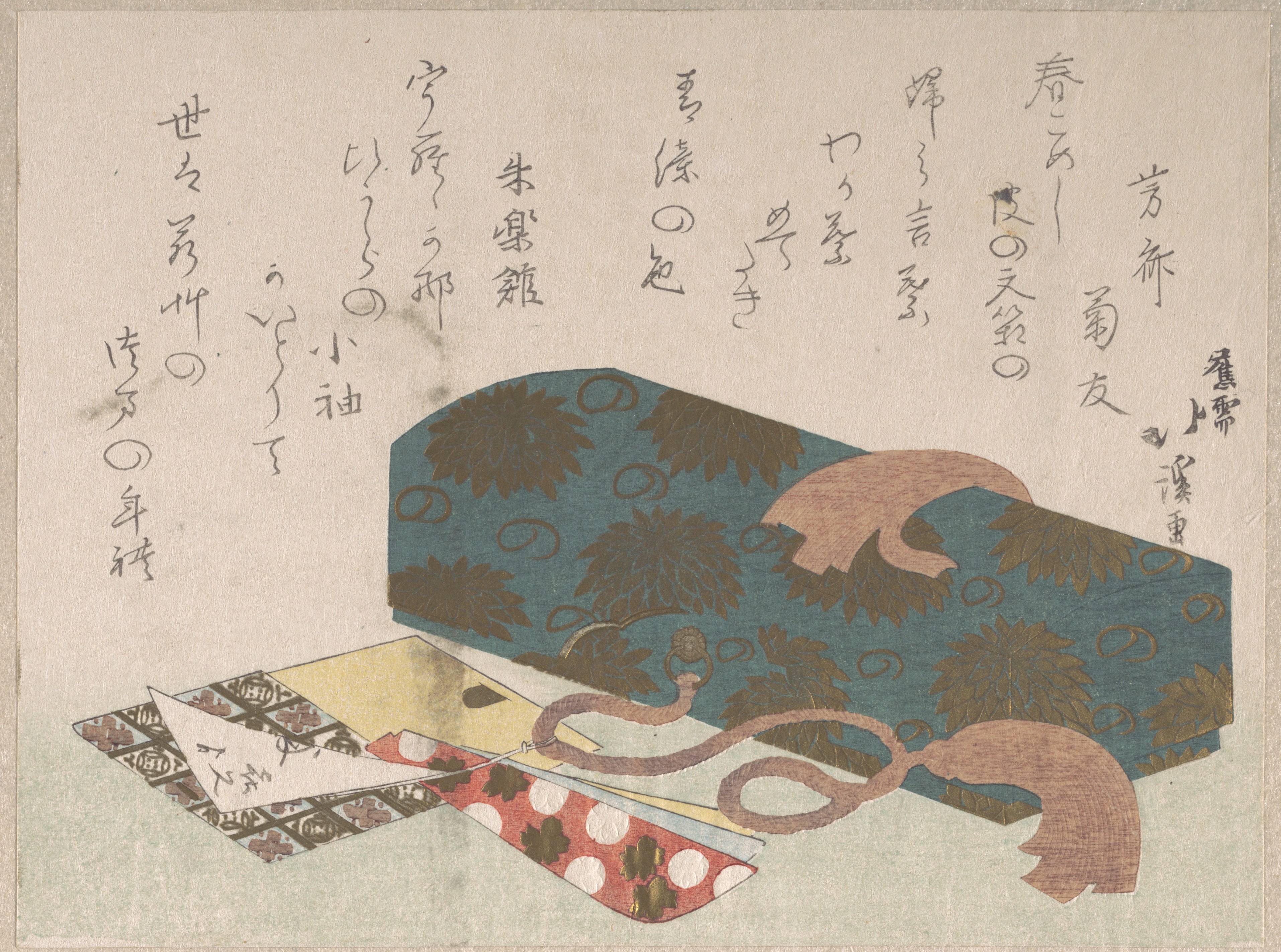
Woman and box of poem cards
- Date:
- ca. 1828
- Medium:
- Source:
- Victoria and Albert Museum
Description
In Woman and Box of Poem Cards, Totoya Hokkei brings together two of the staples of his surimono practice: an elegant female figure and a literary game associated with the New Year. The box would have held the cards used in karuta, the matching game built around the Hyakunin isshu anthology of one hundred classical poems, and the woman is shown either selecting or contemplating a card with the slightly self-conscious composure that surimono figures often adopt. Hokkei was by this date one of the most accomplished Hokusai school designers of surimono, and the print uses the conventions of Edo kyoka-e — refined paper, restrained but carefully tuned color, embossed details, and metallic pigments — to elevate what would otherwise be a simple genre subject. The image is also a sly literary joke, because surimono themselves accompanied kyōka verses that parodied the classical poems of the karuta deck, so the picture and its likely original poems would have conducted a sustained conversation about high and low forms of Japanese verse. The Victoria and Albert Museum holds the sheet within its broader Hokkei holdings, where it joins a coherent body of surimono in which female figures, literary games, and New Year imagery cluster together. Image courtesy of the Victoria and Albert Museum.
More Prints by Totoya Hokkei

Potted Plant (Ueki), from the series "Eighteen Illustrations of the Ladder of Ancient Words (Kogentei juhachiban tsuzuki)"
1831
Color woodblock print; shikishiban, surimono
Letter-box and Toothpick Holders
19th century
Part of an album of woodblock prints (surimono); ink and color on paper

Illustration of a Chinese poem, from the series "Picture Book of Chinese Poems (Toshi gafu no uchi)"
c. 1830/44
Color woodblock print; chuban

Kyōka Verse Anthology of Elegant Friends (Kyōka gayū shū) 狂歌雅友集
1826 (Bunsei 9)
Woodblock printed book; ink and color on paper
Frequently Asked Questions
Woman and box of poem cards was created by Totoya Hokkei (魚屋北渓) in ca. 1828.