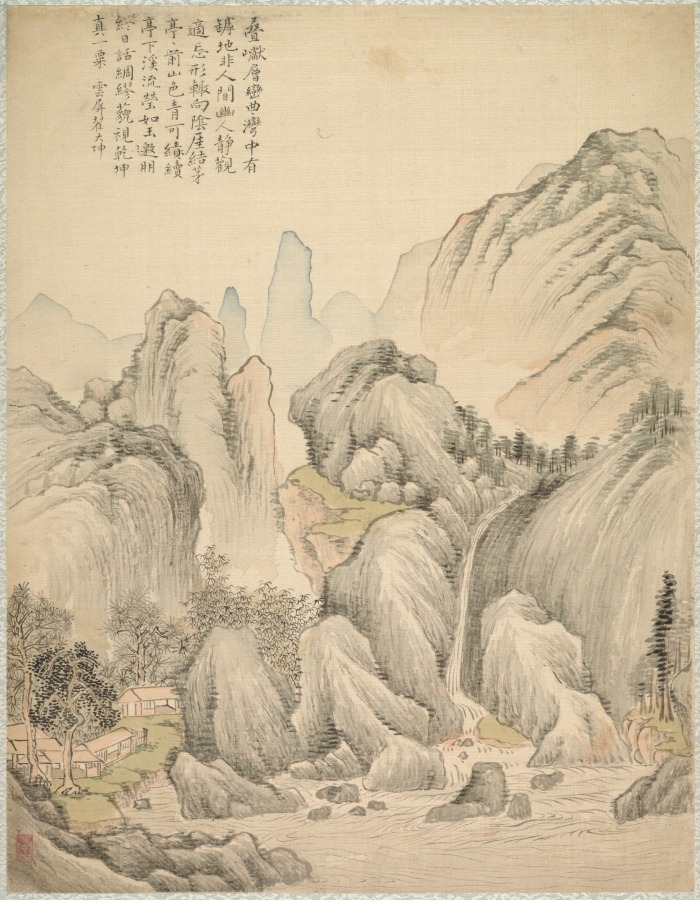
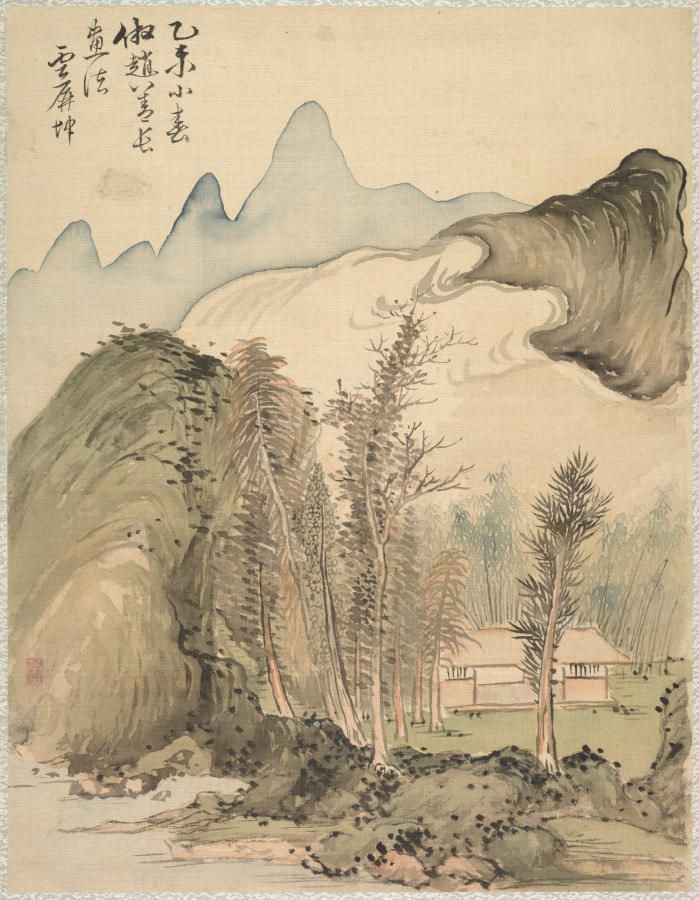
Folded Hills and Layered Peaks
- Date:
- 1847
- Medium:
- Album leaf; ink and color on silk
- Source:
- Cleveland Museum of Art
Description
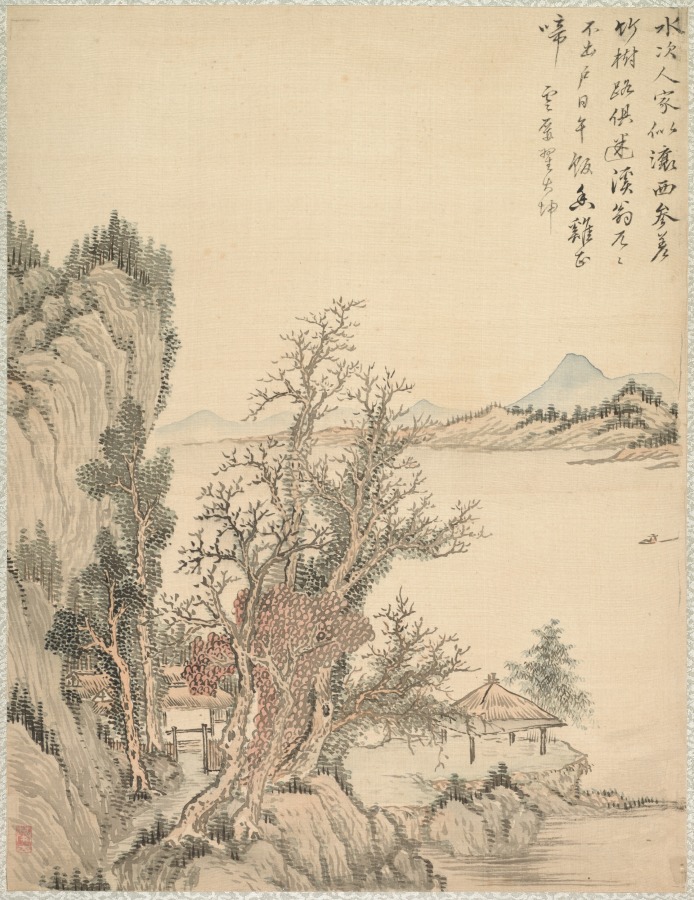
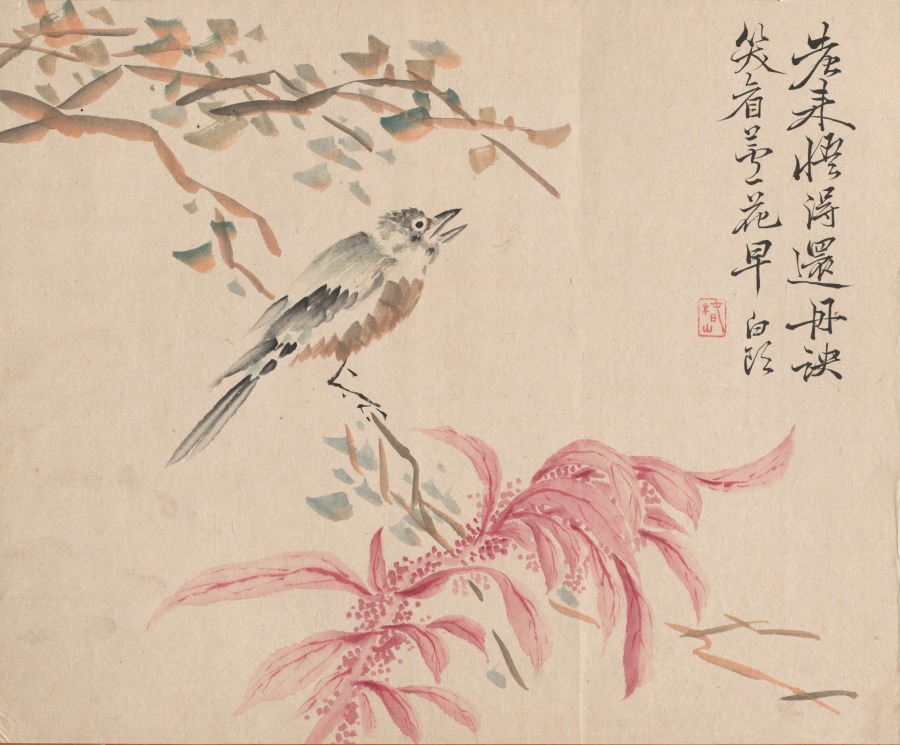
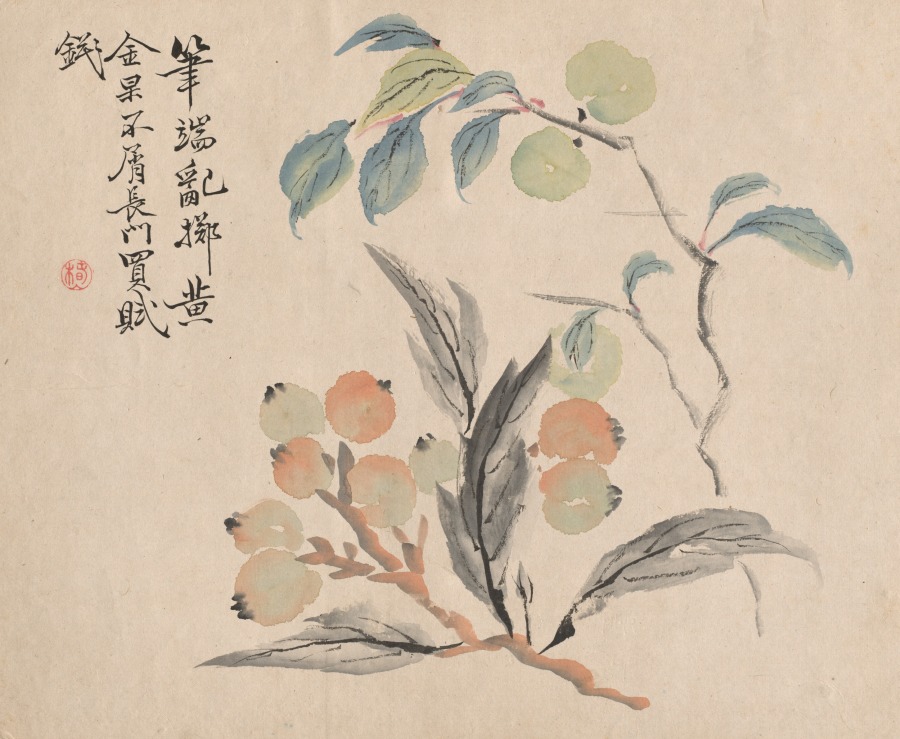
Folded Hills and Layered Peaks, dated 1847, is an ink-and-color landscape leaf by the late-Edo nanga painter Tsubaki Chinzan (椿椿山, 1801-1854), held in the collection of the Cleveland Museum of Art (accession 1985.251.1; https://www.clevelandart.org/art/1985.251.1). The sheet belongs to a closely related group of 1847 landscapes by Chinzan now in Cleveland (accessions 1985.251.1 through 1985.251.10), all entering the museum together as a single album-like ensemble representing a coherent moment in the artist's mature production. The composition pursues a subject central to the Chinese literati tradition that nanga painters in Japan absorbed and reinterpreted: a layered recession of mountain forms, each ridge stacked behind the last to suggest the deep, inhabited geographies of Song and Yuan painting filtered through the Ming and Qing models that Edo bunjin studied through woodblock-printed albums such as the Mustard Seed Garden Manual of Painting. As a student of Watanabe Kazan (1793-1841) and a prominent member of the Tani Bunchō circle, Chinzan inherited a nanga practice that prized brushwork as a record of the cultivated mind rather than as topographic description; the folded hills here are built up from a vocabulary of texture strokes (cun) and dotted moss applied with the deliberation of a calligrapher. Although Chinzan is now best remembered for his refined kachō-e — the bird-and-flower compositions that earned him a leading place in the late-Edo nanga revival — landscape painting remained a serious literati discipline for him throughout his career, particularly in the 1840s as he worked to sustain the bunjinga ideals of his teacher after Kazan's death in 1841. The 1847 date thus locates the leaf at a moment when Chinzan was both the most senior surviving pupil of the Kazan circle and an active transmitter of the Chinese literati landscape vocabulary into the next generation of Edo nanga practitioners. The Cleveland source provides the firm attribution, the 1847 date, and the album context that situates the sheet within Chinzan's mature practice.
More Prints by Tsubaki Chinzan
Frequently Asked Questions
Folded Hills and Layered Peaks was created by Tsubaki Chinzan (椿椿山) in 1847.