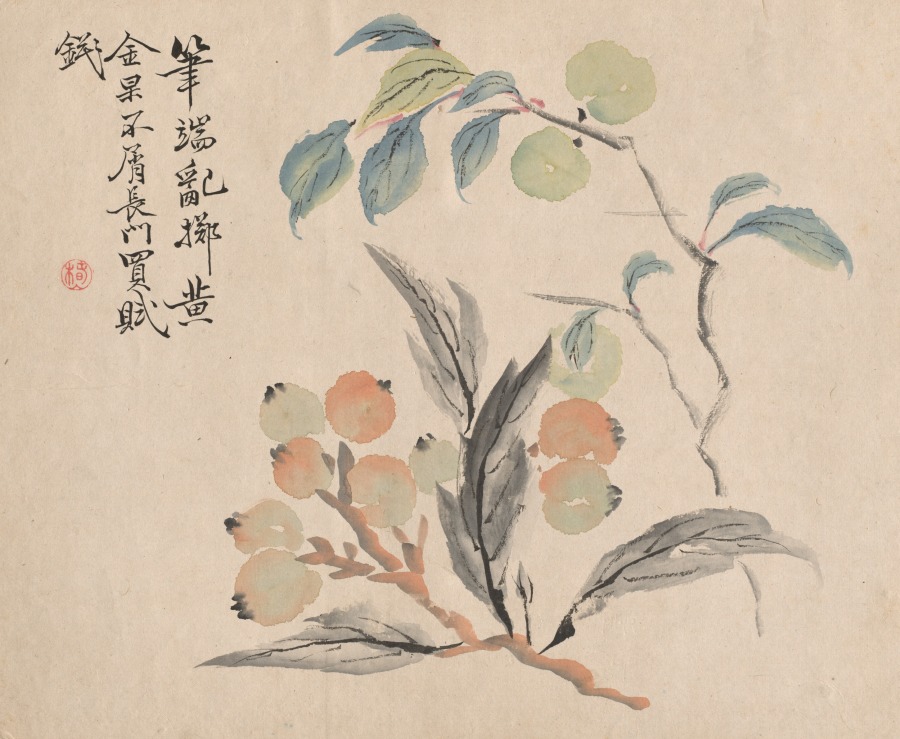
Loquat Tree of Japan
- Date:
- c. 1845–54
- Medium:
- Ink and color on paper
- Source:
- Cleveland Museum of Art
Description
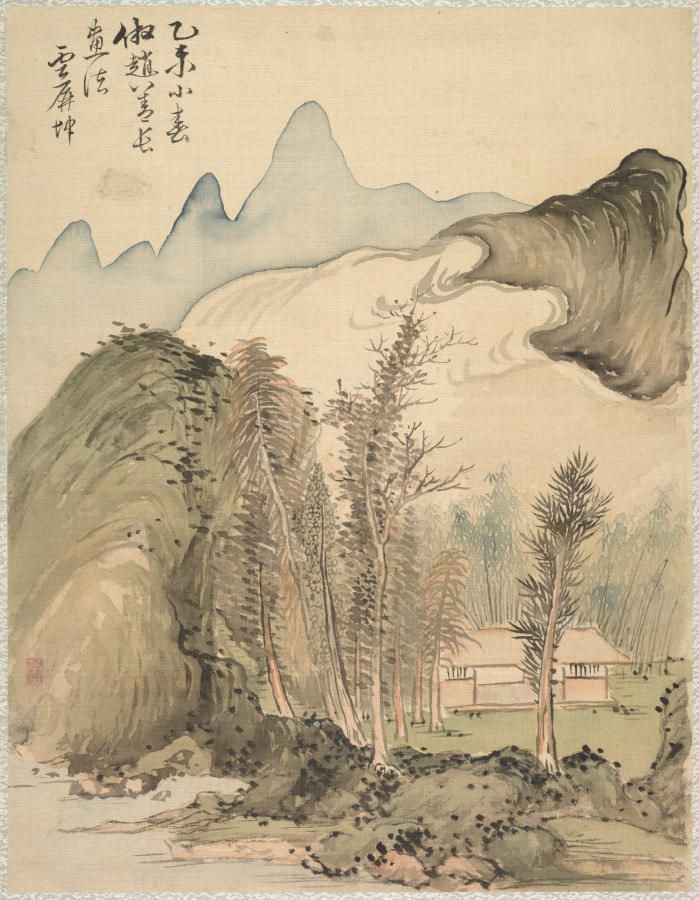
Loquat Tree of Japan, dated 1849, is a kachō-e by Tsubaki Chinzan (椿椿山, 1801-1854) held by the Cleveland Museum of Art (accession 1985.292; https://www.clevelandart.org/art/1985.292). The loquat (biwa) — an evergreen fruit tree long admired in East Asian painting for its broad ribbed leaves and pendant clusters of golden fruit — is a recurrent subject in Chinese bird-and-flower painting from the Song onward, when its combination of structural foliage and ripe color made it a favored vehicle for demonstrating the full range of brush and pigment effects. The motif passed into Edo nanga practice through the imported scrolls and printed albums on which late-Tokugawa literati painters depended. As Watanabe Kazan's most trusted pupil and a leading member of the late-Edo nanga revival, Chinzan brought to kachō-e a distinctive combination of inheritances: the disciplined brushwork of nanga drawn from Chinese painting manuals, the close natural observation Kazan had absorbed through his contact with rangaku scholarship, and the refined color sense that made Chinzan's bird-and-flower work especially prized among Edo collectors. The 1849 date places the sheet in the productive final phase of his career, the period between Kazan's death by ritual suicide in 1841 and Chinzan's own death in 1854, during which he stood as the principal living transmitter of the Kazan lineage. Painted with controlled attention to the leaves' venation and the gradation of color in the fruit, the composition exemplifies the synthesis on which Chinzan's reputation rests: an image botanically alert enough to satisfy the modern eye and yet built on the slow, literati brushwork that allies it with the Chinese painting genealogy his circle revered. The Cleveland source provides the firm attribution and date.
More Prints by Tsubaki Chinzan
Frequently Asked Questions
Loquat Tree of Japan was created by Tsubaki Chinzan (椿椿山) in c. 1845–54.