
Moon
- Medium:
- Mokuhanga (Japanese woodblock)
- Image courtesy of
- Saru Gallery
Description
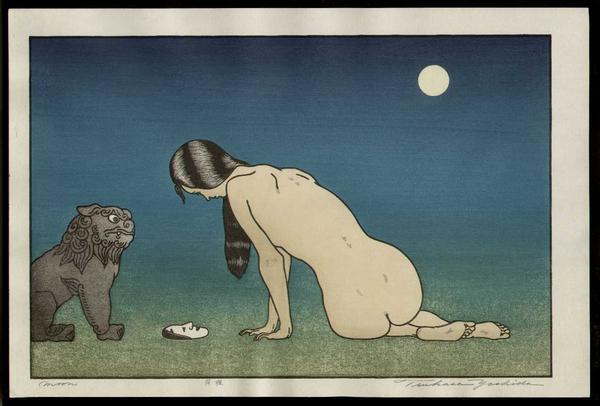
The slug indicates this print depicts a saru (monkey) paired with the moon, a pairing rooted in classical East Asian painting tradition where a monkey reaching toward a reflected moon symbolizes the futility of grasping illusion. Tsukasa Yoshida likely renders the subject as a nocturnal scene, with the full disc of the moon set against a darkened sky and a silhouetted or partially lit primate figure. The composition would rely on the strong tonal gradations characteristic of his work, with bokashi shading used to soften the transition between moonlight and shadow and to suggest atmospheric depth. The moon itself is typically achieved through careful registration and a flat, evenly inked circle, often left as the unprinted washi to read as luminous against surrounding tones. Animal subjects, particularly cats, recur throughout Tsukasa's output, and this monkey-and-moon image extends that interest into a more emblematic, nature-symbolic register. The print also continues the Yoshida family's long engagement with moonlit scenes, a subject his grandfather Hiroshi explored in shin-hanga landscapes and his father Toshi developed in more graphic, modernist directions.
More Prints by Tsukasa Yoshida
More Moonlight Prints
![Mount Fuji on a Moonlit Night, Kawai Bridge (Tsukiyo no Fuji [Kawaibashi]), from the series "Selection of Views of the Tokaido (Tokaido fukei senshu)" by Kawase Hasui](https://www.artic.edu/iiif/2/d0960668-1e73-339a-b182-fb995a54bff0/full/843,/0/default.jpg)
Mount Fuji on a Moonlit Night, Kawai Bridge (Tsukiyo no Fuji [Kawaibashi]), from the series "Selection of Views of the Tokaido (Tokaido fukei senshu)"
1947
Color woodblock print; oban

Evening Moon at Nakanoshima, Sapporo (Sapporo Nakanoshima no yuzuki), from the series "Collection of Views of Japan, Eastern Japan Edition (Nihon fukei shu higashi Nihon hen)"
March 1933
Color woodblock print; oban

Matsushima in Moonlight (Tsuki no Matsushima)
1919
Color woodblock print

Kiyozumi Garden in Moonlight
January 1938
Woodblock print, ink and color on paper
Frequently Asked Questions
Moon was created by Tsukasa Yoshida (吉田司).
Moon depicts moonlight.