
Atsumori, from the series "One Hundred No Dramas (Nogaku hyakuban)"
- Date:
- 1898/1903
- Medium:
- Color woodblock print
- Source:
- Art Institute of Chicago
Description
Atsumori is one of the great warrior plays (shura-mono) of the Noh repertoire, drawn from the Tale of the Heike. It depicts the encounter between the wandering priest Renshō — formerly the Genji warrior Kumagai no Naozane — and the ghost of the young Taira aristocrat Atsumori, whom Kumagai killed at the Battle of Ichi-no-tani. Atsumori was sixteen, a flute-player rather than a warrior by temperament, and Kumagai's grief over killing him drove him to take monastic vows. Kōgyo depicts the ghost-warrior shite in the elegant courtly armor that distinguishes Taira shades in Noh from Genji warriors, the figure paused at the moment of confronting his former killer. Published by Matsuki Heikichi as part of Nōgaku Hyaku-ban (One Hundred Noh Dramas), this color woodblock print is held by the Art Institute of Chicago and exemplifies the documentary precision that made Tsukioka Kōgyo the canonical Meiji-era illustrator of Noh.
More Prints by Tsukioka Kōgyo

Yokihime, from the series "Pictures of No Performances (Nogaku Zue)"
1898
Color woodblock print

Momijigari, from the series "One Hundred No Dramas (Nogaku hyakuban)"
1898/1903
Color woodblock print; left sheet of oban diptych (right: 1943.833.42a)

Kamabara (Kyogen), from the series "Pictures of No Performances (Nogaku Zue)"
1898
Color woodblock print

Su-yo or Suutai, from the series "Pictures of No Performances (Nogaku Zue)"
1898
Color woodblock print
More Sumo Prints


Frequently Asked Questions
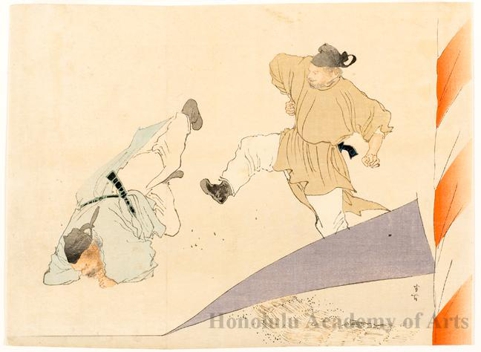
Atsumori, from the series "One Hundred No Dramas (Nogaku hyakuban)" was created by Tsukioka Kōgyo (月岡耕漁) in 1898/1903.
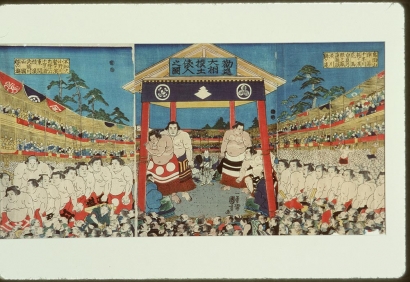
Atsumori, from the series "One Hundred No Dramas (Nogaku hyakuban)" depicts sumo and theater.