
Old city Kudara (Korea)
- Medium:
- Mokuhanga (Japanese woodblock)
- Image courtesy of
- Saru Gallery
Description
Kudara is the Japanese name for Baekje, the ancient Korean kingdom (18 BCE–660 CE) whose former capital sites lie in present-day South Korea. The title indicates a meisho-e view of a historic Korean townscape, rendered in Hiratsuka's signature bold black-and-white woodcut technique. Hiratsuka traveled in Korea during the colonial period and produced a body of prints documenting Korean architecture, street scenes, and rural landscapes — subjects that broadened the topographical vocabulary of sosaku-hanga beyond Japan. Carved and pulled entirely by the artist according to the movement's jiga-jikoku-jizuri principle (self-drawn, self-carved, self-printed), such works typically reduce roof tiles, lattice walls, and stone foundations to flat planes of sumi black against unprinted washi. The composition belongs to the urban and architectural subjects Hiratsuka pursued throughout his career, alongside his better-known views of Japanese temples and shrines.
More Prints by Hiratsuka Un'ichi


More Urban Scenes Prints
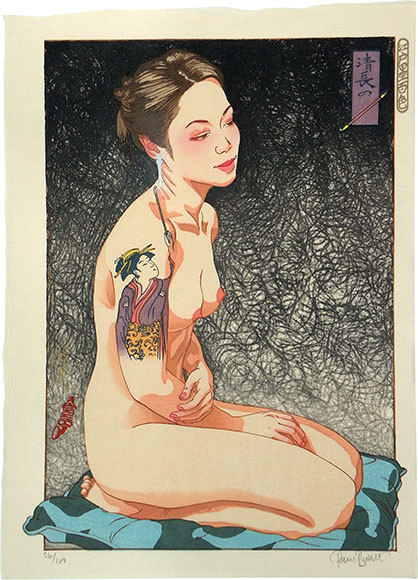
A Hundred Shades of Ink of Edo: Kiyonaga's Pipe (Edo zumi hyaku shoku: Kiyonaga no kiseru)
Woodblock print

View of Kabuki Theater from Matsuya (Ginza Matsuya yori Kabukiza), no. 3 from the series "Pictures of Ginza, First Series (Gashu Ginza dai isshu)"
1928
Color lithograph

Distant View of Mitsukoshi Movie Theater in Shinjuku from the Sixth Floor of Hoteiya (Hoteiya rokkai kara Shinjuku Mitsukoshi Musashi no kan enbo zu), no. 1 from the series "Scenery of Shinjuku (Gashu Shinjuku fukei)"
1930
Color lithograph
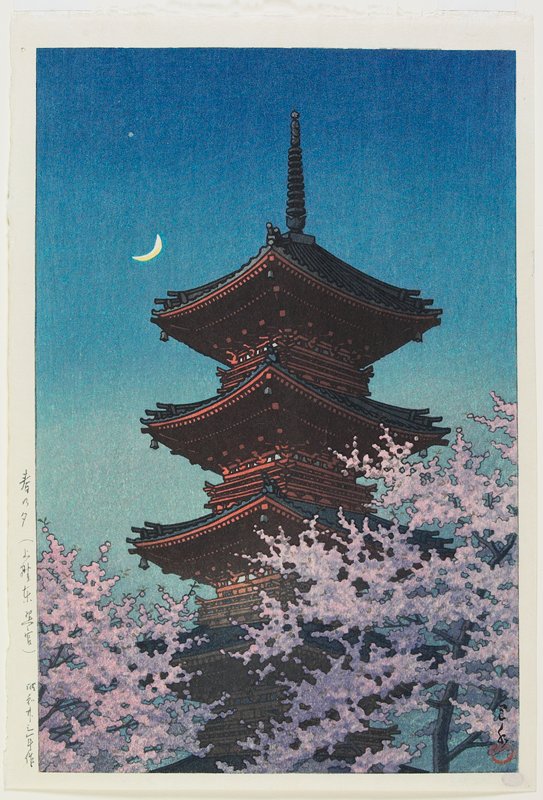
Spring Dusk at the Tōshō Shrine in Ueno
1948
Woodblock print, ink and color on paper
Featured in Collections
Curated cross-cuts that include this print.
Frequently Asked Questions
Old city Kudara (Korea) was created by Hiratsuka Un'ichi (平塚運一).
Old city Kudara (Korea) depicts urban scenes.