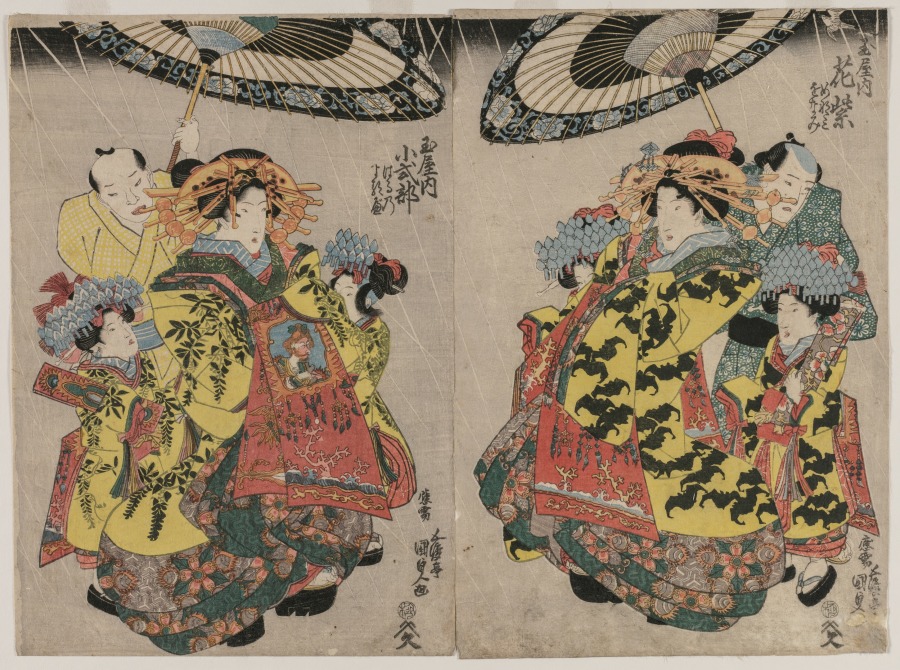
The Courtesans Hanamurasaki and Koshikibu of the Tamaya Promenading in the Rain
- Date:
- c. early 1830s
- Medium:
- color woodblock print
- Source:
- Cleveland Museum of Art
Description
Designed by Utagawa Kunisada about 1830 and held by the Cleveland Museum of Art, The Courtesans Hanamurasaki and Koshikibu of the Tamaya Promenading in the Rain is a high-end bijinga that names two specific oiran of the Yoshiwara establishment Tamaya. By identifying the women by name and house, the print operates in the fan-magazine register of late Edo ukiyo-e, where individual courtesans had public personae and devoted followings. Kunisada gives each figure the long-faced grace and tapered fingers of his 1820s and 1830s bijinga style, and the rain provides the compositional pretext for elaborate umbrellas, dragged trains, and the careful sandaled footwork that elite Yoshiwara processions required. Pattern is the print's central pleasure: the women's outer kimono are loaded with seasonally pointed motifs that Edo viewers would read at once, and the printers' workshop achieves the registration needed to keep the overlapping fabrics legible. By 1830 Kunisada was already the most prolific bijinga designer in Edo, more than a decade before his elevation to the Toyokuni III name, and works like this one defined how the Yoshiwara presented itself to the rest of the city. The Cleveland Museum's catalogue confirms the date and house identification, marking the print as a specific record of two named courtesans rather than an anonymous beauty study.


