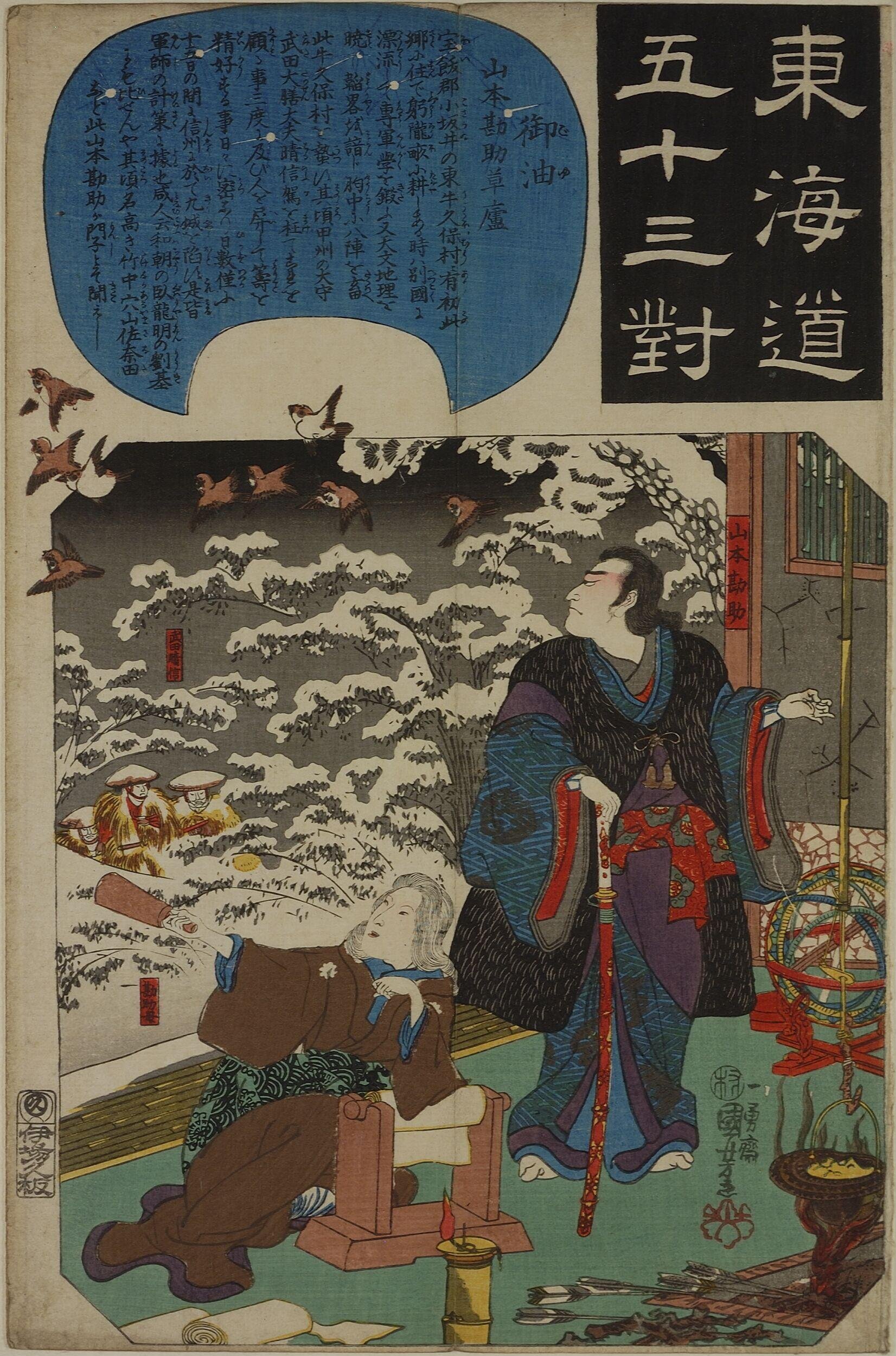
Fifty-three Pairings for the Tōkaidō Road (Tōkaidō gojūsan tsui)
- Medium:
- Source:
- Victoria and Albert Museum
Description
Fifty-three Pairings for the Tokaido Road (Tokaido gojusan tsui) is an Edo ukiyo-e series in which Utagawa Kuniyoshi participated alongside Utagawa Hiroshige and Utagawa Kunisada (Toyokuni III), pairing each of the fifty-three post-stations on the Tokaido highway between Edo and Kyoto with a figure or scene from history, legend, or theater. Unlike Hiroshige's purely topographic Tokaido sets, the Tokaido gojusan tsui treats each station as an occasion for a story, anchoring the print in a particular character whose tale is associated with the place or its locality. Kuniyoshi, an Utagawa-school master best known for warrior prints, contributed designs that play to his strengths in dynamic figure work, dramatic stance, and ground-level narrative tension, while a cartouche supplies the station name and a brief vignette of the relevant landscape. The collaboration is itself characteristic of mid-nineteenth-century Edo print culture, in which leading designers were sometimes pooled in a single ambitious set to maximize variety and marketability. The Victoria and Albert Museum holds an impression of the series (item O425089), where it represents one of the major collaborative Tokaido projects of the period. The set demonstrates how the geography of Edo-period Japan could be reimagined as a sequence of moral, historical, and theatrical encounters, and how Kuniyoshi's specific contribution to that reimagining grew naturally out of his work in warrior prints and theatrical portraiture.
More Prints by Utagawa Kuniyoshi

Yan Qing (Roshi Ensei), from the series "One Hundred and Eight Heroes of the Popular Water Margin (Tsuzoku Suikoden goketsu hyakuhachinin no hitori)"

Poem by Abe no Nakamaro, from an untitled series of One Hundred Poems by One Hundred Poets

Hu Sanniang (Ko Sanjo Ichijosei), from the series "One Hundred and Eight Heroes of the Popular Water Margin (Tsuzoku Suikoden goketsu hyakuhachinin no hitori)"

Miya, Kuwana, Yokkaichi, and Ishiyakushi, from the series "Famous Places on the Fifty-three Stations of the Tokaido, Four Stations (Tokaido gojusan eki yonshuku meisho)"
Frequently Asked Questions
Fifty-three Pairings for the Tōkaidō Road (Tōkaidō gojūsan tsui) was created by Utagawa Kuniyoshi (歌川国芳).