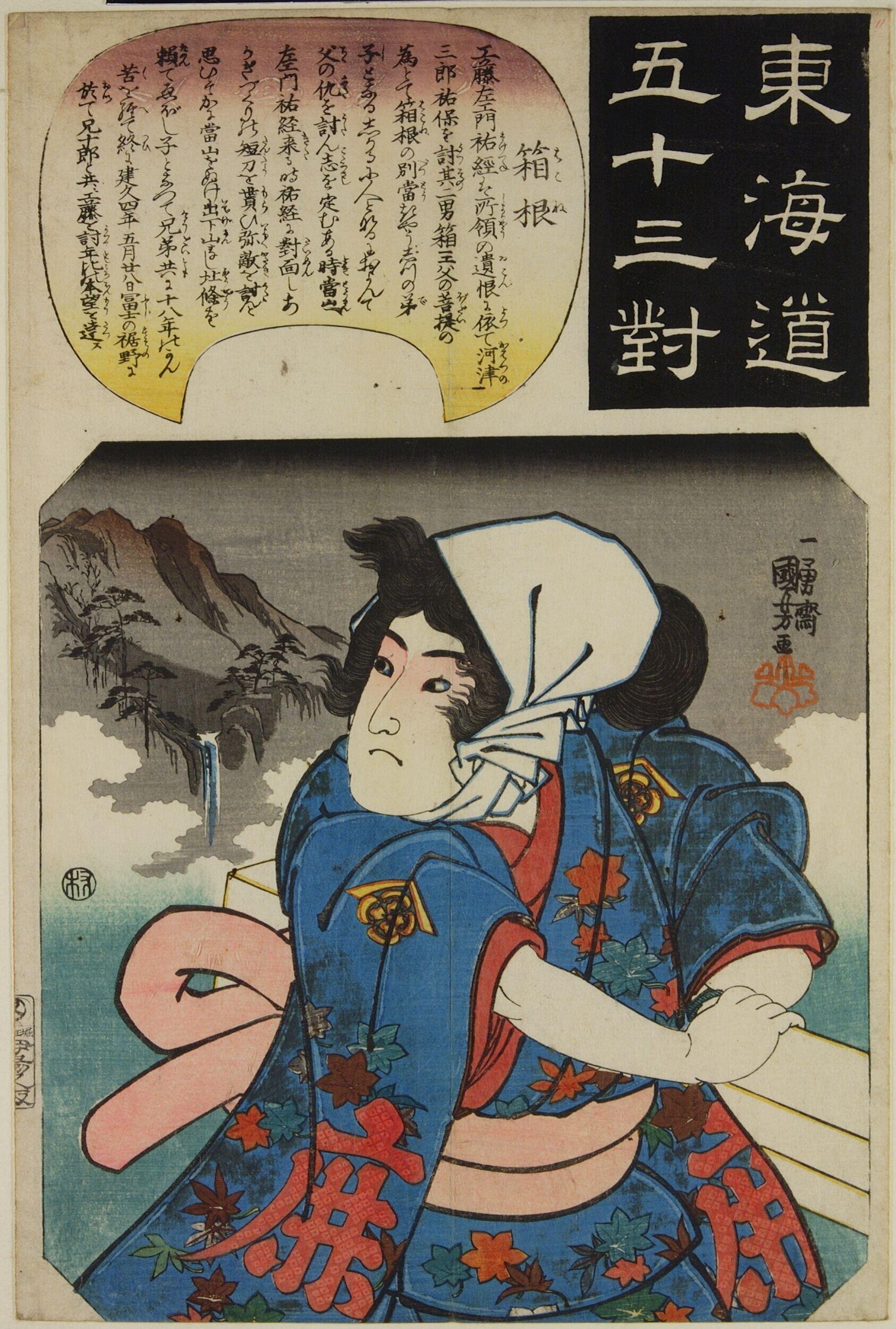
Hakone (Hakone)
- Medium:
- Source:
- Victoria and Albert Museum
Description
Hakone is a Tōkaidō-related print by Utagawa Kuniyoshi (1797-1861) preserved in the Victoria and Albert Museum. Hakone, the tenth station on the great highway between Edo and Kyoto, was famous for its mountain barrier, its lake and the dramatic landscapes of its ascent, and was one of the most frequently depicted stops on the road in nineteenth-century ukiyo-e. Kuniyoshi designed several Tōkaidō series in which each station was paired with a historical figure, hero from drama or legend; this Hakone sheet belongs to that family of works, where the station name and the figural subject are equally important to the design. Trained under Utagawa Toyokuni I, Kuniyoshi became from the late 1820s onward one of the dominant figures of Edo print culture and was particularly suited to the Tōkaidō-and-heroes format because the vocabulary of warrior prints he had pioneered could be carried into figural moments along the road. The Victoria and Albert Museum's catalogue places the sheet within Kuniyoshi's Tōkaidō output, where Hakone, with its rugged setting and barrier station associations, served as a particularly evocative location for the dramatic figural scenes that Kuniyoshi liked to develop. The description offered here follows the museum record and reads the print as a representative example of Kuniyoshi's contribution to the Tōkaidō series tradition in Edo ukiyo-e, in which place, story and figure are bound together within the single visual unit of the printed sheet.
More Prints by Utagawa Kuniyoshi

Yan Qing (Roshi Ensei), from the series "One Hundred and Eight Heroes of the Popular Water Margin (Tsuzoku Suikoden goketsu hyakuhachinin no hitori)"

Poem by Abe no Nakamaro, from an untitled series of One Hundred Poems by One Hundred Poets

Hu Sanniang (Ko Sanjo Ichijosei), from the series "One Hundred and Eight Heroes of the Popular Water Margin (Tsuzoku Suikoden goketsu hyakuhachinin no hitori)"

Miya, Kuwana, Yokkaichi, and Ishiyakushi, from the series "Famous Places on the Fifty-three Stations of the Tokaido, Four Stations (Tokaido gojusan eki yonshuku meisho)"
Frequently Asked Questions
Hakone (Hakone) was created by Utagawa Kuniyoshi (歌川国芳).