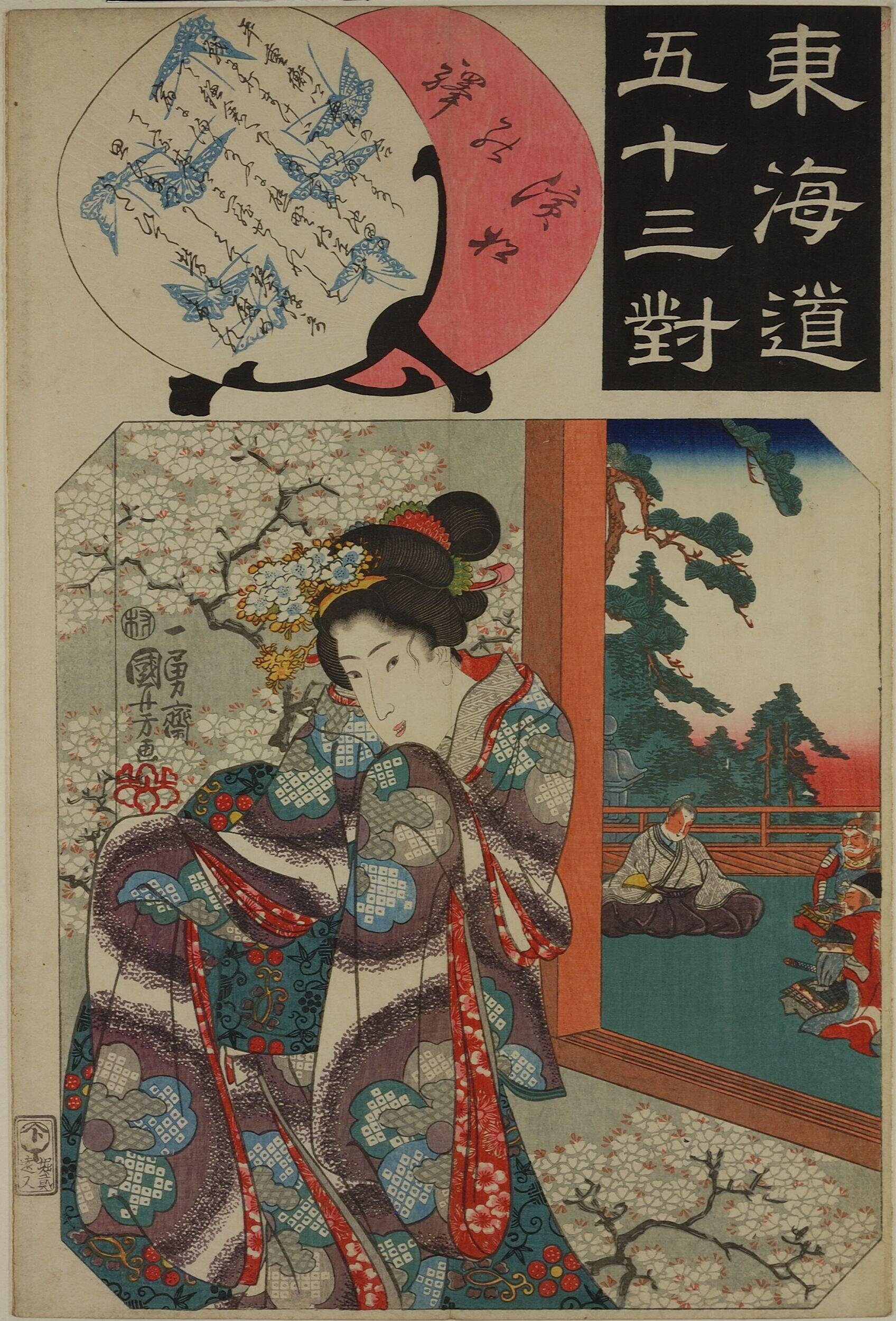
Hamamatsu Station (Hamamatsu no eki)
- Medium:
- Source:
- Victoria and Albert Museum
Description
Hamamatsu Station (Hamamatsu no eki) is an undated woodblock print by Utagawa Kuniyoshi held by the Victoria and Albert Museum, drawn from one of his Tōkaidō-themed series in which each station along the great Edo-period highway is paired with a historical or legendary figure. Hamamatsu, in Tōtōmi province, was an important castle town on the road between Edo and Kyoto and a familiar subject of station prints throughout the Tokugawa era. As in his other Tōkaidō designs, Kuniyoshi diverts attention from panoramic landscape and toward figural narrative, drawing on his deep familiarity with warrior prints, kabuki characters, and popular legends to populate each station with character and drama. The carved outlines, well-balanced colour, and detailed costume of the figure all reflect the technical confidence of mid-nineteenth-century Edo workshop production. The cartouche reading "Hamamatsu no eki" anchors the print within a named-place series and connects this single sheet to a broader vision of the highway as both physical route and shared cultural geography. The Victoria and Albert Museum's holdings of Kuniyoshi's Tōkaidō-related designs allow Hamamatsu Station to be studied in conjunction with other stations and related narrative prints, illustrating how Edo ukiyo-e reimagined the road as a stage for the heroes, lovers, and storytellers of Japan. The print typifies Kuniyoshi's instinct for embedding character-driven narrative within the recognisable, named-place format of mid-century Edo publishing.
More Prints by Utagawa Kuniyoshi

Yan Qing (Roshi Ensei), from the series "One Hundred and Eight Heroes of the Popular Water Margin (Tsuzoku Suikoden goketsu hyakuhachinin no hitori)"

Poem by Abe no Nakamaro, from an untitled series of One Hundred Poems by One Hundred Poets

Hu Sanniang (Ko Sanjo Ichijosei), from the series "One Hundred and Eight Heroes of the Popular Water Margin (Tsuzoku Suikoden goketsu hyakuhachinin no hitori)"

Miya, Kuwana, Yokkaichi, and Ishiyakushi, from the series "Famous Places on the Fifty-three Stations of the Tokaido, Four Stations (Tokaido gojusan eki yonshuku meisho)"
Frequently Asked Questions
Hamamatsu Station (Hamamatsu no eki) was created by Utagawa Kuniyoshi (歌川国芳).