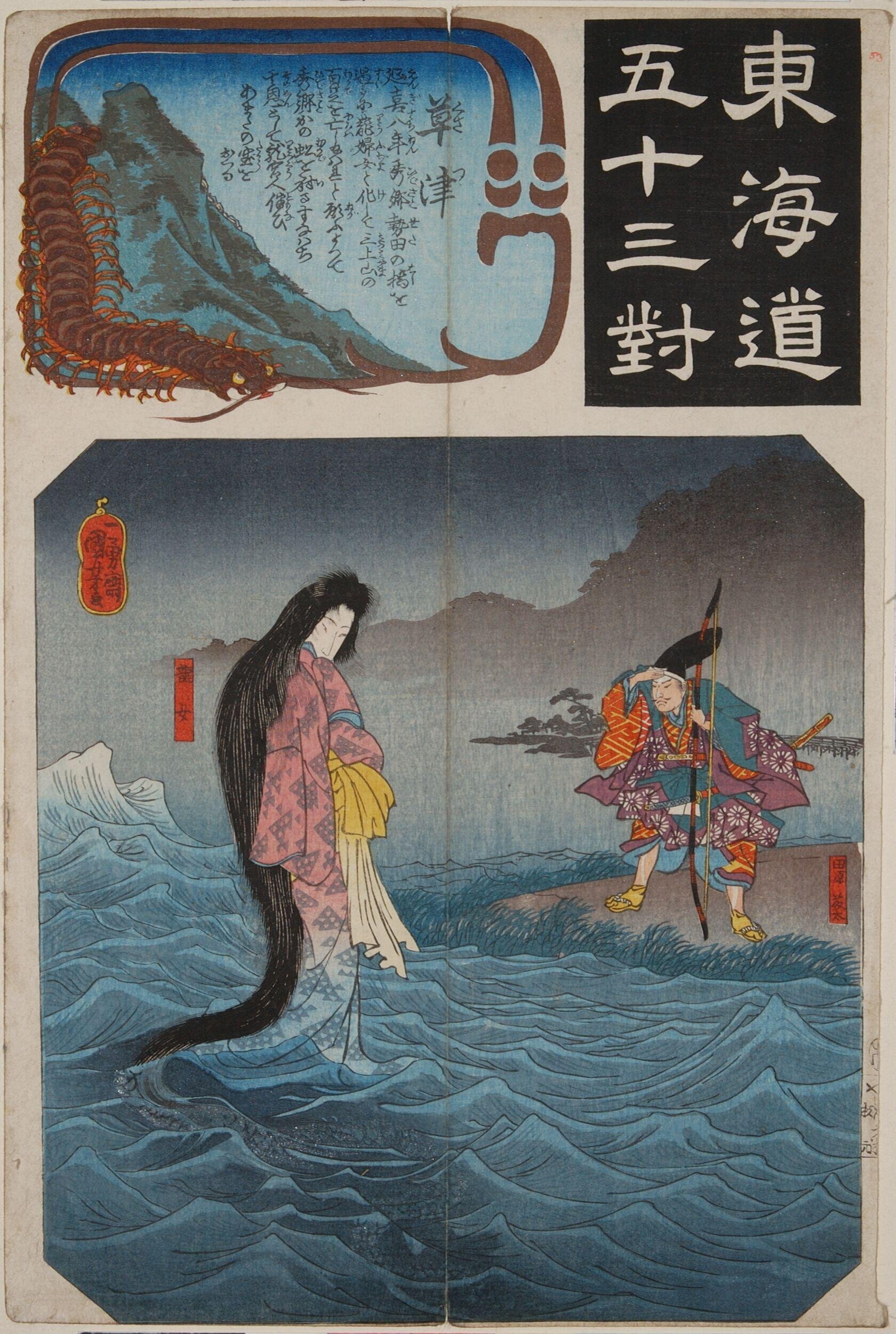
Kusatsu (Kusatsu)
- Medium:
- Source:
- Victoria and Albert Museum
Description
Kusatsu is an undated woodblock print by Utagawa Kuniyoshi, preserved in the Victoria and Albert Museum, drawn from one of his Tōkaidō-themed series in which each station along the great Edo-period highway is paired with a historical or legendary figure. Kusatsu, located near the eastern shore of Lake Biwa, marked the meeting point of the Tōkaidō and the Nakasendō, two of the most heavily travelled roads of the Tokugawa era. Kuniyoshi's treatment, like his other Tōkaidō designs, foregrounds character and narrative rather than topographic detail, anchoring the sheet within his lifelong engagement with warrior prints, kabuki personalities, and figures from popular literature. The carved outlines and considered colour palette show the technical assurance of mid-nineteenth-century Edo woodblock printing, where designer, carver, and printer collaborated closely to render figural detail and costume. The cartouche bearing the place-name reminds the viewer that, despite its narrative emphasis, the print belongs to a broader Edo print culture that mapped famous routes through the imagination of its city audience. The Victoria and Albert Museum's holdings of Kuniyoshi's Tōkaidō-related sheets provide a valuable comparative context, and Kusatsu can be studied alongside other works that revisit the great highway as a stage for retelling Japan's stories. As such, the print typifies Kuniyoshi's instinct for embedding character-driven narrative within familiar Edo ukiyo-e formats.
More Prints by Utagawa Kuniyoshi

Yan Qing (Roshi Ensei), from the series "One Hundred and Eight Heroes of the Popular Water Margin (Tsuzoku Suikoden goketsu hyakuhachinin no hitori)"

Poem by Abe no Nakamaro, from an untitled series of One Hundred Poems by One Hundred Poets

Hu Sanniang (Ko Sanjo Ichijosei), from the series "One Hundred and Eight Heroes of the Popular Water Margin (Tsuzoku Suikoden goketsu hyakuhachinin no hitori)"

Miya, Kuwana, Yokkaichi, and Ishiyakushi, from the series "Famous Places on the Fifty-three Stations of the Tokaido, Four Stations (Tokaido gojusan eki yonshuku meisho)"
Frequently Asked Questions
Kusatsu (Kusatsu) was created by Utagawa Kuniyoshi (歌川国芳).